

Is 12-Year Education Necessary in Kyrgyzstan – Comment by Sadyr Japarov
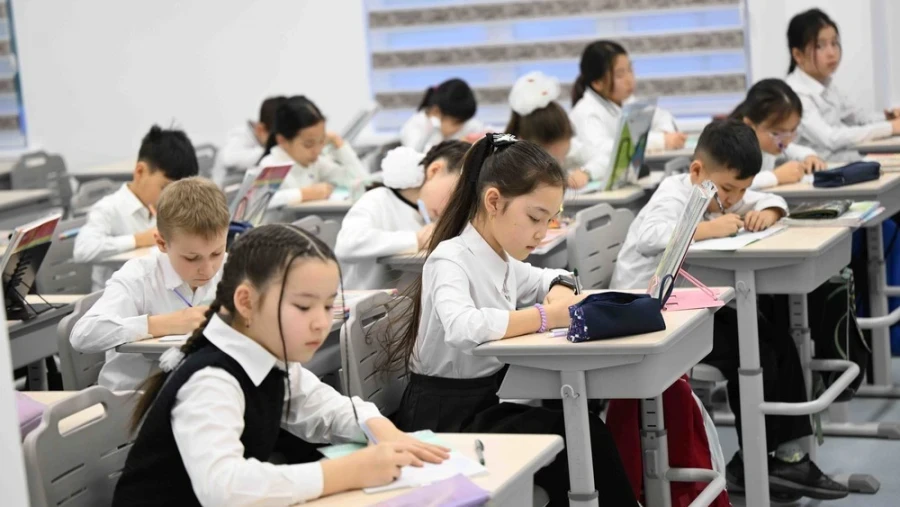
“In 10 years, the number of schoolchildren has increased by almost 500 thousand”
At the IV People's Kurultai, delegates actively discussed the problem of the shortage of educational institutions. President Sadyr Japarov commented in detail on this situation in an interview with KNA “Kabar,” as well as on issues related to the transition to a 12-year education system and the growing population of the country.
One of the key points raised by the delegates was the lack of schools. They noted that in some classes there are up to 40-50 students, and called for a solution to this problem. Can this situation be linked to the transition to 12-year education?
“No, this is not related to the transition to the 12-year system. I have emphasized this many times in my interviews. The problem of the lack of places in schools existed long before the introduction of 12-year education,” the president explained.
For example, in previous years, about 140-150 thousand children were admitted to the 1st and 2nd grades.
According to the data from the electronic diary “E-Kündölük,” for the 2025-2026 academic year, the expected number of students will be:
1st grade - 106,015 students,
2nd grade - 124,593 students.
If we compare this with 2015, when the total number of students was 1,043,356, by 2025 this number has increased to 1,536,633, which means an increase of almost 500 thousand.
This is linked to population growth and increased internal migration to cities, creating a need for the construction of new schools and kindergartens.
Currently, systematic work is being carried out in this direction.
Since the beginning of 2025 and up to the present moment, 134 educational facilities have been completed with funds from the republican budget.
Among them are 60 schools and 28 kindergartens, and major repairs have been carried out in 41 schools and 5 kindergartens.
Additionally, with funds from various sources, including local budgets and sponsorship, 16 schools and 13 kindergartens have been built (a total of 29 facilities).
A total of 163 educational facilities have been completed across the republic, of which 117 are new constructions and 46 are major repairs.
In 2022, 15 schools were built in Bishkek, and in the new academic year, it is planned to construct 20 schools in the capital, 10 in Osh, and 6 in Manas.
Construction work will begin in February and will be completed in September, as these three cities have the greatest need for educational institutions.
Thus, the problem of the shortage of schools will be addressed step by step.
Additionally, 216 schools and 107 kindergartens are currently being built across the country, and it is planned to complete at least half of them by 2026.
As for the transition to a 12-year education system, this is a relevant requirement of the time.
Firstly, it corresponds to world standards; secondly, it is a requirement of the global educational market.
Considering modern conditions, it is necessary to integrate our educational system into the international educational space.
Neighboring countries have either already completed this process or are in the process of doing so.
In 2029, the first graduates of the 12-year education system will receive their diplomas.
If we do not make this transition, our graduates from schools that do not meet world standards will have to undergo an additional year of preparation to enter foreign universities.
The transition to a 12-year education system has become an urgent necessity.
This is a global requirement, and without access to the international educational space, we face challenges in training specialists who meet the demands of the global labor market.
It is extremely important for Kyrgyzstan to develop human capital capable of competing at a global level.
The 10-11 year education system has fulfilled its historical role and was oriented towards a planned command economy.
Today, training specialists who can successfully compete in the market is a pressing task, and we cannot afford to lag behind these processes. This is a system that ensures early professional self-determination,” the president concluded.
Photo www


Related materials:
