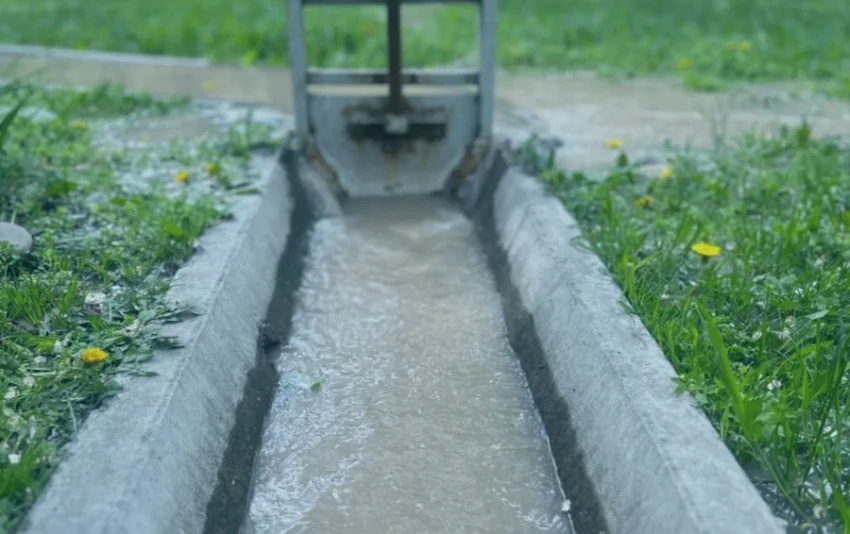
With the beginning of the growing season in 2026, Kyrgyzstan is once again facing alarming news. The Ministry of Water Resources, Agriculture, and Processing Industry of the Kyrgyz Republic reports that water supplies are insufficient and points to natural factors as the main reason. This raises a logical question: if the agency is aware of glacier melting and global warming, why are its actions limited to warnings rather than active measures to improve the situation?
Let us recall that in May of last year, Minister Bakyt Torobaev called on farmers to rationally use resources. He emphasized that in conditions of abnormal heat, every drop counts, and that the future of the country depends on the ability to avoid unnecessary water consumption. Torobaev assured that implementing conservation methods would help avoid shortages. However, a year later, we are again hearing calls for understanding. If the minister's only task is to urge farmers to be frugal with water, it raises serious doubts about the effectiveness of his work.
However, behind these calls lies a harsh reality. The ministry regularly reports on providing preferential loans for the installation of drip irrigation, but in fact, this process is not working. As one farmer explained, they are ready to switch to modern technologies, but obtaining a loan turns into an endless bureaucratic procedure. The collection of numerous certificates, strict collateral requirements, and the sluggishness of government structures create serious barriers that not every farmer can overcome. As a result, innovations remain on paper, and fields are left without water.
Perhaps the Ministry of Agriculture should take a closer look at the experiences of other countries in search of solutions. This experience is likely known to the agency, but the issue lies in implementation. For example, Israel, where more than 60% of the territory is desert, is nevertheless a world leader in agro-export. If Israelis saw our fertile lands, they would laugh at our drought problems. The Israeli model of water resource management could serve as a handbook for Torobaev if he truly intends to save agriculture. Here are a few key aspects from the Israeli experience:
- Recycling 95% of wastewater: Israel cleans and reuses water twice.
- Drip irrigation standards: in Israel, this is not just a recommendation but a mandatory requirement. Each plant receives water through systems managed by sensors and artificial intelligence.
- Innovative agribusiness: Israel shares knowledge and precision agriculture technologies with the world, successfully growing tomatoes, strawberries, and flowers in the desert at minimal costs.
Thus, the effectiveness of the minister and his team today is measured not by the number of trips and the opening of small agricultural enterprises, but by the number of hectares that have adopted Israeli water use standards. Simple calls for farmers not to waste water could lead to the agency becoming the "Ministry of Drought," merely recording losses in the agricultural sector.
Most likely, 2026 will be a turning point for Kyrgyzstan. Either the Ministry of Agriculture under Torobaev's leadership will achieve a technological breakthrough and make modern irrigation systems accessible to every farmer, or it will admit its incompetence. Either we create Israel in Central Asia, or we prepare for our fields to turn into a desert.