
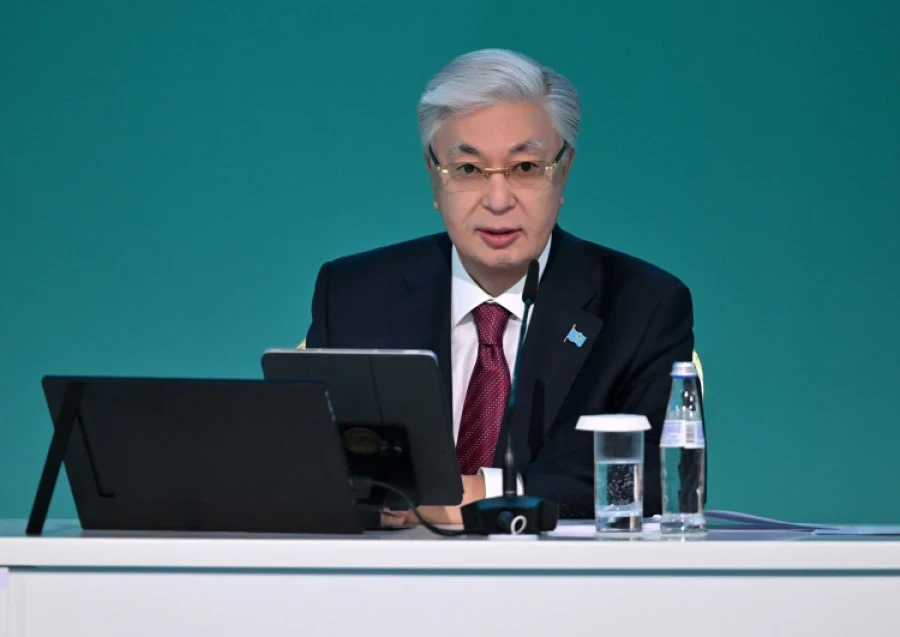
The President of Kazakhstan presented systemic reforms, expanded powers, and responsibilities for rural akims
At a dialogue platform for rural akims, where about 80% of local government representatives gathered, Kassym-Jomart Tokayev spoke. This event was the first of its kind, bringing together representatives from all levels of executive power.
The President emphasized the particular importance of this meeting, as the development of rural areas is directly related to the sustainability and future of Kazakhstan.
“The state of affairs in the villages is a matter of strategic importance for our country. The roots of our people are in the aul. Strong villages are the foundation of the well-being and prosperity of the state,” Tokayev stated.
He highlighted that the demands on rural akims remain high, as they serve as the link between the state and society.
The priority of state policy is rural development
Tokayev reminded that issues of rural development were central to his 2022 election program, and the first decree signed after the elections was dedicated to this topic.
“The aul is the golden cradle of our unique civilization. The responsibility to develop the village lies with all of us, and the state approaches this with special responsibility,” he added.
According to him, a Concept for the Development of Rural Areas for 2023–2027 has been developed, and its implementation has already begun. Since 2021, 864 primary healthcare facilities have been built in the country, 388 new schools have been opened, and about two thousand rural schools have gained access to high-speed internet. Every year, the potential of villages improves, and the number of settlements with a high level of self-sufficiency is growing.
The volume of gross agricultural output has increased by more than one and a half times over the past six years, reaching 8.3 trillion tenge, and 1 trillion tenge is planned to be allocated in 2026 to support farmers.
“A few countries in the world provide such significant financial support to farmers,” the president noted.
Political reforms and elections of akims
Tokayev reminded about the large-scale political reforms initiated in Kazakhstan since 2019, which have become a significant step in the country's development.
“We have created a legal framework for serious transformations by adopting about 20 laws, expanding the powers of Parliament, strengthening the accountability of the Government, and activating the activities of political parties,” he added.
One of the main decisions was the introduction of direct elections of rural district akims.
“Local akims are the backbone of the entire vertical of power,” Tokayev emphasized.
Over the past five years, 2,334 rural akims have been elected in Kazakhstan, with an average age of 43 years. About a third of them had not previously worked in public service.
“It is important that they know the needs and expectations of local residents well,” the president noted.
According to him, the elections have contributed to the development of the party system, and the trust of villagers in akims has reached 84 percent.
The key requirement is the competence of akims
Tokayev identified the enhancement of the professionalism of rural akims as a top priority.
“Winning the elections is just the beginning of a long journey. The akim must demonstrate their qualifications as a manager,” he stated.
The president emphasized that the akim must not only be aware of affairs in the village but also be able to implement state reforms locally, earn the trust of residents, and work on improving their well-being.
In this regard, he pointed to the need to improve the training system and adapt educational programs in the field of public and local administration.
Expansion of powers and accountability
The second direction was the expansion of the powers of rural akims. The president reminded that amendments to the law on local governance are being considered in the Mazhilis, which envisage new functions in the area of landscaping and oversight.
However, he noted that existing ambiguous norms hinder effective work.
“Because of this, akims cannot provide clear answers to residents' requests and sometimes find themselves in difficult situations. This cannot be allowed; it is a weakness of the state,” Tokayev emphasized.
He instructed to conduct an analysis of non-core and duplicative functions of akims within a month and to review their distribution.
The third priority was to strengthen accountability.
“The law does not establish norms regarding the accountability of akims to voters. This is incorrect,” the president noted.
He proposed to enshrine at the legislative level the mandatory reporting of akims and to develop mechanisms for their recall in case of unfulfilled promises.
Budgets, digitalization, and support for businesses in villages
Tokayev paid special attention to fourth-level budgets, noting that the revenues of rural districts have increased fourfold, but financial independence is still insufficient.
“Taxes should be paid where work is done and income is generated,” he emphasized.
The president also noted that digitalization should encompass rural areas as well.
“Creating a Digital Kazakhstan is impossible without villages. This is a matter of survival,” he added.
The fifth direction was to promote business in rural areas, develop cooperation, and infrastructure.
“The development of the village requires new thinking, advanced ideas, and updated approaches,” the president concluded.
Results and priorities
In conclusion of his speech, the President noted that the main task of akims is to improve the quality of life for local residents.
“The well-being of every citizen is the key to the prosperity of the entire village. The state will always support the development of rural areas, as this is the foundation of our nation,” Tokayev summarized.


