Small Slowdown in Growth
According to preliminary data, the country's gross domestic product in January and February 2026 amounted to 264.1 billion soms, which is 8.8% more compared to the same period in 2025.As noted by the First Deputy Minister of Economy and Commerce Choro Seiitov, the growth rate of Kyrgyzstan's economy is projected to be at 8.5-8.6% this year. Growth is expected in the production of building materials, pharmaceuticals, rubber and plastic products, as well as in the light industry and automotive manufacturing.
Seiitov also reported that by 2030, Kyrgyzstan's GDP is likely to reach $30 billion. In 2025, the gross domestic product already amounted to about 2 trillion soms (approximately $22.5 billion), and GDP per capita increased to $3,000, while in 2024 this figure was around $2,500.
Is a Price Increase Expected?
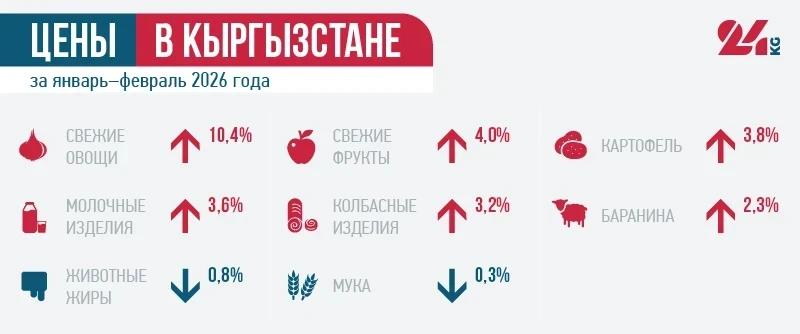
In the first two months of 2026, the increase in consumer prices and tariffs in the country was 1.9% compared to December 2025, as reported by the Deputy Chairman of the National Statistics Committee Bakytbek Shokenov.According to him, tariffs for services to the population increased by 3.6%, while prices for alcoholic and tobacco products rose by 2.2%. Food products and non-alcoholic beverages became 2.1% more expensive, while non-food goods increased by 0.4%.
The most significant price increases affected fresh vegetables and fruits, dairy products, eggs, potatoes, as well as meat products and fish.
Nevertheless, a more significant price increase is expected in the coming months, especially for fuel and lubricants, as well as for vegetables and fruits. Political scientist Sheradil Baktygulov noted that the current economic difficulties may be temporary; however, there is a risk that local entrepreneurs may start to unjustifiably raise prices, citing external conflicts.
He emphasized that this could lead to speculative price increases for certain goods. Additionally, the lack of diversified supplies may force entrepreneurs to raise markups to cover losses. This, in turn, will affect inflation.
Choro Seiitov stated that the authorities will not allow a shortage of fuel and lubricants in the country. He noted that risks associated with the situation in the Middle East are being taken into account.
According to him, work is being done to control prices. Russia remains the main supplier of fuel and lubricants, and Kyrgyzstan has quotas. The Russian side guarantees the supply of fuel and lubricants, despite external circumstances.
Although Seiitov did not make specific price forecasts, he pointed to the establishment of a maximum allowable price for diesel fuel for farmers in anticipation of the spring fieldwork. Measures will also be taken to control price increases at the local level.
Additional risks for agriculture may arise due to disruptions in the global fertilizer market. According to the Financial Times, the situation in the Middle East has negatively impacted urea production in the Persian Gulf - one of the most common nitrogen fertilizers, and a gas shortage has forced producers in South Asia to cut production volumes.
As a result, over 1.1 million tons of fertilizers and raw materials, including 570 thousand tons of urea, have found themselves in a difficult situation in the Persian Gulf.
However, Kyrgyzstan receives a significant portion of nitrogen fertilizers from Russia (as well as from Uzbekistan and Kazakhstan). However, if the main supplying countries decide to raise prices due to the current global situation, this may affect the domestic market.
Increase in Imports
The foreign trade turnover of Kyrgyzstan in January 2026 amounted to $1 billion, which is 2% more compared to the same period last year.Trade with the EAEU member states amounted to $396.8 million (+11.3%). The largest share came from Russia (68.6%) and Kazakhstan (29%).