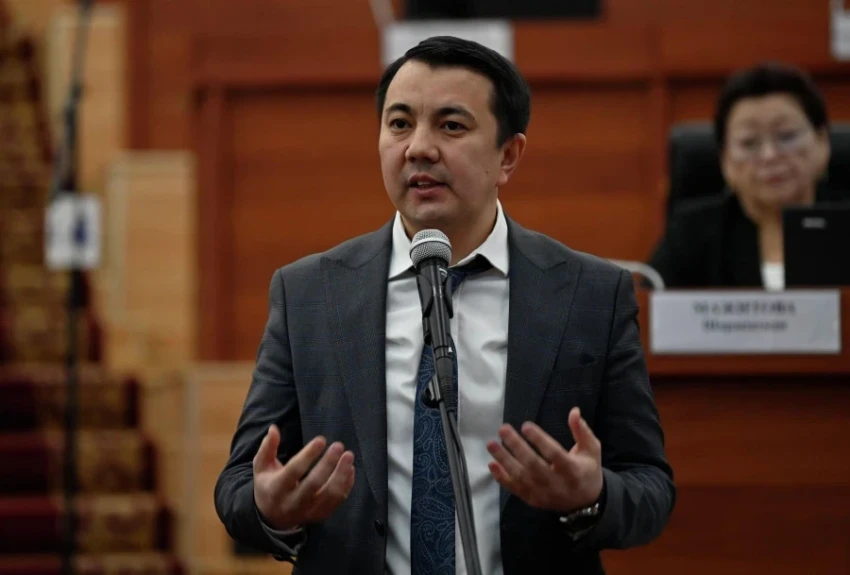
According to the current law "On Elections of the President and Deputies of the Jogorku Kenesh," "no one has the right to influence citizens with the aim of coercing them to participate or not participate in elections, as well as to influence their free will."
Mamataliyev proposes to amend this provision, replacing it with a formulation prohibiting any illegal influence on a citizen's will during elections, while specifying legal ways to influence.
If the proposed changes are approved, a new article "Obligation to Participate in Voting" will be added to the legislation, which will require citizens to personally participate in voting.
However, the bill also includes valid reasons for not appearing at the elections, exempting the following citizens from this obligation:
- incapacitated individuals;
- persons over 70 years old;
- those who are outside the country on the day of voting;
- citizens for whom attendance at the polling station is impossible due to natural disasters, severe illness, hospitalization, or other extraordinary circumstances documented;
- military personnel and law enforcement officers on duty in remote areas on the day of the elections.
Some categories of citizens will be required to provide their electoral commission with documents confirming the valid reason for their absence within 10 working days after the elections.
The first violation will result in a warning from the Central Election Commission (CEC), a repeated violation will incur a fine, and systematic violations (three or more times) may lead to a ban on running for elected positions and holding public office for up to five years.
The amounts of fines in the draft law are not specified.
Additionally, a provision is planned to be added to the article on the voting procedure regarding the issuance of vouchers to voters for participation in a state lottery along with ballots. The organization of this lottery will be entrusted to the CEC.
The bill also provides for benefits for voters, which will be determined by the cabinet of ministers. The document states that the state may introduce incentives for actively voting citizens, such as:
- discounts on payment for state and municipal services;
- additional points when enrolling in a personnel reserve.
Similar obligations and incentives are proposed to be implemented in the Law "On Referendums."
Constitutional Issues
The proposal for mandatory voting, currently under public discussion, has raised numerous questions and criticism. The main concern is whether this initiative contradicts the Constitution of the country.
Lawyer Nurbek Toktakunov firmly asserts that a fine for non-participation in voting violates the Constitution.
“Participation in elections is a moral obligation of citizens. I have repeatedly spoken about the importance of voting, but coercing people under the threat of fines is a violation of the Constitution. Voting is a personal matter for everyone; it may even be a form of protest,” he noted.
The lawyer added that material penalties may increase turnout, but it is unclear how those who were forced to come to the polling station out of fear of fines will vote.
Marlen Mamataliyev acknowledged the contradictions in his bill but emphasizes the need to increase voter turnout. He proposes a combined approach with incentives and penalties, including benefits and lotteries.
“I understand that the provisions on mandatory voting and fines may contradict the Constitution. We have brought the bill to discussion for now, and it will be refined. If society supports it, I may initiate changes to the Constitution. If not, we can remove this provision. I am not inclined to include fines myself,” the deputy explained.
He believes that many citizens do not participate in elections because they do not trust the system and think their vote will not change anything. Mamataliyev also noted that there is currently no administrative pressure or falsifications, so voters should realize that “their future is in their hands” and start participating in voting.
However, many voters emphasize that the issue is not only about “dishonest elections” but also about distrust in the parliament. Many believe that deputies cannot influence the resolution of state issues, so it does not matter to them who will be in the Jogorku Kenesh.
Control Over Turnout
The bill proposes significant additional responsibilities for the Central Commission for Elections and Referendums, which will be required to track each voter, identify those who did not vote, send them warnings, and check for valid reasons for non-participation.
It is also unclear who will impose fines on those who fail to show up for elections twice.
The developer of the bill is confident that there will be no technical problems.
“This is not a complicated task; it is easy to create a list of election participants. The CEC database will record information about who came to the elections and who did not. This data will be transmitted to other authorities for decision-making,” he added.
Read more on the topic
Turnout could be higher. The CEC answers questions about early elections of deputies
Member of the CEC Kairat Mamatov agrees with him, noting that the commission has already made significant technological progress, and it will not be difficult for them to implement the provisions of the bill if it is adopted.
However, he is against the introduction of fines and believes that turnout should be increased in other ways.
“I believe we should use not the method of ‘carrot and stick,’ but exclusively ‘carrot.’ Lotteries can be held and incentives introduced. I know that my colleagues from the CEC share this opinion, as everyone was against such an initiative when it was discussed a few years ago. We need to motivate voters, as control may provoke negativity, increasing the protest electorate,” Mamatov believes.
He expressed the opinion that if fines are introduced, more people will start voting “against everyone,” which may lead to the need for repeat elections.
In the last parliamentary elections, which took place on November 30, 2025, the CEC introduced remote voting and opened about 100 additional polling stations to increase turnout, which has repeatedly been cited as the biggest problem in recent elections.
Despite the measures taken, only 36.9 percent of over 4 million voters participated in the voting, which, although 200,000 more than in previous elections, still remains a low figure.
At the first meeting of the new convocation of the Jogorku Kenesh, President Sadyr Japarov noted that in some countries voting is mandatory and suggested that deputies consider initiating a new bill.