Forecasts indicate that over the next five years, the number of hotel rooms will only increase, with each country developing according to its own scenario. Kyrgyzstan, in particular, is expected to experience the most rapid growth.
Increase in tourist flow due to global brands
Today, Central Asia represents one of the new attractive tourist destinations, connecting the heritage of the Silk Road, UNESCO World Heritage sites, picturesque mountain landscapes, and unique cultural experiences. The region is appealing to both cultural tourism enthusiasts and fans of eco, medical, and gastronomic tourism. Last year, over 15 million tourists visited the countries of Central Asia.Among hotel chains, Accor and Hilton are showing the most activity, opening new properties almost annually (Accor — except for 2024, Hilton — starting from 2025). A brief slowdown in the pace of openings is expected in 2024, but activity will resume again in 2025.
Each country has its unique features in the development of the hotel business. Kazakhstan remains the key center of the hospitality industry in the region, with a peak in the emergence of new hotel brands in 2020, after which there has been a decline in openings.
As for Uzbekistan, the Hilton chain is demonstrating steady growth, opening hotels every year from 2020 to 2024. As a result, the country’s hotel sector has quadrupled since 2020 due to the influx of international brands.
Experts from Commonwealth Partnership Uzbekistan also note that the hotel market in Tajikistan is still limited, but signs of recovery are already visible — new openings are planned. Currently, the market of branded hotels in Tajikistan is led by Hyatt, which accounts for almost 46% of the total number of rooms, followed by Hilton (30%) and IHG (24%).
Stable growth of Kyrgyzstan's hotel industry
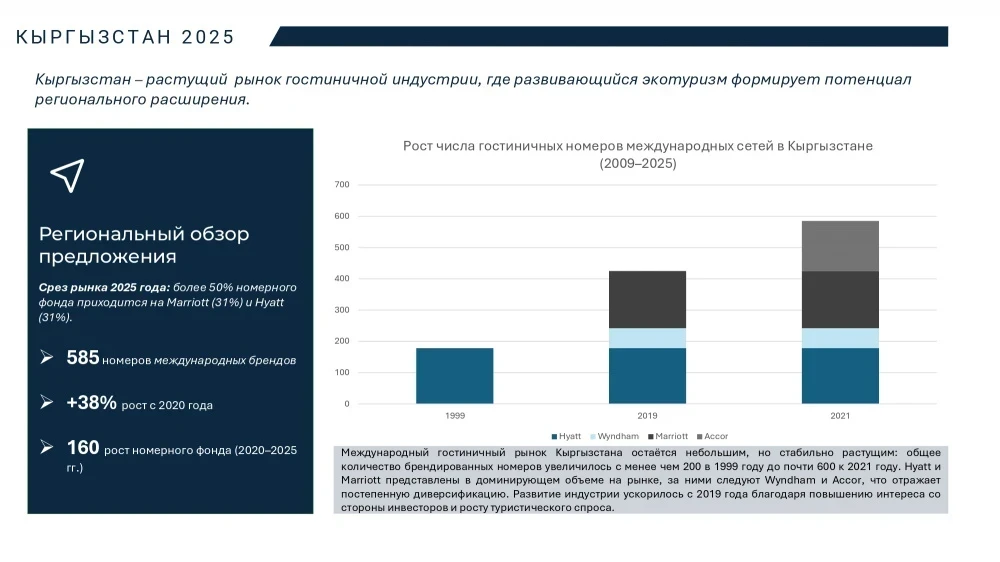
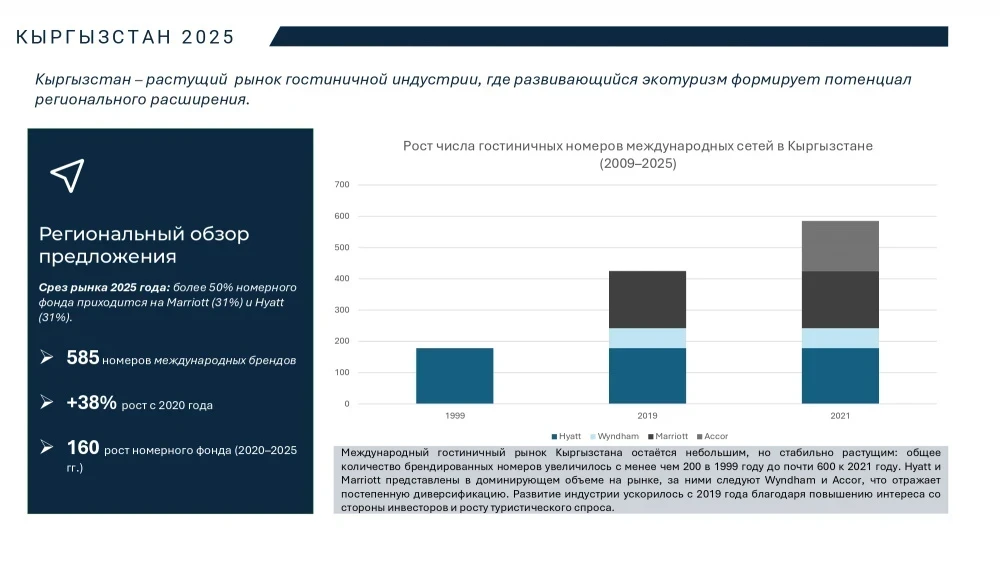
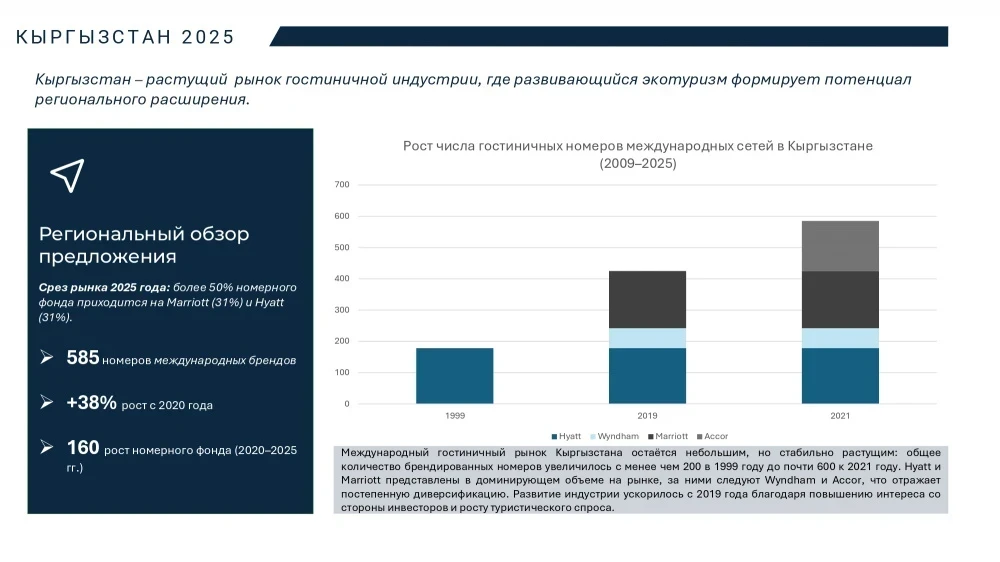
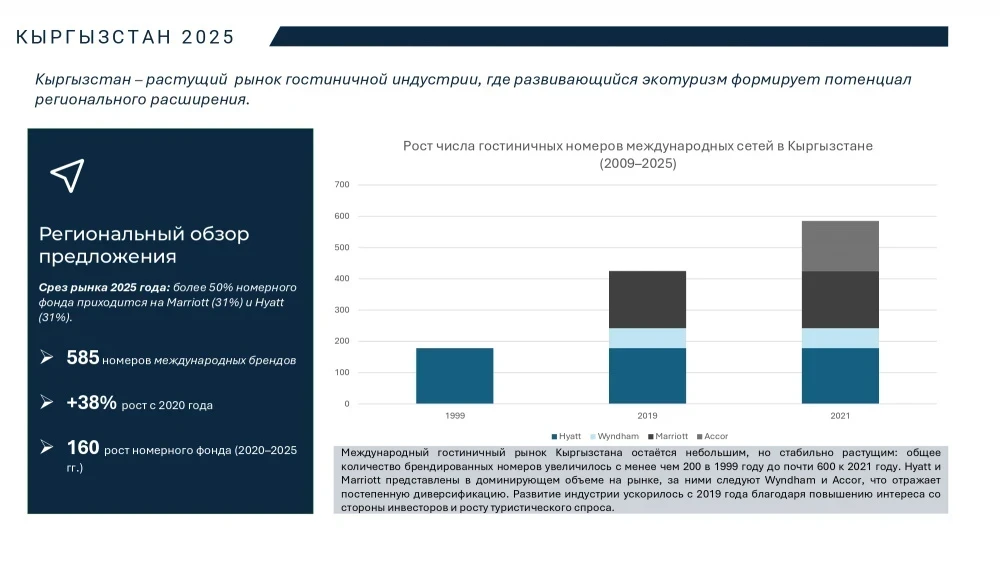
Although the international hotel market in Kyrgyzstan is small, it demonstrates stable growth. The chains Hyatt, Wyndham, Accor, and Marriott are concentrated in Bishkek, with demand primarily driven by business, diplomatic, and eco-tourism.The Hyatt chain was the first in the market, and Accor's entry in 2021 was the latest addition to Kyrgyzstan's international hotel portfolio. Currently, Marriott and Hyatt each hold 31% of the market, Accor — 27%, and Wyndham — 11%. The growth of the hotel industry has accelerated since 2019 due to increased investor interest and demand for tourist services.
A key aspect of Kyrgyzstan's development is the diversification of the hotel market through projects in the premium and niche segments.
The future of growth in the hotel sector
Analysis shows that over the next five years, the presence of international hotel brands in Central Asia will increase. The main drivers of growth will be Uzbekistan and Kazakhstan. While Kazakhstan previously led in the number of rooms, this year Uzbekistan may take that position. Kyrgyzstan and Tajikistan continue to develop gradually.Kyrgyzstan is ahead of other countries in brand diversification and the number of new hotel projects.The project portfolio of Kyrgyzstan is focused on 2026-2027, with Wyndham in the lead, along with the entry of Hilton and AZIMUT, indicating a new wave of diversification. Wyndham accounts for 69% of the project portfolio, AZIMUT — 16%, and Hilton — 15%.
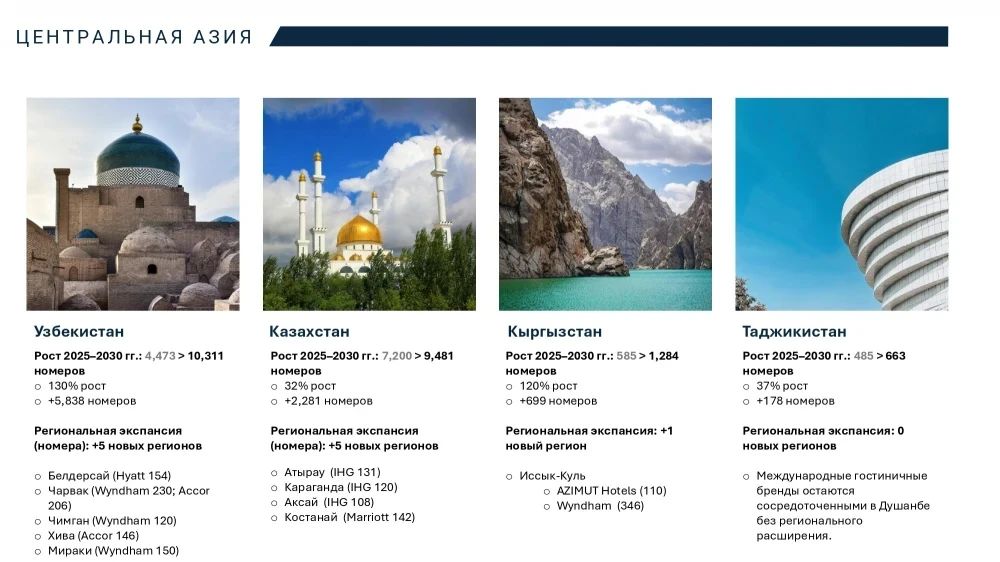
From 2025 to 2030, the number of hotel rooms in Central Asia is expected to nearly double. Accor will lead this process, capturing 19% of the market, followed by Hilton and IHG, each with 17%.