
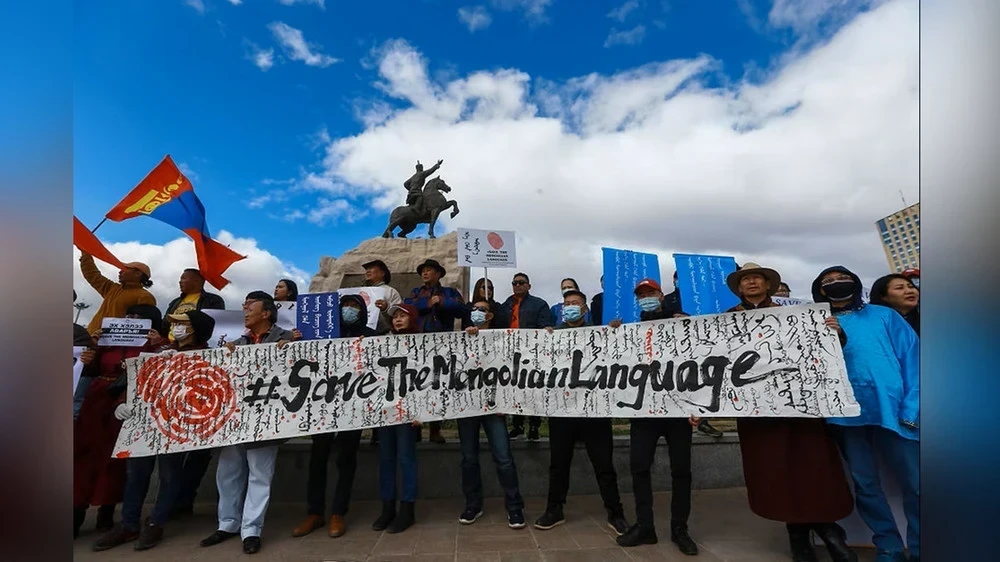
// Photo by BYAMBASUREN BYAMBA-OCHIR/AFP via Getty Images
Despite constant pressure from Chinese authorities, the internet has long remained one of the few spaces where residents of the Autonomous Region of Inner Mongolia, or Southern Mongolia, could freely use their language, share music and literature, and communicate with each other. This conclusion is contained in a recent report released on Friday.
The report, prepared by PEN America and the Southern Mongolian Human Rights Information Center, indicates that the Chinese government is actively suppressing the Mongolian language and cultural aspects in certain digital spaces, destroying important communities where Mongolian identity could develop.
The study titled "Save Our Native Language" reports that nearly 89% of known Mongolian cultural websites have been censored or completely shut down. Online communities are also restricted, including the popular Mongolian-language social media app Bainu. The report mentions the "One Province, One Newspaper, One Client" policy, which allows state media to create their own apps, thereby pushing out independent platforms developed by Mongolian programmers, as detailed in a report by the organization Genocide Watch.
Soembo Borjgin, a journalist from Southern Mongolia who now lives in exile in New York, witnessed the closure of the newspaper "Inner Mongolia," where he worked, and was punished with a month in a re-education class. He is currently writing about what he calls "systematic cultural repression."
"After the government banned the teaching of the Mongolian language in local schools, the internet became the last free space for our people. This means that the Chinese government is deliberately destroying places where Mongolians could speak their native language, share music, discuss history, and interact as a community. Mongolian songs are being removed from music apps. For example, the songs 'Let's Be Mongolians' and 'I Am a Mongol' have been taken down," Soembo Borjgin shared in an interview with Tech24.
"In our region, people are now not allowed to discuss any topics in Mongolian. All cyberspace intended for the Mongolian language has disappeared," he added.
Human rights organizations PEN America and the Southern Mongolian Human Rights Information Center are calling on technology companies, governments, and international organizations to take joint action to protect Mongolian culture online.
"We hope that technology companies and social media platforms will adopt the concept of protecting cultural rights when developing their services, respect human rights, and collaborate with independent organizations to provide digital support, especially to affected Mongolian communities," the report quotes Lizl Gerntholz, Executive Director of the PEN/Barbey Center for Free Expression at PEN America.
Translation: MiddleAsianNews


