

DAVAADORJ Battögs
According to MiddleAsanNews, Davaadorj Battögs is a design engineer and visualizer at Audi, positioned at the intersection of design ideas and digital storytelling.
— I AM DAVAADORJ Battögs, I am 25 years old, and I work at Audi in Los Angeles, California, USA. My job involves 3D rendering and computer graphics. These tools help visualize my projects. Hand-drawn sketches are transformed into 3D models considering engineering requirements, allowing for a better assessment of how they will look in real life.
Davaadorj became part of the team that created two outstanding concept cars for Audi: the Audi Activesphere (2023) and the Audi Concept C (2025), which is expected to be an important milestone in the evolution of the company's design philosophy.
“My passion for cars began in childhood. When I was 8-9 years old, my father gave me a CD titled ‘Цахим Цагаан Толгой’ (The Alphabet of Digitalization), which had an application that allowed me to create cars by pushing two water trucks down a hill. It was a revelation for me, and I immediately thought, ‘How cool would it be to create such a car.’ Since then, I have drawn many cars in notebooks. In the eighth grade, my architect brother asked me what I wanted to be, and inspired by my love for cars, I replied, ‘I want to work in the automotive industry.’ He advised me to start seriously drawing cars. I saved some of my early works and still carry them with me. From grades 8 to 12, I constantly drew various cars in preparation for university.
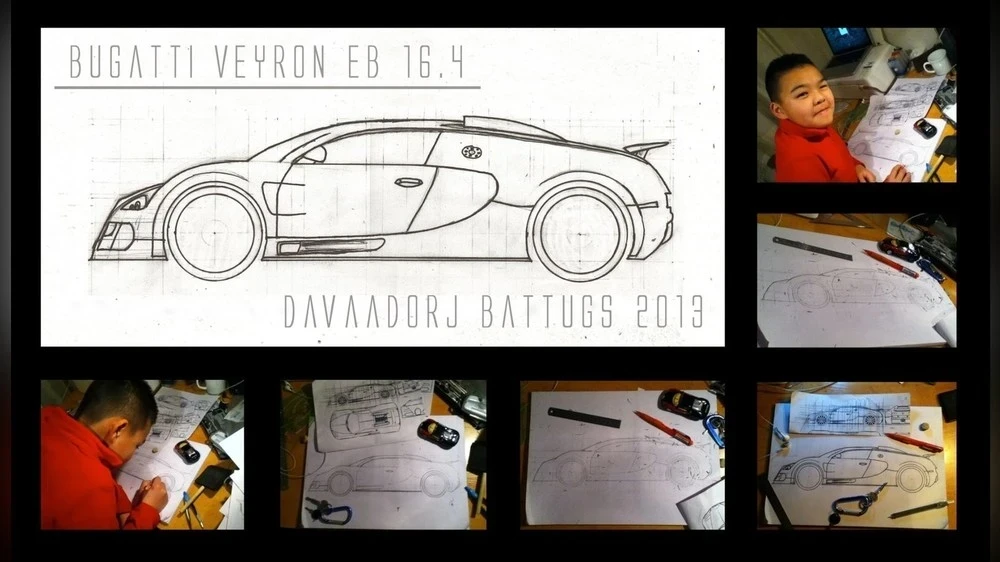
Thus, my passion for automotive design was born at an early age. I have always been interested in cars, their functionality, and their visual impact on people. As I delved deeper into this field, I began to realize how digital tools can turn ideas into reality before a physical product appears,” he shared in an interview with IKON.
“It was at that moment that I truly became fascinated with visualization using computer graphics. I understood that creating realistic images is not the only goal. It is important to tell stories, create atmosphere, and convey design ideas. The connection between automotive design and visual storytelling opened doors for me to work on concepts at Audi,” he added.
“My transition to visualization was natural, as I started using 3D tools during my student years. I studied Blender 3D and Unreal Engine, developing my traditional design skills, so digital visualization has never been a separate area for me. Traditional design taught me the fundamentals—proportions, shapes, surface language, and clear expression of ideas, while 3D allowed me to develop those ideas further. I became interested not only in modeling cars but also in their emotional representation. We create objects that move, so I began experimenting with animation and environments to visually tell the story of how a car can be used,” he continued.
“With the development of real-time rendering tools and technologies like Unreal Engine, the boundaries between design and visualization began to blur. It became much easier to quickly obtain visual feedback and apply it to improve the design.”

Davaadorj Battögs
“My main task was to visualize the project: developing a visual language, style, and narrative for the concept car. This involved translating design ideas into appealing images that not only accurately represented the car but also reflected the emotions and atmosphere behind it.
A significant part of the work involved developing the exterior, adjusting materials, lighting, and environments to ensure the car looked realistic and aligned with Audi's concept. At the same time, storytelling played a key role. Concept cars are not just objects; they embody scenarios of the future, so the visual imagery must convey how the car fits into this world and how people perceive it.
“Our task was to connect design and storytelling, ensuring that the concept is perceived not only visually but also emotionally,” Davaadorj summarized.
“Visualization using computer graphics is critically important as soon as a 3D model is created. Designers shape a volumetric model that conveys the essence of the key sketch, and it is important to see how light interacts with surfaces and how well the model looks under photorealistic lighting. Visualization helps identify and eliminate potential issues at early stages. At later stages, this tool is used to present the project to management for approval. It is crucial that all participants in the process are aligned at every stage,” he noted.
“It was an exchange of ideas between designers and engineers. For Concept C, new mechanisms for the headlights and taillights were developed that implied movement. I helped visualize how this would look before finalizing the details with engineers and designers,” he added.
“I believe it is important to understand the fundamentals of automotive design. This process evokes much more emotion than any other. Visual imagery should always come first, and details second. I would advise aspiring artists to stay updated on new tools and technologies to remain competitive. After all, to achieve success, one must utilize modern means,” Davaadorj concluded.


