
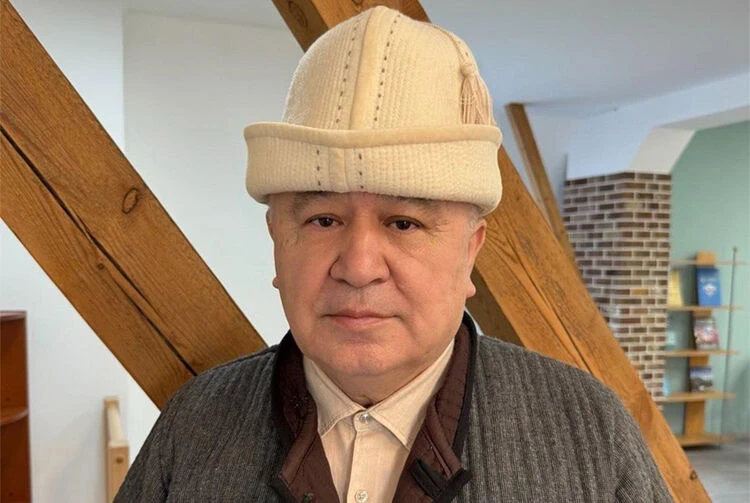
Omurbek Tekebayev shares his impressions of the unexpected role of a researcher of the history of Eurasia.
— Omurbek Chirkeshovich, on your Facebook page you wrote about completing work on the first volume of your research, which is dedicated to the history of the Eurasian steppe. You co-authored with Kuban Choroев. Can you tell us what the main message of your book is? What new insights do you bring to historical science?
— The main point we want to convey is that the Eurasian steppe is not a periphery, but an important center of the historical process.
The existing opinion that history was formed in China, Europe, or the Middle East, and that the steppe was merely secondary, needs to be reconsidered. We propose a different view: the steppe is a system that has connected various civilizations for millennia and contributed to the formation of complex power structures. It is not just chaos of migrations, but a stable model.
— But you are not a historian; you are a politician, diplomat, physicist, and lawyer by education. How did you come to the idea of researching the history of Eurasia?
— It is precisely because I am not a historian that I began this research. I am a physicist, and my co-author is an economist. This may be our advantage.
We can look at the problem from different angles, without being limited by the frameworks of a single scientific school. During the work, I noticed that there are no explanations in the history of the steppe about how this system functioned. We encountered facts, but could not find a model, and decided to try to create one.
— This is an ambitious task. You essentially want to change the perception of the role of nomads in world history. Do you not think this is too bold a step?
— Yes, it is indeed ambitious, but that is normal for science. The scientific process moves forward not only through facts but also through hypotheses. We do not claim that our model is the ultimate truth. We say that it can explain more facts than existing approaches. If it withstands criticism, it will mean we are closer to the truth. If not, then we will need to reconsider our conclusions.
— Some may argue that your research is not science, but rather journalism.
— I expect such a reaction. It is important to distinguish between form and content. We intentionally used accessible language, but behind it lies serious work. This includes archaeology, archaeogenetics, and analysis of written sources. We are not engaging in fantasies; we are comparing various data.
— Who verified the correctness of your use of archaeological and genetic data?
— We are not creating new data and are not substituting specialists. We rely on already existing research. Our principle is that every conclusion must be supported by several independent sources. If data from archaeology, genetics, and written sources coincide, it is not a coincidence.
— You may be accused of idealizing nomads and creating a new myth.
— We do not idealize. Nomadic civilization is not a “heroic legend,” but one of the forms of complex society with strengths and weaknesses. Our intention is to debunk the existing myth of “barbarians on the periphery.” We are in search of a more accurate interpretation.
— So what you are doing is science or hypothesis?
— It is a hypothesis, and any science begins with a hypothesis. Science allows for verification and criticism. We openly present our model for discussion and are ready for criticism.
— What is the essence of your methodology and how does it differ from the classical one?
— Unlike classical methodology, which usually starts with texts, we start with facts. First, we investigate archaeological data, then genetic, spatial, and only then do we turn to written sources. This is important because in the period we are discussing, there were either no texts or they did not reflect the reality of the steppe.
— What conclusions have you reached?
— First, the steppe is a center, not a periphery. Second, its history is not chaos, but represents an institutional continuum. And finally, steppe empires arise systematically when three factors combine: environment, institutions, and resources. These are the main points.
— You also touch on the topic of language, which is quite a sensitive issue.
— Yes, and we approach this issue with great caution. We focus not on words, but on the interaction between people. If the interaction is long-lasting, a common language emerges. This leads to the hypothesis that linguistic continuity in the steppe could have been much deeper than is commonly believed.
— How does all this reflect on Kyrgyzstan? Is it ideology?
— It is not ideology. It is more a matter of self-understanding. If you consider yourself part of the periphery, that is how you will live. If you understand that you are part of a large historical process, it will change your perception of yourself.
But I emphasize, we are not imposing an ideology. We provide material for reflection.
— And finally, what question would you ask yourself, summarizing our interview?
— A very simple one: does our model really explain more than the existing ones? If yes, then it will develop. If not, it will need to be revised. That is the essence of science. We do not seek to rewrite history; we want to understand why it was written the way it is and what might have been overlooked.


