
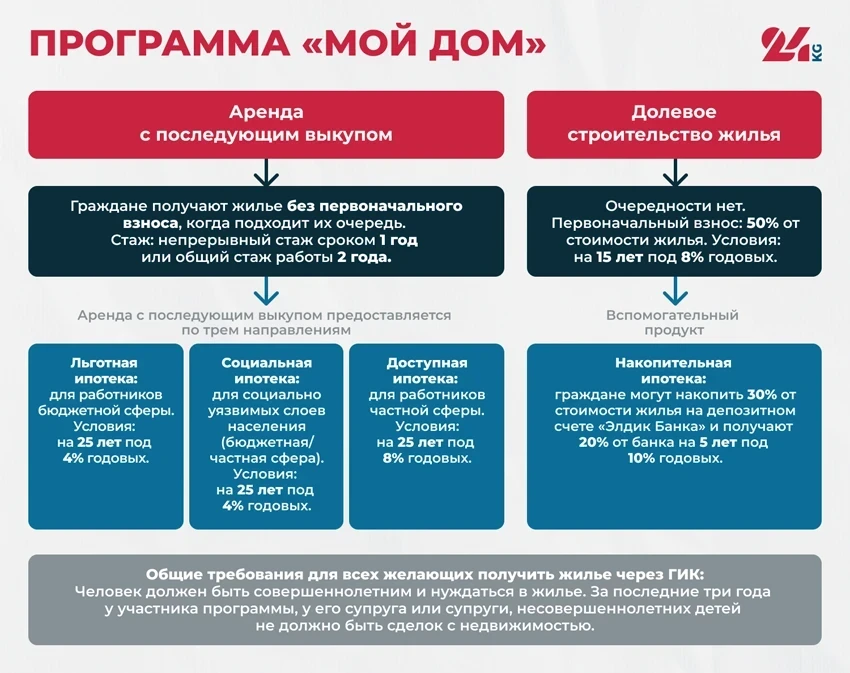
Gulzat Totubaeva, head of the Public Relations Department of GIK, gave an interview to 24.kg, in which she spoke about the mechanisms for obtaining housing, apartment prices, and the current state of queues.
— How many citizens are in line for housing? Is there data on how many Kyrgyz citizens need housing but are not yet registered in the GIK queue? How long will it take to provide housing for all Kyrgyz citizens?
— Currently, 91,159 citizens are registered in our database across the country. The largest number of applications has come from Bishkek — over 48,000. The list also includes participants in the program who have applied for shared construction and received approval.
It is difficult to determine the exact number of citizens without their own housing, but the housing shortage is a reality.
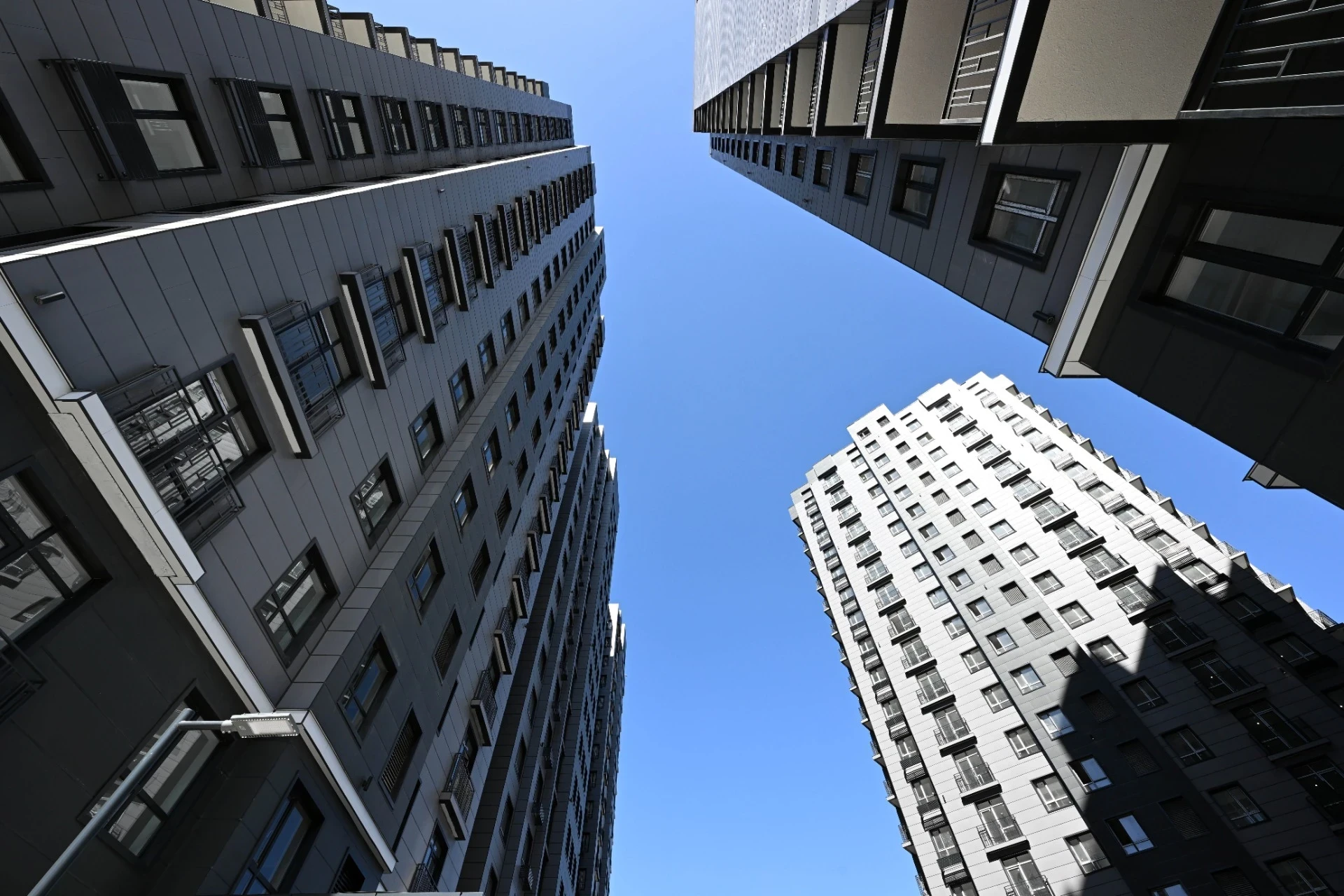
At the moment, GIK is implementing projects for the construction of 5.5 million square meters of mortgage housing, which is equivalent to more than 80,500 apartments.
From 2024 to 2026, the completion of construction and issuance of 463,000 square meters is planned, which amounts to 6,882 apartments.
— This is significantly less than currently, right?
— Yes, that is correct. It should be noted that GIK has not always been involved in construction. In 2015, when the company was founded, the mortgage policy in the country looked different. Our task was to check citizens for compliance with criteria, after which they would turn to partner banks for financing. The decision on loan issuance was made by the banks themselves.
Thus, until 2023, GIK issued only about 9,495 apartments, which is extremely low against the backdrop of the existing housing deficit. The number of refusals was high, which caused dissatisfaction towards GIK.
In this regard, the government decided that GIK would cease cooperation with partner banks and focus on housing construction independently. Since 2023, we have begun implementing projects for building structures, and the results are already noticeable. I believe this was the right strategic decision.
If we had continued to cooperate with banks, the number of refusals would have remained high, as banks strictly check citizens' incomes. Our requirements for solvency at GIK are less strict: the main thing is that the income covers the monthly payment. So far, we have not had refusals due to lack of solvency.
— What is the current charter capital of GIK? Is the company funded from the budget? What will happen to the program if budget funding is reduced or stopped?
— Currently, the charter capital is 87.5 billion soms. When GIK was founded in 2015, the capital was only 10 million soms. Gradually, it increased, and by 2020 it reached 480 million soms, including profits from the program. In 2021, the capital sharply increased to 5.6 billion soms due to budget loans and other sources. In 2022, we were transferred real estate, and since 2023, we have started mass construction. Since then, we have also begun attracting funds from international financial organizations, such as the Saudi Development Fund and the Asian Development Bank.
In our future, there are plans to increase the charter capital to 200 billion soms. However, then GIK must transition to self-financing. This means that there will be no more budget revenues, and we will build housing with our own funds. To achieve this goal, a shared construction mechanism was implemented in 2024, which will allow us to generate profits. We are also actively working on attracting funds through various international institutions.

— Some claim that GIK receives land plots for free, yet the cost of housing is almost the same as that of private developers. Why is there no division into economy and premium classes? How is housing selected for citizens?
— Land plots are transferred to GIK by presidential decree; we do not purchase them from private individuals. We do not have the opportunity to independently choose locations for construction: we build on the plots provided to us by the state.
The cost of apartments is set based on the decision of the board of directors and is determined by the cost of construction. It is influenced by all factors — actual expenses, material costs, labor, location, and inflation. It should be noted that all facilities are handed over with interior finishing. We pay contractors all construction costs, while program participants only pay for the living area. Even here, the difference in figures is significant. We provide apartments with repairs.
Read more on the topic
The President explained what determines the prices of mortgage housing from GIK
We do not classify housing into classes. For example, in Bishkek, houses are being built with more than 23,000 apartments. All of them are the same. However, one of the facilities located at the intersection of Baytik Baataar and Southern Highway, the "Yntymak" complex, indeed has a higher status. Accordingly, the price for participants will be higher. For example, in the Malikova area, where the colony was located, we issued housing for 78,705 soms per square meter, while in "Yntymak," the price will be 87,450 soms, which is about 100 dollars more. But not all apartments in this building will be available, only for participants of the shared mechanism, despite the fact that there will be about 8,000 apartments in the complex.
Our goal is to ensure fair distribution of the housing stock. We operate according to the housing distribution regulation: in each facility, up to half of the apartments are allocated to participants of shared construction, while the remaining part is distributed among those in line. Those in line who receive housing for 25 years at 4 or 8 percent without an initial payment pay 78,705 soms per square meter, which is approximately equal to 900 dollars. Participants of the shared mechanism in the same facility receive apartments for 96,195 soms, which amounts to 1,100 dollars.
Although it is more expensive for shared participants, they have the opportunity to choose the region. For example, those living in Bishkek can buy an apartment in Cholpon-Ata or Manas. They can also choose the area of the apartment depending on their financial capabilities. Those in line do not have such a choice, but we try to distribute housing as fairly as possible based on the number of family members of the program participant.
Read more on the topic
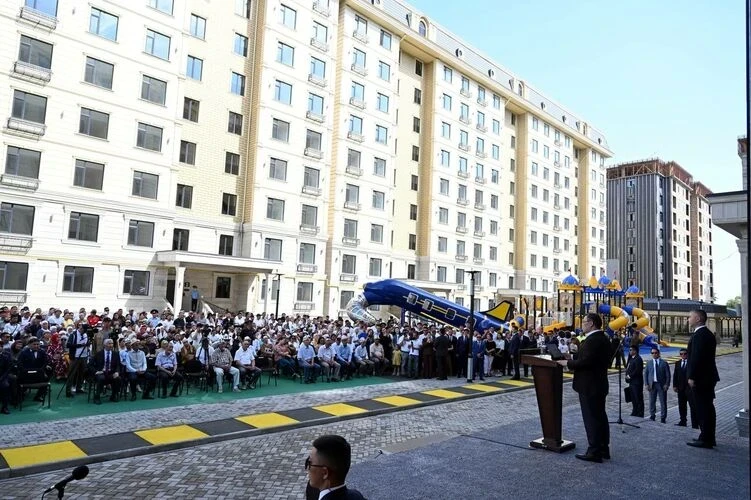
Instead of a colony — a residential complex: the second phase of "Muras" was completed in Bishkek
It is also important to note that we do not build houses for specific categories of citizens, such as doctors or military personnel. Everyone in line receives apartments in the same buildings. Our program stipulates that agencies that provided their plots receive apartments according to a quota of up to 20 percent of the housing stock. For example, on Malikova Street, apartments will be allocated to employees of the State Penitentiary Service, who received their apartments as a result of three phases of issuance.
— You mentioned that 5.5 million square meters of housing are being built in the country. Is GIK able to control the quality of construction? There is often criticism about this on social media.
— Quality control of the constructed facilities is carried out not only by us. We actively check the quality; we have our own construction department that works on each facility. Control is also carried out by contractors.
All 100 percent of GIK shares belong to the presidential administration, so control is also exercised from their side. In addition, inspections are conducted by the State Construction Agency, which creates a multi-tiered control system.
In our construction, we use monolithic formwork technology, recognized as the most earthquake-resistant. We have a specialized laboratory for material testing.
Read more on the topic
GIK builds "human warehouses." Kanibek Tumanbaev responded to the criticism
After the completion of construction and the issuance of apartments to citizens, there is a warranty period during which contractors are obliged to eliminate identified deficiencies. We provide apartments for 15 and 25 years, and during this period they remain on GIK's balance sheet, where control is exercised. Our houses are built within the framework of a state program approved by presidential decree, and we pay special attention to quality. Although problems may arise during large-scale construction, we strive to resolve them promptly.
— How is the design of residential complexes carried out? Is it taken into account that with an increase in the number of residents in the area, kindergartens, schools, and hospitals are needed?
— Certainly. We engage in dialogue with local self-government bodies in the areas where construction is taking place. For example, near the facility on Malikova Street, there is a city school, but due to the large number of apartments built, there is a shortage of places. Therefore, the first floors of the houses were allocated for this school, allowing children to study without going far from home.
However, we do not engage in the construction of entire districts: we build individual facilities. If we were building entire residential complexes, we would certainly plan for the construction of polyclinics, schools, and kindergartens as well.
— The majority of GIK's construction projects are concentrated in Bishkek and Osh. What awaits the residents of At-Bashy or Leylek?
— Currently, we are building housing in all seven regions of Kyrgyzstan to provide as many citizens as possible with apartments. Housing is provided in the region where the program participant works. For example, if a person works in Kara-Balta, we will provide them with housing in that city if they are in line. Participants of shared construction have the opportunity to choose the region.
We cannot say that construction is taking place in every district of the country, but housing is being built in regional centers and small towns. In the regions, we have a unified queue, meaning that a resident from one district, even if we are not yet building in their locality, can receive an apartment in the nearest completed facility when their turn comes.
— Will the conditions for recipients of state mortgages be revised, especially regarding interest rates? Is there a possibility of returning to a system where citizens can choose apartments in any building, not just those built by GIK?
— It should be noted that since the establishment of GIK, the conditions of the housing program have only been revised to improve accessibility for citizens. Interest rates have been reduced from the initial 6-14 percent to the current 4-8 percent, depending on the direction and category of program participants. Currently, the conditions are among the most accessible in the field of mortgage lending in the CIS countries.
As for the mechanism of housing financing through banks, it was previously applied, and its return in the future is possible. GIK actively collaborates with international financial organizations and donors. Currently, a project is being coordinated with the Asian Development Bank, within which it is planned to attract 65 million dollars, including for the development of the housing financing mechanism through partner banks.


