
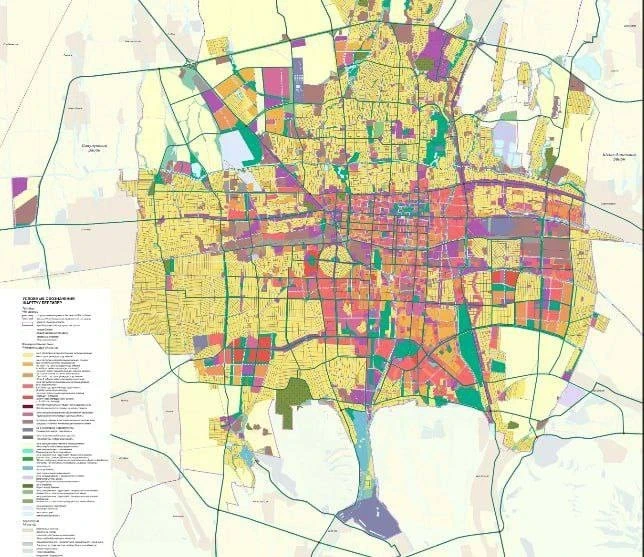
The topic of private property and potential demolitions raised the most concern. Residents actively inquired whether their private homes, including both Stalin-era and panel or brick buildings located along major streets, would be affected.
City hall representatives and developers repeatedly emphasized that the master plan does not foresee the demolition of residential buildings, and any changes in this regard would only be possible with the consent of the owners. At the same time, they stressed that specific decisions regarding the expansion of streets and functional land use would be made after the document's approval, creating additional uncertainty for citizens.
Photo by Bishkek City Hall. Master Plan-2030
Questions regarding red lines and the accessibility of information also caused tension. Residents pointed out the lack of clarity regarding the delineation of red lines and the associated restrictions. Developers acknowledged that the previous Master Plan was not accessible to the public. Now, city authorities plan to provide materials in electronic format, except for engineering sections, which, according to participants, should help restore trust in this document.
Discussion of functional zoning and color coding of areas also raised many questions. Residents wanted to understand what each color on the map means and whether it relates to building rights. It was clarified in the responses that the red zone implies multi-story construction, the purple zone indicates multifunctional or specialized facilities, the green zone represents green areas, and the white zone consists of plots undergoing land amnesty. Nevertheless, people were more interested in legal aspects, such as the possibility of obtaining documents or constructing at present.
The topic of green zones was also sharply raised. Many residents from streets and neighborhoods expressed dissatisfaction as their plots fell within greening zones, despite the presence of private property and residential houses. In some cases, the city hall promised to consider the comments and adjust the boundaries of green zones, while in others, they refused, citing previously approved projects.
Additionally, authorities announced their intention to restore irrigation systems and develop watering, emphasizing that without this, the expansion of green zones loses its relevance.
Transportation issues also became a subject of discussion, revealing a gap between residents' expectations and the logic of the urban planning document. Residents raised topics such as expanding streets to 6-8 lanes, constructing new roads, organizing parking, and pedestrian infrastructure. Responses indicated that the master plan only defines the direction of road network development, while specific parameters would be clarified later.
It should be noted that the document does not provide for the construction of a metro; instead, tram, urban rail, and bus rapid transit are proposed. However, many practical issues, such as sidewalks, stops, and underground crossings, are not included in the tasks of the master plan.
Social infrastructure also became an important aspect of discussions. Residents and deputies pointed out the lack of educational and medical institutions, especially in areas with individual housing and annexed territories. In responses from the city hall, it was reported that schools and kindergartens are planned on reserved municipal lands, and in multi-story construction, social facilities must be accounted for, but specific addresses and timelines for implementation were not provided.
Questions regarding land amnesty and the transformation of plots also remained relevant. Residents were concerned about the fate of houses built after 2021 and why areas with utilities are still considered agricultural land. It was clarified in the responses that such plots are temporarily marked in white, and their status will be reviewed after the amnesty procedures are completed. Regarding transformations, residents were advised to submit documents in the established order.
Public hearings showed that the master plan is perceived by residents not as a strategic document, but as a tool that directly affects their daily lives.
The key requests from citizens boil down to three points: clear guarantees regarding private property, access to maps and red lines, and real coordination of development plans with transportation, green zones, and social infrastructure.
The level of trust in the master plan and its practical implementation will depend on how effectively the city responds to these requests.


