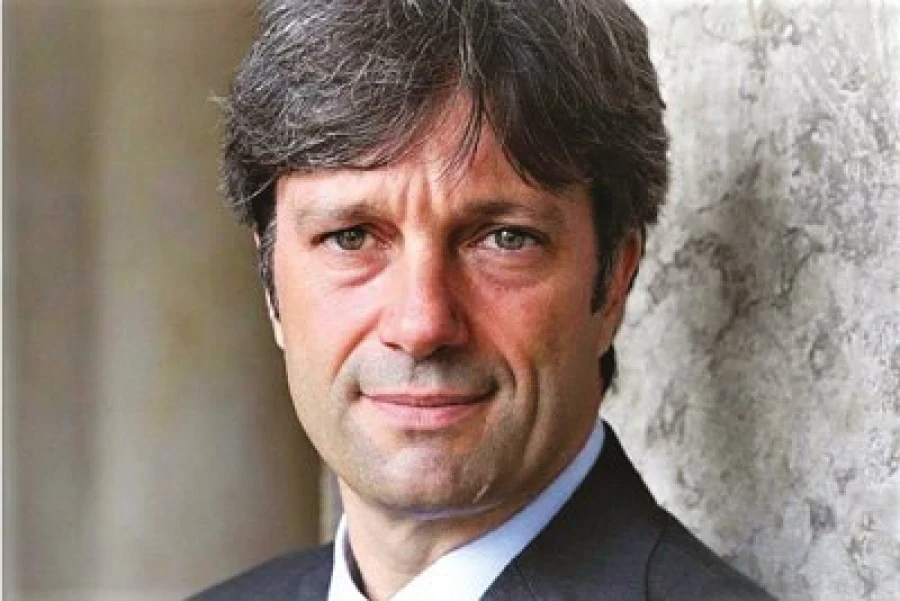
Interview with Matteo Zoppas, President of the Italian Trade Agency (ICE) by Vesti.kg
On March 23 and 24, a business forum dedicated to agro-innovations, titled “Innovations, Regenerative Agriculture, and Digitalization for Sustainable Agroecosystems” (Italy – Central Asia + Azerbaijan Business Forum), took place in Tashkent. The event brought together representatives from businesses, industry associations, and government structures from Italy and Central Asia.
This forum became not just a platform for discussions, but an important tool for establishing direct business connections. Matteo Zoppas shared insights with Vesti.kg about the reasons behind Italy's increased presence in this region and the technologies that can be offered.
- Matteo, why has Italy targeted Central Asia? Is it due to economic interests or geopolitical considerations?
It certainly has an economic underpinning, but it is inextricably linked to the geopolitical situation. Last year, the Italian Ministry of Foreign Affairs identified several priority areas that are now in focus. This decision is based on the need to reassess economic relations and diversify markets, considering current international realities. Prime Minister Giorgia Meloni clearly outlined this strategy. A key aspect is the development of partnerships between companies that create a sustainable model of mutually beneficial cooperation.
- Why is Central Asia a priority for Italy right now?
This is a region with enormous growth potential. We are witnessing the transformation of local economies and a clear demand for modernization, especially in the agro-industrial sector. The focus is on mechanization, upgrading equipment, and creating production with higher added value.
There is also a growing demand for product quality and standards in both domestic and export markets. These factors make Central Asia particularly attractive for Italian businesses.
- What specific technologies can Italy offer to this region?
First and foremost, these are solutions aimed at increasing efficiency. There is a significant need for equipment that reduces dependence on manual labor and increases productivity in the agri-sector. The FederUnacoma association, representing Italian agricultural machinery manufacturers, plays an important role in this by offering a wide range of solutions—from basic mechanization to high technologies.
Technologies related to food security, agricultural product processing, and quality improvement are also in demand. However, technologies without proper training will not yield the desired effect. Training specialists is a key aspect for the effective use of equipment.
Digitalization and the implementation of digital solutions in managing machinery and production processes are also very important. All requests coming from the region fit into this context.
- What is the practical attractiveness of Kyrgyzstan for Italian businesses, considering its small economy?
That is its potential. A small market is often in a growth phase. Kyrgyzstan has to go through a technological path that Italy has already successfully traversed. We have the necessary technologies and experience for this.
This allows not only supplying equipment but also supporting transformation, training, sharing knowledge, and implementing solutions. As a result, accelerated development, increased production volumes, and improved product quality are possible.
- Are there already specific projects, or are they still in the preparation stage?
At the moment, we are not talking about classic investments. It is not about large investment projects, but about creating an infrastructure for interaction.
We are organizing trips for entrepreneurs from the region to Italy, where they can visit exhibitions and production sites to see technologies in action. At the same time, Italian companies come here to assess the local market and its needs.
Thus, we are creating a platform that connects supply and demand. In particular, about 400 business meetings took place at the forum, involving nearly 100 Italian companies and around 200 companies from Central Asia. This is already a full-fledged interaction platform comparable to an industry exhibition. Companies get acquainted and start negotiations, leading to deals.
- What are the chances for companies from the region to enter the Italian market?
This is quite realistic, but two conditions must be met. First, companies must show initiative and willingness. Entering the external market requires readiness. Second, systemic support is needed, including commercial and financial assistance. Small and medium-sized enterprises rarely can enter the market independently, but with support, this process becomes significantly easier. Once a company establishes itself in the market, it can develop independently.
- What does Italy expect from Central Asia in response to its actions?
We are not talking about demands, but about mutual opportunities. Companies in the region are generally in the mid-segment, while Italian companies offer higher technologies. This creates a complementary effect.
For example, in the food sector, we can train specialists and chefs, transferring standards and technologies to them. At the same time, there is potential for importing products from the region, especially in the agri-food sector. Thus, a bilateral model of interaction is formed.
- How do you see cooperation in 10 years?
At the initial stage, these will be separate projects. However, as interaction develops, considering similar needs, a sustainable system of cooperation may emerge. Such forums already show that companies from different countries are ready to work together, creating a foundation for deeper economic ties.
- Does Italy consider Central Asia and the South Caucasus as a single space?
This question is difficult to answer theoretically. Everything will depend on the practice and the activity of entrepreneurs in establishing connections. Only practice will show whether it is possible to create a unified economic space.
- What will be the indicators of success for this forum?
Today we have launched the process of interaction. Companies have begun to get acquainted, engage in dialogues, and discuss cooperation. Next should come negotiations, deals, and business growth. If this chain is realized, we can talk about real results.
- What does Italy expect from the countries of the region in response to your actions?
It is important to adhere to the agreements reached and create a transparent business environment. We also raise issues related to combating counterfeiting and products imitating Italian origin. This is a serious problem that undermines trust and harms the economy.
In addition, it is necessary to understand the value of technologies. Although quality solutions may cost more, when used correctly, they provide higher efficiency. In this case, the return on investment will be higher, and the total cost of ownership will be lower due to increased productivity.
Thank you for the conversation.
Interview conducted by Gladis Temirchieva