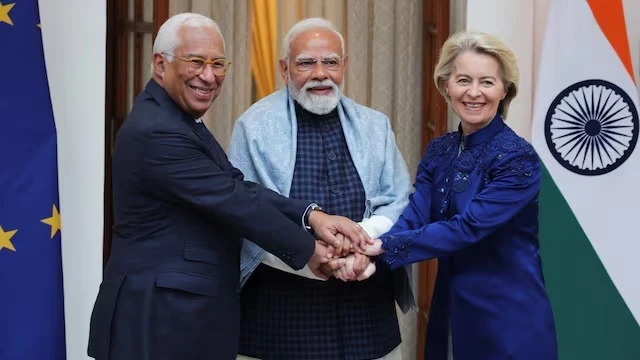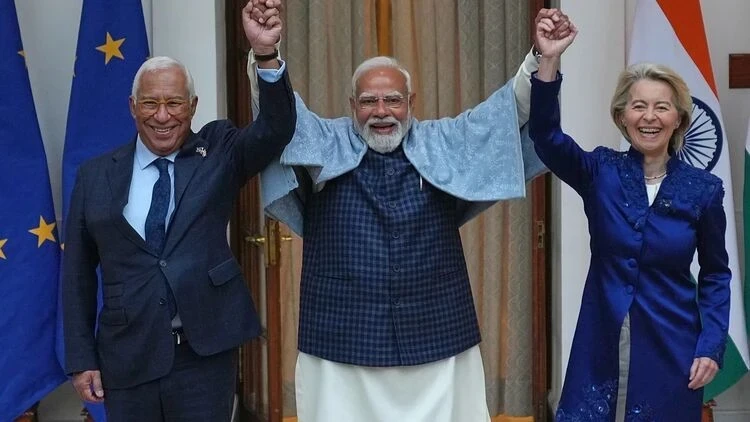
The European Union and India have agreed on the terms of free trade, creating one of the largest economic zones in the world, encompassing nearly 2 billion people. This agreement is the result of long negotiations that lasted about 20 years, and many international media characterize it as historic.
This agreement includes a phased reduction or complete elimination of tariffs on a wide range of goods and services. It also provides for expanded market access for both parties in the areas of investment, digital trade, and services. According to the European Commission, European companies could save up to 4 billion euros annually due to the elimination of tariffs, and exports from the EU to India could double in the medium term.
For the European Union, key aspects of the agreement include the reduction of high Indian tariffs on cars (currently over 100%), alcoholic beverages, including wine and spirits, as well as on machinery and chemical products. These sectors have long been sensitive for European exports and were a subject of disagreement during negotiations.
India, in turn, gains the opportunity to improve access to the EU market for its products, including textiles, clothing, leather goods, jewelry, seafood, and some agricultural products. This agreement is expected to promote export growth, attract investments, and create new jobs in export-oriented sectors of the economy.
The agreement covers not only goods exchange but also services, including finance, telecommunications, and the digital economy. Additionally, the document includes measures for investment protection, sustainable development, environmental standards, as well as simplification of procedures, technical regulations, and intellectual property protection.
Why this agreement is significant
The significance of this agreement between the EU and India goes beyond merely changing tariffs and export quotas. This agreement symbolizes a redistribution of economic influence in a world that is moving away from the traditional bipolar model.
In recent years, the global economy has been influenced by the United States and China, where the former set the rules through the financial system and access to markets, while the latter did so through industrial dominance and control of supply chains. However, protectionism, trade wars, and rising geopolitical tensions have made this model less stable.
The agreement between the EU and India is a response to these challenges.
A new power on the global stage?
The combined market of the EU and India is nearly 2 billion people, representing a significant portion of global trade and GDP. In terms of scale and potential, this union is comparable to the largest economic blocks on the planet, forming an independent economic contour that will not depend on either Washington or Beijing.
This changes the global balance of power, making the world more multipolar. For countries and multinational companies, this opens up new opportunities for choosing partners and markets, rather than having to adapt to a single center of influence.
Strategic interests of Europe
For the EU, this agreement represents a step towards restoring strategic autonomy. The European economy has been under pressure from both American protectionism and Chinese industrial superiority. In this context, India becomes an important market, a platform for diversifying production, and a partner in long-term projects, including the digital economy and "green" transformation.
Thus, the European Union is creating protection against potential trade conflicts and reducing dependence on a single direction of foreign economic relations.
India as a global player
This agreement for India signifies a transition from the status of a "promising developing market" to that of a systemic player on the global stage. Access to the European market strengthens the country's economy, enhances its investment attractiveness, and political influence.
India demonstrates its readiness to engage in an equal dialogue with the leading economies of the world and to build its own strategy without rigidly aligning with any of the global blocs.
Impact on the USA and China
Although this agreement is not directed against anyone specifically, its consequences will affect both China and the USA. The PRC will face increased competition for investments and supply chains, while the United States will experience a weakening of its role as the main economic arbiter.
This does not mean a loss of leadership but indicates a gradual decline in the monopoly on setting the rules of global trade.
Impact of the agreement on Central Asia
Although the free trade agreement between the EU and India does not directly concern Central Asia, its consequences for the region will be significant. This is primarily related to transit, competition in markets, and changing interests of major players in this region.
Increased trade between the EU and India will lead to a growing demand for reliable and diversified logistics routes. In this context, Central Asia has a chance to strengthen its role as a link between Europe and South Asia.
Special attention should be paid to the development of the Trans-Caspian International Transport Route and corridors through Central Asia. The larger the volumes of trade between the EU and India, the greater the interest in land routes that bypass congested maritime paths and zones of geopolitical instability.
This creates opportunities for attracting investments in transport infrastructure, logistics, and related services.
The agreement between the EU and India also expands opportunities for Central Asia in the field of foreign economic policy.
The region gains additional arguments for dialogue with both Europe and India on issues of transit, investments, and participation in regional supply chains.
With sound policies, Central Asian countries can leverage the increased trade between the EU and India to integrate into new logistics and production chains.
For Central Asia, this agreement is neither a threat nor a guaranteed benefit, but rather a possibility. The key is the ability of the countries in the region to adapt to the new multipolar economy and to use their geographical position as an economic resource.