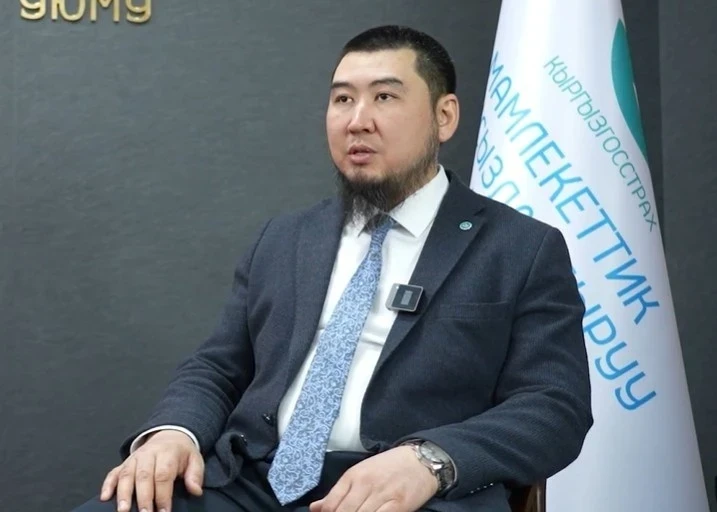
Kyrgyzstan is demonstrating impressive economic growth rates, and the insurance sector has tripled in size over the past two years. In an interview with Baktygul Abdyjaliev, Deputy Chairman of the Board of the State Insurance Organization, we discussed why insurance is an integral part of the country's stability.
- Mr. Baktygul, where shall we begin? What is the necessity of insurance in our country?
- Undoubtedly, insurance plays a key role in development and economic progress. Over the past three years, we have observed a stable GDP growth rate of 10% per year, placing us on the podium among the CIS countries and third in the world ranking. Ten years ago, no one even dreamed of such success, and many were reluctant to speak about their country. Now we have confidence in the future of Kyrgyzstan and its potential.
Insurance significantly contributes to this progress. Historically, many states have achieved significant success through insurance mechanisms. In developed countries such as Japan and the USA, the ratio of the insurance market to GDP is high: 16.5% and 13%, respectively. People actively use insurance in various aspects of life, from mobile phones to business liability. This helps maintain the economy without serious fluctuations. Here, companies often face bankruptcy due to the lack of risk insurance.
The actions of our president, who issued a decree on the development of the insurance market, have become a turning point for Kyrgyzstan. In two days, on March 20, this decree will be two years old, and during this time the market has increased from 3 to 10 billion soms, which is more than three times.

- How does this reflect on the life of an ordinary person?
- Insurance creates a financial safety net. Since our establishment, we have made payouts to citizens totaling about 400 million soms, helping businesses and people in difficult situations. Since the beginning of this year, we have paid out 82 million soms, mainly under two laws: OSAGO (compulsory motor third-party liability insurance) and mandatory housing insurance against fires and natural disasters.
In Soviet times, there was "Gosstrakh USSR" with assets amounting to half a trillion dollars by today's standards. After its collapse, until 2015, insurance in Kyrgyzstan was at a low level, covering only those areas required by international standards, such as aviation. People forgot about insurance. Since 2015, ideas began to emerge, but the mechanisms did not work, and there were no penalties. As a result, the coverage of housing insurance remained at 10%. Over the past two years, we have increased this figure to 30%, which amounts to 350,000 insured houses out of 1,250,000 in the country.
- What about cars?
- With the introduction of fines for OSAGO in October last year, we observed a high demand and queues at the public service centers. We have digitized many processes to reduce the burden on people. There are 1,750,000 registered vehicles in the republic, of which more than 1,100,000 are already insured. Over 320,000 vehicles are insured with the State Insurance Organization, which constitutes 20% of the total and 35% of all insured vehicles. Thus, we control a third of the OSAGO market.
Citizens have begun to trust the government more, seeing economic growth, new construction projects, and rising wages. The name "State Insurance Organization" itself inspires confidence. Sometimes it happens that a person buys a policy from a private company through an app and then, when faced with an accident, turns to us, believing they are insured with the state. However, this turns out to be a mistake. We are the only company where 100% of the shares belong to the Cabinet of Ministers, which implies strict oversight and the ability to implement social programs. Mandatory housing insurance is one such program. The policy costs 600 soms per year in rural areas and 1200 in the city, with payouts of up to 500,000 soms in villages and up to one million in cities. Considering that natural disasters occur in Kyrgyzstan, these are very reasonable rates. Many may say that you cannot rebuild a house for a million, but in villages, people can build new housing for 500,000.
- Is the house insured against both fire and natural disasters?
- Yes, this is provided for by one law. It covers both man-made risks and natural phenomena such as earthquakes, mudflows, and landslides. Currently, we are considering the possibility of changing the thresholds.
- Tell us more about this. The Jogorku Kenesh has adopted in the first reading a project to create an insurance pool and reduce the threshold for earthquakes to 5 points. Why is this important?
- This is one of the most important innovations in the system of mandatory housing insurance, based on practical experience from recent years and our main goal — real protection of citizens' property. The project includes two main solutions: first, lowering the threshold for an insurance case in the event of an earthquake to 5 points, and second, creating a special insurance pool.
Previously, an earthquake with a magnitude above 6 points was considered an insurance case; however, an analysis of seismic activity showed that such a threshold is too high for Kyrgyzstan. Our country is located in a zone of increased seismic activity, and earthquakes of around 5 points occur quite frequently. Even at this magnitude, many houses sustain damage: cracks in walls, peeling finishes, and damaged roofs are common occurrences, especially in rural areas and in older buildings. Previously, such cases were not recognized as insurance cases, leaving citizens without compensation. Therefore, it was decided to lower the threshold to 5 points. We adhere to the principle that "insurance should protect people not only from major disasters but also from the real consequences of natural phenomena in everyday life."
As for the insurance pool, this measure is important because natural disasters can cause mass damage. For example, during a strong earthquake, thousands of houses may be affected simultaneously, creating a significant financial burden on the insurance system. The creation of an insurance pool will provide a combined financial reserve to cover damages from large-scale disasters. This is a kind of national financial safety net for citizens, allowing us to confidently state that insurance payouts will be made regardless of the scale of the disaster.
In Kyrgyzstan, there have already been cases of earthquakes with magnitudes of 4.5–5.5. Destruction occurred, but we could not legally pay compensation. At that time, the chairman of the Cabinet used his own funds to assist according to our methodology. To maintain the level of trust, we developed a new mechanism. We are also lowering the threshold for wind damage from 25 to 20 meters per second, as roofs begin to be blown off at 20 m/s. Of course, there are questions regarding compliance with construction standards, but it would be impractical to wait for the entire country to be rebuilt according to standards. Flexibility is needed.
Since the beginning of the year, we have already recorded 54 cases related to housing, of which 51 are fires, which occur more frequently in cities where houses are stronger and withstand 6 points. We have registered 500 cases under OSAGO, mainly in Bishkek.
- What do you say about OSAGO? Drivers often complain about bureaucracy and impound lots.
- It is pointless to acknowledge bureaucracy. We need a decision from the authorities to recognize a person as guilty. If they have caused damage to third parties, and the traffic police have confirmed this, OSAGO comes into effect. Yes, it takes time for examinations and impound lots. We are trying to speed up the process: we have created round-the-clock emergency commissioner services in Bishkek and Osh that go to the scene and provide consultations.
But the law cannot be bypassed. The payout procedures and coefficients are approved by the Cabinet, and we cannot change them. We are moving towards a system of European protocols, like in Europe or our neighbors, where drivers in minor accidents without injuries simply exchange policy data and leave without police intervention. This will only be possible when we achieve coverage of 90-100%. For now, 80% of violations in Bishkek are related to the lack of OSAGO. When we reach maximum coverage, we will switch to the European protocol. Yes, there is a risk of fraud, but we will address this through digitalization.
- Insurance for loans and export-import supplies has been announced in Kyrgyzstan. What is its essence?
- The State Insurance Organization actively supports small and medium-sized businesses and develops export potential within the framework of the National Program-2030. Simply put, it is the protection of our entrepreneurs on the international stage.
When a company sends goods abroad, the partner may go bankrupt or fail to fulfill obligations. There are also political risks, such as currency restrictions, sanctions, and conflicts. Insurance allows for the recovery of 50 to 90 percent of the transaction amount. Additionally, export loans are insured, protecting against the risk of non-repayment. It is important to note: contract insurance does not cover damage to the cargo during transportation; there is a separate type for that — cargo insurance. The main benefit is that businesses can more boldly expand their horizons, offering partners deferred payment, knowing that their capital is protected.
- What are the consequences of granting the State Insurance Organization the status of the National Reinsurance Operator?
- This status was approved by Presidential Decree No. 79 on March 24, 2024, and is part of cooperation with the Eurasian Reinsurance Company (ERC) within the EAEU. To explain simply: reinsurance is insurance for insurance companies themselves. When the risk is too great, a company transfers part of it to a reinsurer.
Previously, these risks went abroad, taking currency in the form of insurance premiums with them. The creation of a national operator will allow these resources to remain within the country, which means greater reliability of the entire system for citizens. Even in the event of large-scale disasters, the system will retain the ability to fulfill payment obligations. Our strategic goal is to create a system that reliably protects the interests of citizens and contributes to economic development.