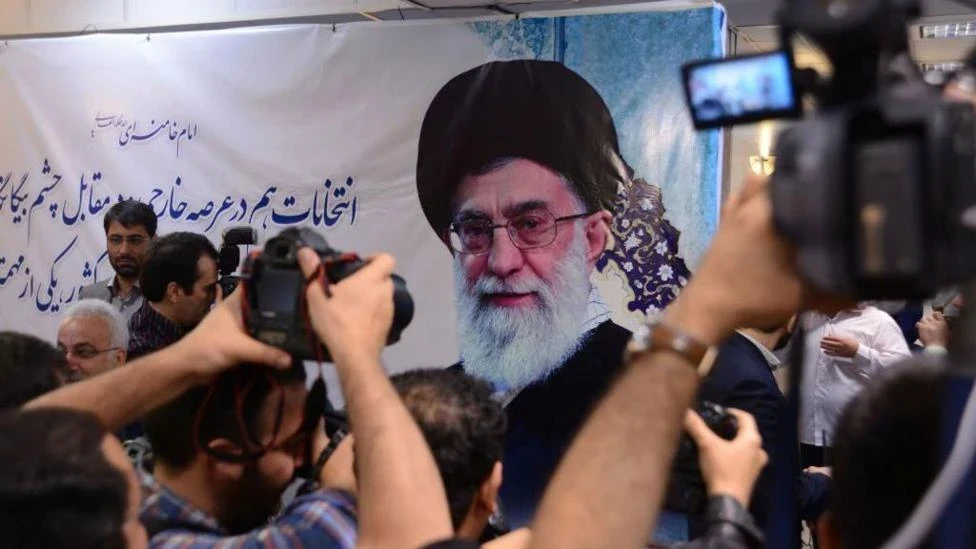
Archive photo. Supreme Leader of Iran Ali Khamenei. His death was confirmed both in Tehran and in the USA and Israel
We invite you to familiarize yourself with the biography of Ali Khamenei and his legacy.
Ali Khamenei, whose full name is Seyyed Ali Hosseini Khamenei, was born on April 19, 1939, in Mashhad to a family of a Shia cleric. He studied in religious educational institutions and became a mujtahid, which is the highest level of a Sharia expert, possessing the right to make independent legal decisions (ijtihad).
In the 1960s and 1970s, he actively fought against the regime of Shah Mohammad Reza Pahlavi, for which he was repeatedly arrested and exiled, including being banished to Iranshahr.
Khamenei repeatedly spoke out against the pro-American policies of the Shah, which led to persecution by the authorities. He spent two months in solitary confinement.
In 1975, after anti-government lectures, he was arrested again and sent to the prison of the Ministry of State Security of Iran, where, according to his recollections, the conditions of detention were extremely harsh.
After returning to Mashhad, he continued his underground activities, but in early 1976, he was detained again and sentenced to three years of exile in the southeast of the country.
Khamenei became one of the most well-known preachers opposing the Shah.
During the Islamic Revolution of 1979, he entered the inner circle of the first Supreme Leader of Iran, Ruhollah Khomeini, became one of the founders of the Islamic Republican Party, and participated in the creation of the Islamic Revolutionary Guard Corps. He also held positions as a member of the Majlis and Deputy Minister of Defense, regularly visiting the front lines during the Iran-Iraq War.
In June 1981, an assassination attempt was made on Khamenei: an explosion in one of the mosques in Tehran left his right hand partially paralyzed. A few months later, he was elected President of Iran, receiving more than 95 percent of the votes, and was re-elected in 1985.
After the death of Ruhollah Khomeini in June 1989, the Assembly of Experts elected Khamenei as the new Supreme Leader of Iran, amending the provisions of the Constitution and granting him the title of Grand Ayatollah.
Under his leadership, Iran continued to develop its nuclear program. In 2015, an agreement was signed with world powers (JCPOA), but after the USA withdrew from the deal in 2018, Iran gradually began to reduce its compliance with its obligations.
The Ayatollah actively criticized the United States and did not recognize Israel. He maintained ties with Lebanese Hezbollah and other radical groups in the region.
Under Khamenei, mass protests became a common occurrence. The most significant unrest occurred in 2009, 2017-2018, 2019, and 2022. The authorities brutally suppressed these protests, imposing restrictions, including blocking internet access and tightening security measures.
Since 1964, Khamenei had been married and had six children. His son Mojtaba is already being considered a potential successor.
Ali Khamenei was killed on February 28, 2026, at the age of 86.