
Janibek Gadaev, an ethnic Kyrgyz, returned to his homeland from Tajikistan more than ten years ago. He settled in the village of Vasilyevka in the Alamudun district of Chui region, and despite successfully obtaining a passport, this process took him almost four years.
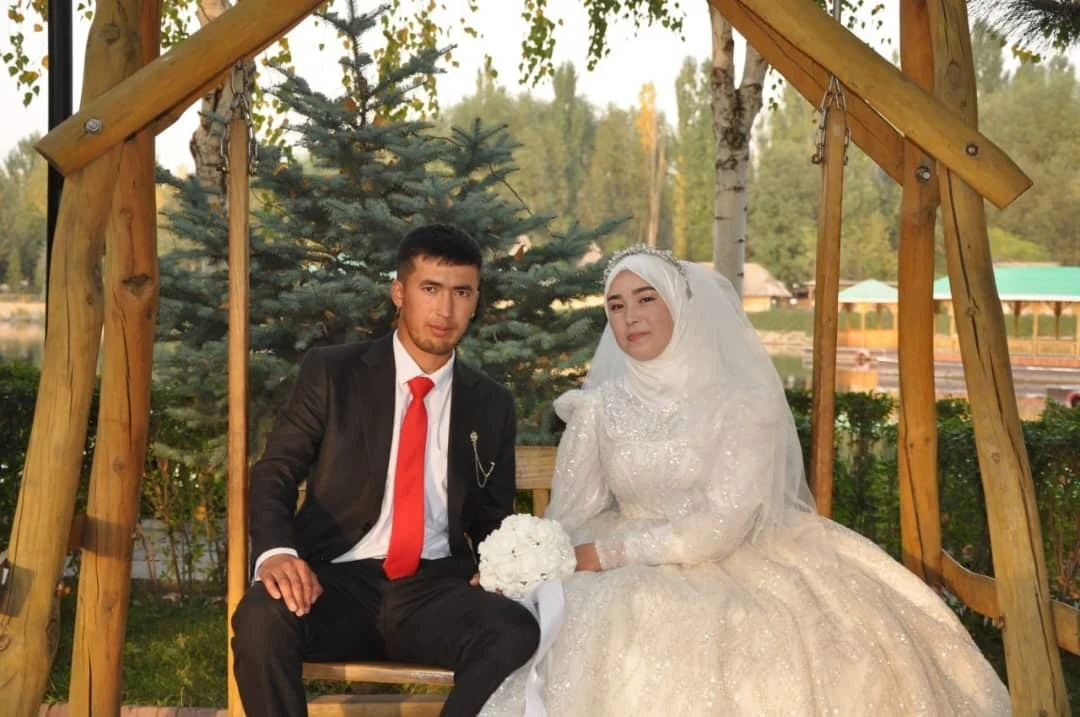
Photo from personal archive. Janibek and Parvana
Currently, his family is facing similar bureaucratic difficulties. Janibek's wife, Parvana, who arrived in Kyrgyzstan in 2023, cannot obtain documents due to an error in her mother's surname, as indicated in her passport and civil registry documents. This has resulted in Parvana lacking legal status and a birth certificate for their four-month-old child.
"We have been going from one institution to another, but no one has explained what we should do. We hope that contacting a deputy will help solve our problem. I have been running around the offices since the wedding and often encounter rudeness," Janibek recounts.
Many ethnic Kyrgyz, like Janibek, have found their place in the Alamudun district, including the villages of Vasilyevka, Vinogradnoe, Polevoe, and Oktyabrskoye. According to deputy Temirlan Aitieev, their number exceeds 40,000 people. Many of them come to him with complaints about difficulties related to obtaining citizenship, processing documents and social benefits, as well as the "Batyr Ene" status.
In addition to bureaucratic problems, there is a pressing issue regarding the professional ethics of government employees, especially those providing services to the public. Temirlan Aitieev emphasizes that the constant rudeness and indifference of officials create additional barriers for migrants.
"Our compatriots who returned home in search of protection are sometimes treated worse than enemies," he notes.
A situation similar to that of Aysulu Nosirova illustrates this problem. Aysulu, born in Tajikistan, moved to Kyrgyzstan in 2021 with two children after a border conflict. Although she and her husband have already obtained citizenship, they have been unable to process documents for their children for almost five years.
The main issue has been confusion over surnames: her husband changed his surname from Nosirov to Sulaymanov, but the children's birth certificates still bear the old surname. The Center for Population Services (CPS) demanded that all documents be brought into compliance. As a result, the family had to spend nearly 50,000 soms to change the children's surnames through Moscow, but upon returning to the CPS, they were simply asked, "Why did you do this?".
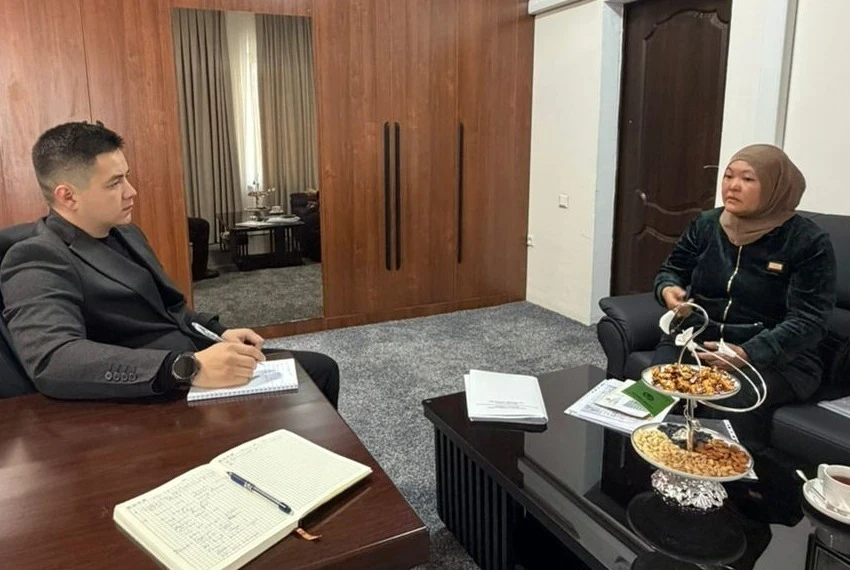
Photo from Jogorku Kenesh. Aysulu Nosirova at a meeting with deputy Temirlan Aitieev
"My eldest son is 19 years old, and my youngest is 16. He is finishing school, but he is not in the electronic gradebook. Now they say he will not be allowed to take the exams. The CPS sends me from one window to another. When I asked the head what I should do, he rudely replied: 'Go wherever you want, even to the ministry,'" Aysulu complains.
The Ombudsman Institute confirms that the problems faced by Janibek and Aysulu are systemic: monitoring has revealed hundreds of appeals from ethnic Kyrgyz who have found themselves in a "legal trap".
Migrants from Tajikistan face criminal prosecution for attempting to cross the border illegally, seeking to avoid conflicts. Men encounter difficulties in obtaining passports due to the inability to be removed from military registration in their home country, where they face the threat of interrogation.
The situation is exacerbated by bureaucratic "football" in the CPS, where citizenship documents can be lost for years, the absence of mechanisms to verify children's birth certificates, and strict registration deadlines, the violation of which incurs significant fines.
Human rights activists are demanding that the government conduct a large-scale migration amnesty and simplify legislative procedures for the legalization of compatriots.
In response to a request from 24.kg, the Ministry of Labor, Social Protection, and Migration reported that according to the presidential decree of August 2, 2024, the issue of discrepancies in documents has been resolved: now the applicant can choose how they want to indicate their full name — according to their passport or birth certificate. The ministry also emphasized that ethnic Kyrgyz with the status of "kairylman" have the same rights to social benefits and privileges as citizens of Kyrgyzstan.
Reference 24.kg
Ethnic Kyrgyz returning to their homeland initially receive the status of "kairylman" for three years. This status grants the right to social benefits, allowances, and legal residence while the process of obtaining full citizenship is underway.
The ministry also emphasizes that the "kairylman" status was created for the simplified acquisition of citizenship, and the decision on its issuance is made by an interdepartmental commission within two months.
Despite existing complaints, the ministry states that kairylmans receive all the benefits they are entitled to: hundreds of children are studying in schools and universities, and adults have access to medical care, pensions, and allowances as citizens of Kyrgyzstan.
"If there are cases of discrimination or improper treatment by the Ministry of Labor employees, one can contact the public reception of the ministry at the number 1966. This call is free," the ministry added.
Meanwhile, deputy Temirlan Aitieev has appealed to the Ministry of Justice to review the mechanisms for issuing documents and develop clear algorithms for interaction with countries of origin. He noted that obtaining a single certificate should not take an entire year.
The parliamentarian criticized the inaction of officials: "Why do the authorities not notice the problem? Ethnic Kyrgyz are a very patient people. They rarely turn to social networks or the media. And government bodies only react when discontent becomes widespread," he stated.
- According to the Ministry of Labor, Social Protection, and Migration data as of January 1, 2025, more than 70,000 ethnic Kyrgyz have returned to their homeland since gaining independence.


