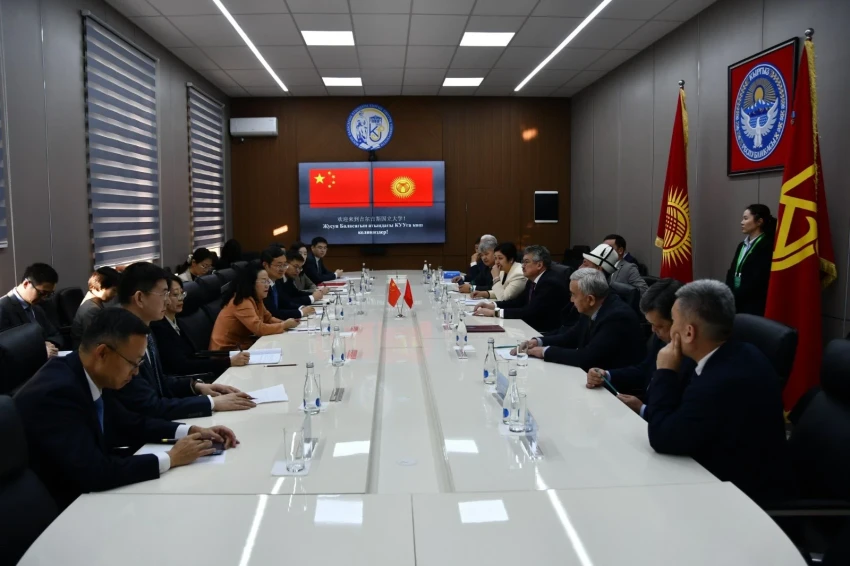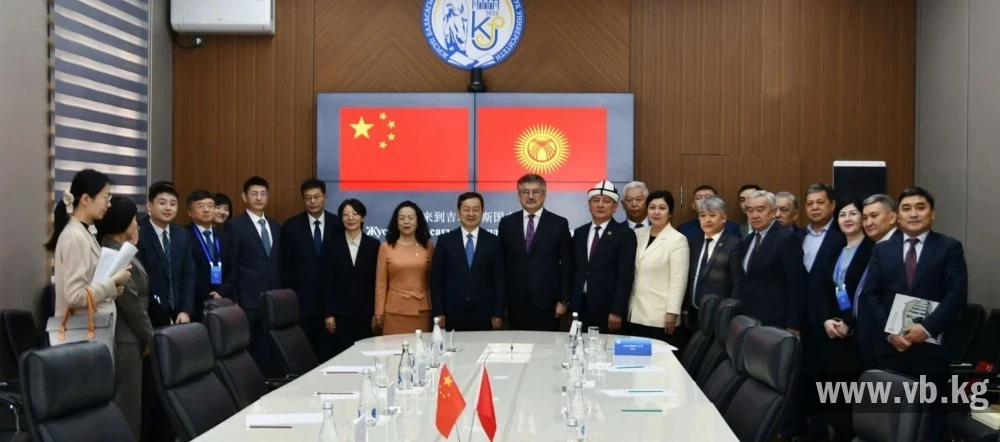
Cooperation in the fields of science, education, and humanitarian studies is becoming a key aspect of relations between Kyrgyzstan and China, especially in the context of the growing need for mutual understanding between peoples. The participants were greeted by the Secretary of State of the Kyrgyz Republic, Arslan Koichiev, the rector of KNU, Dogdurbek Chontoев, the Ambassador of China to Kyrgyzstan, Liu Jiangping, the President of the Chinese Academy of Social Sciences, Gao Xiang, the Deputy Speaker of the Jogorku Kenesh, Karim Khandzheza, and the Minister of Science, Higher Education, and Innovations, Gulzat Isamatova. Scholars and experts from both countries shared their opinions on the prospects for joint development and deepening ties.
Deputy Speaker of the Jogorku Kenesh, Karim Khandzheza, emphasized that the university named after J. Balasagyn is an important scientific and educational center that promotes dialogue and knowledge exchange between the two states.
According to him, "We highly value the trusting relationship with our Chinese partners, based on the principles of sovereign equality and mutual support." He also noted that the decisions made at the plenary session are of great interest to Kyrgyzstan, providing valuable analytical and practical experience.
Khandzheza also highlighted the significance of scientific and expert dialogue for making balanced decisions and achieving mutual understanding. He expressed confidence that the briefing would serve as an effective platform for exchanging opinions and strengthening trust, as well as for implementing new initiatives aimed at deepening Kyrgyz-Chinese cooperation.
President of the Chinese Academy of Social Sciences, Gao Xiang, reported that last year his academy signed a memorandum with the National Institute of Strategic Initiatives under the President of Kyrgyzstan, which will deepen the strategic partnership between the two countries. Kyrgyzstan, according to him, demonstrates a firm commitment to implementing the National Development Plan until 2030.
Gao Xiang added that "China will always be a reliable friend for Kyrgyzstan and is ready to work together on implementing the cooperation plan."
He elaborated on the unique solutions adopted at the 4th Plenary Session of the Central Committee of the Communist Party of China, which, in his opinion, are important experiences in governance. "The priority given to scientific development of long-term plans is one of the key reasons for the success of Chinese modernization," noted Gao Xiang.
According to him, the implementation period of the 15th Five-Year Plan (2026-2030) will be crucial for China in strengthening the foundations and advancing in the field of socialist modernization. Gao Xiang also noted that China's achievements in socio-economic development attract global attention.
He compared China's economy to an ocean that is not afraid of storms and emphasized that it demonstrates stability and enormous potential, creating a solid foundation for the country's modernization. Over the past five years, China's economy has crossed several important milestones, including 140 trillion yuan (about 20.1 trillion dollars).
Gao Xiang pointed out that "modernization has opened a new path unattainable for the Western model" and created opportunities for developing countries, bringing more confidence to the world regarding development issues. He emphasized that the achievements of Chinese modernization have received high praise on the international stage.
This opinion was also voiced by the Ambassador of China to Kyrgyzstan, Liu Jiangping, who noted that China seeks to share the fruits of its development and actively develops cooperation with Kyrgyzstan within the framework of the "Belt and Road" initiative.
Liu Jiangping pointed to the dynamic development of bilateral relations and the growth of trade volume between the countries, which is expected to reach 27.2 billion dollars by 2025, increasing by 20%. "Friendship and partnership between our countries will be strengthened for the common good," she emphasized.
She also noted that regular meetings between the leaders of the two countries, Xi Jinping and Sadyr Japarov, play an important role in determining the direction of their relations.
During the event, a cooperation agreement was signed between KNU, the University of the Chinese Academy of Social Sciences, and the Institute of Russia, Eastern Europe, and Central Asia. An exhibition of scientific works by Chinese scholars was also held, and the "Book House of the Works of General Secretary of the Central Committee of the Communist Party of China Xi Jinping" was opened.
By the way
The Chinese Academy of Social Sciences is a leading scientific and analytical center of the People's Republic of China in the field of social and humanitarian sciences, established in 1977. The academy conducts research on various aspects of history, economics, and politics, and its materials are used to develop strategic decisions at the highest level in China.
Gao Xiang is the president of the Chinese Academy of Social Sciences, a renowned historian specializing in the history of China during the Qing dynasty, and the author of numerous scientific works and analytical reports, considered one of the leading experts in the field of socio-political analysis in China.