The conflict in Iran continues.
According to reports from American media, the Pentagon estimates the costs for the first six days of the war at more than $11.3 billion.
As mentioned by The New York Times and NBC News, military officials announced this figure during a closed briefing for lawmakers on Tuesday, citing unnamed sources.
It should be noted that this amount does not include additional costs related to the preparation of military equipment and personnel before the first strikes, suggesting that the actual expenses are significantly higher.
What else is happening?
Attacks occurred on two foreign oil tankers in the Iraqi port of Al-Faw, while Kuwait, Qatar, the UAE, and Saudi Arabia intercepted new Iranian missiles and drones.
Iranian President Masoud Pezeshkian has set three conditions for ending the conflict: recognition of Tehran's legitimate rights, compensation for damages, and the provision of reliable international guarantees against future attacks.
Amid the escalation of Iran's attacks on energy infrastructure in the Persian Gulf, concerns are growing.
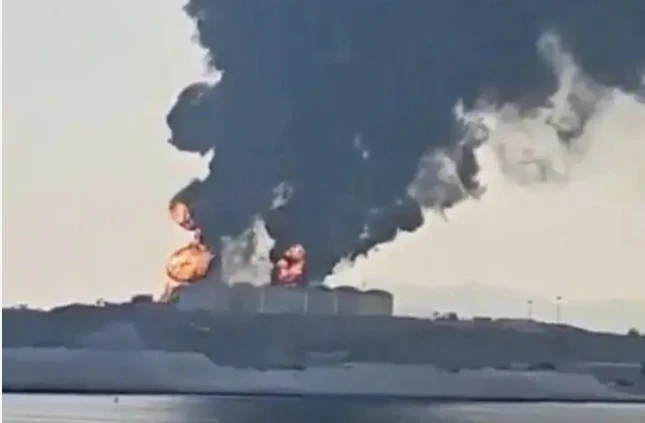
In recent hours, an attack occurred on fuel tanks in Bahrain, and on Wednesday, drones attacked tanks in the port city of Salalah in Oman. On the same day, Iranian forces attacked a cargo ship in the Strait of Hormuz, resulting in three sailors missing and 20 being rescued by the Omani coast guard.
This incident occurred shortly after Trump's warnings about the threat of attacks on ships in the strait.
Iranian authorities stated that they attacked a Thai vessel because it did not comply with their orders. They emphasized that all ships must request permission to pass through the strait and warned that the U.S. and its allies would not be able to pass through this strategically important waterway, which carries 20% of the world's oil supplies.
Overview of events:
- U.S. President Donald Trump stated that American military forces have "twice overthrown" Iran's leadership and destroyed its navy, without going into details.
- Masoud Pezeshkian, President of Iran, confirmed Tehran's commitment to peace in the region but emphasized that the war can only end with the recognition of its "legitimate rights."
- A representative of the Islamic Revolutionary Guard Corps (IRGC) stated that attacks on American military bases in the region will continue.
- The UN Security Council adopted a resolution proposed by the Gulf Cooperation Council, demanding an end to Iran's attacks on countries in the region.
- Israel continues to conduct airstrikes on Beirut and other regions of Lebanon, leading to the forced displacement of more than 800,000 people.
- Kuwait, Qatar, and Saudi Arabia report intercepting incoming missiles.
- The International Energy Agency (IEA) released strategic oil reserves in response to a sharp rise in energy prices.
Despite the release of strategic reserves, oil prices continue to rise.
Brent crude oil futures, which are the international benchmark, have risen nearly 20%, as plans to release 400 million barrels have not compensated for concerns about prolonged disruptions in shipping in the Strait of Hormuz.
As of 14:00 GMT, the price of Brent crude reached $101 per barrel, which is 38% higher than the level before the war began.
Iraq has suspended operations at the oil port following attacks on tankers.
Farhan al-Fartusi, head of the Iraqi General Company for Ports, reported that all operations at the oil terminals have been suspended; however, commercial ports continue to operate as usual.
This decision was made after attacks on two oil tankers that were loading in the Umm Qasr port in Basra province.
Four arrested in Bahrain on suspicion of espionage for Iran.
The Bahraini Ministry of Interior reported the arrest of four citizens for espionage activities in collaboration with the IRGC, including photographing important sites.
The ages of the detainees range from 22 to 36 years, while a fifth person, aged 25, is abroad, according to the official statement.
According to the ministry, the first arrested individual used high-quality photographic equipment to shoot and record the coordinates of key sites in Bahrain at the direction of the organization and with the assistance of others.
“This information was transmitted to the IRGC using encrypted software,” the ministry added.
According to Al Jazeera Arabic, three people were killed and four injured as a result of an airstrike on a military camp belonging to the Popular Mobilization Forces (PMF) in Al-Qaim.
The pro-Iranian "Popular Mobilization Forces," also known as "Hashd al-Shaabi," comprise predominantly Shiite armed groups, many of which emerged during the resistance to the American occupation of Iraq.
The death toll from Israeli attacks on Beirut has increased.
The Lebanese Ministry of Health reported that the number of fatalities from the Israeli airstrike on Ramlet al-Baida has risen to eight, with another 31 people injured.
Trump describes "rosy prospects" for the war and urges oil companies to send ships through the Strait of Hormuz.
John Holman
Reporting from Washington, USA.
Trump continues to insist that the war is nearly over and that the U.S. is close to complete success. Upon arriving in Washington, he addressed the press, claiming that the U.S. is destroying the Iranian navy and promising to "keep a close watch on the Strait of Hormuz."
He also urged oil company executives to send their tankers through the strait; however, these businessmen may be concerned about recent attacks on three vessels near the strait and attacks on two tankers carrying Iraqi oil. Trump assured that all mines in the Strait of Hormuz have been neutralized, but military experts will note that mines are not the only way Iran can threaten maritime transport.
They mention submarines and small explosive boats, which are known to have been used in recent attacks in Iraq.
Thus, Trump paints an optimistic picture of the war, implying that Iran is close to defeat, while analysts believe that Tehran is more likely to dig in than capitulate.
Trump also stated that, in his opinion, the U.S. could disable Iran's power grid in an hour, but added, "We don't want to do that." It remains a question whether this is a real threat or just empty words. We will continue to monitor developments.
The U.S. President spoke to reporters in Maryland, discussing the war in Iran.
Here are his words:
- “We have great news from the front. They are being completely destroyed. Iran is being completely wiped out.”
- “They [Iran] are practically on the brink. That doesn’t mean we are going to end it immediately. But it is so. They have no navy, air force, air defense, nothing. We are moving freely across their territory.”
- “Now we are keeping a close eye on the situation in the strait. It is in excellent condition.”
- “Our goal is to win. Quickly, but to win… Many say that victory has already been achieved. The question is just when we will stop? We don’t want it to come back.”
- “We can attack specific areas of Tehran and other places, but if we do that, they won’t be able to rebuild their country. And we don’t want that. But we can disable their power grids; we can destroy their energy system in an hour, and it will take them 25 years to recover. So ideally, we won’t do that.”
According to information from Al Jazeera, Iraq is becoming a secondary battleground in a broader regional conflict between Israel, the U.S., and Iran.
The two attacked tankers were loaded with crude oil and had come from the Umm Qasr port in southern Iraq. Shortly after leaving the port, they were attacked in Iraqi territorial waters.
Iraqi officials claim that the attack was carried out by an Iranian vessel, reminiscent of earlier threats from Iran to attack oil vessels attempting to cross the Strait of Hormuz.
So far, 38 crew members have been rescued, and one person has died. However, there is no information on the number of missing persons from both vessels.
Iraqi authorities indicate that these attacks are seriously affecting the country's economy.
Since the beginning of the conflict, oil production has sharply declined: from 3.3 million barrels per day to less than one million. More than 90% of Iraq's budget is formed from oil revenues, making these attacks particularly devastating for the economy.
Iran-linked hackers attacked medical company Stryker in response to a cyberattack.
Global networks of Stryker, one of the largest medical equipment manufacturers, were subjected to a major cyberattack. Responsibility for the attack was claimed by a hacker group with Iranian ties, which stated that this "marks the beginning of a new chapter in cyber warfare."
Handala, a hacker with documented connections to Tehran, reported that the attack was in response to the killing of more than 170 people, most of whom were schoolgirls, as a result of a strike on a school in Iran's Minab on the first day of the U.S.-Israeli war.
The hacker group claimed to have seized 50 terabytes of Stryker data, which they asserted "is now in the hands of free people around the world."
More information can be found here.
Event updates
- Two foreign oil tankers were attacked in the Iraqi port of Al-Faw, just hours after a strike on a Thai vessel in the Strait of Hormuz, as well as after drone attacks on fuel tanks in the port of Salalah in Oman.
- Iran and Hezbollah have begun joint attacks on Israel, while Israeli military forces continue large-scale operations against the Lebanese capital, Beirut.
- U.S. President Donald Trump promised to protect oil tankers in the Strait of Hormuz, while Iran warns of a possible rise in oil prices to $200 per barrel.
- The UN Security Council adopted a resolution condemning Iran's attacks on Gulf countries and Jordan.
- Iranian President Masoud Pezeshkian has set three conditions for ending the war: recognition of Tehran's legitimate rights, compensation for damages, and the provision of reliable international guarantees to prevent future aggression.
- The International Energy Agency (IEA) agreed to release historically significant volumes of emergency oil reserves, allocating 400 million barrels.
The article "The Iranian war continues: Oil tankers attacked in Iraq, Tehran sets 3 conditions for peace" was first published on K-News.