
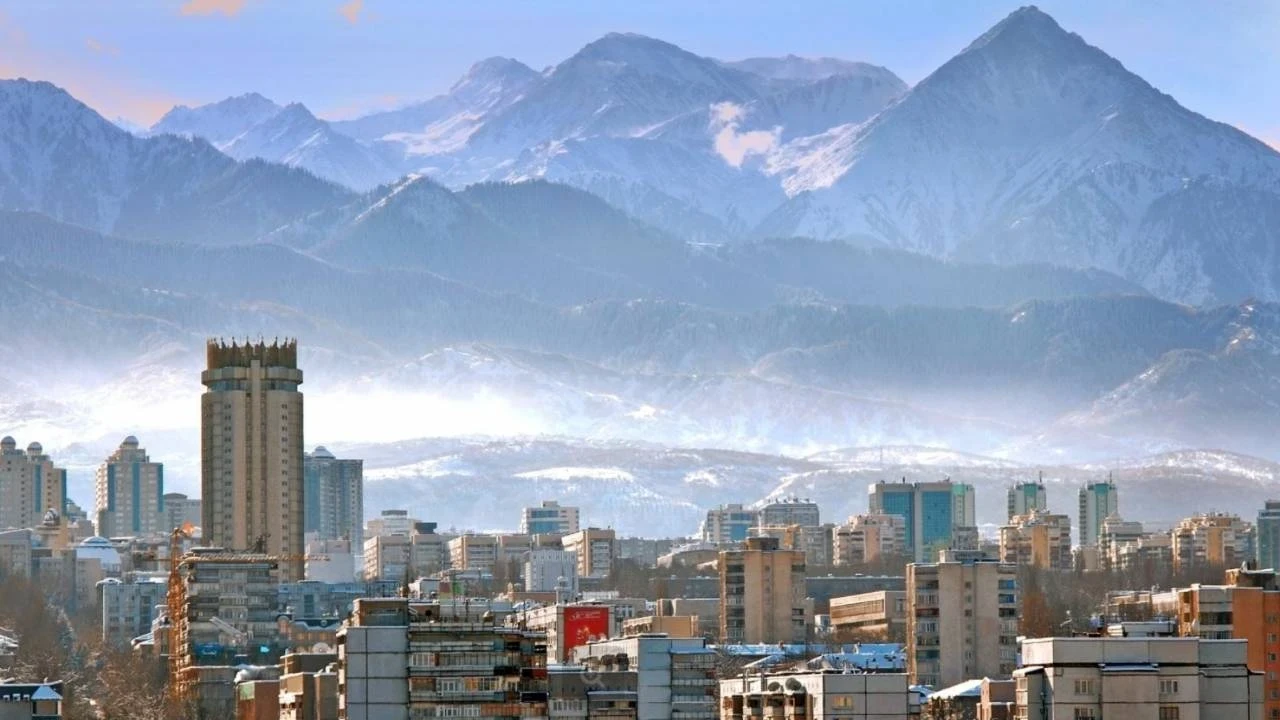
President of Kazakhstan Kassym-Jomart Tokayev emphasized that Almaty should become a place that will "always surprise," following the example of New York, Moscow, and Paris. He also noted that eco-activists are hindering the development of mountain tourism. In response, Zhamilya Zhaksalieva, an international water resources specialist, joined the discussion:
Before discussing "sleepless" cities, experienced development companies, or eco-activists hindering development, we should first pay attention to more important and fundamental issues — ecology.
The mountains are not just beautiful landscapes. They are complex ecosystems that perform many functions: forests stabilize slopes, regulate runoff and snowmelt, purify water, and shape the microclimate, bearing loads for many years before the consequences become visible.
As a forester and natural resource management specialist, as well as the first professional female golfer from Kazakhstan, I know what I’m talking about. I have spent a lot of time between elite urban conditions and real working landscapes.
When the mountain ecosystems are destroyed, tourism does not just suffer. It disappears.
Metropolises also continue to surprise — mainly with traffic jams, noise, and pollution. I have lived in all three cities and can say that, although they are impressive, more and more people are trying to leave them.
From an ecological standpoint, it is not entirely clear why Almaty, embedded in a mountain ecosystem, should copy the negative traits of metropolises that are themselves trying to get rid of them.
The appeal of Almaty has always been not in its size or spectacle, but in nature and the rhythm of people's lives. If we make the city a noisy and fast-paced analogue of foreign places, we risk losing what brings people here and what makes life here valuable.
Tokayev also mentioned that neighboring countries are actively building ski infrastructure, claiming that the intensity of construction is proof of its feasibility. However, in these countries, with the same "intensity," local fisheries have been destroyed, and river dolphins have almost completely disappeared. This is not the best example to follow in the context of the Caspian Sea.
Tourists do not need another Paris or Geneva. They need Almaty.
If we are looking for examples abroad, we should do so honestly. My experience working in the USA, where I was a natural resources technician and managed livestock grazing in the Bridger-Teton National Forest, shows how the landscape can support one of the most exclusive ski resorts in the world — Jackson Hole.
What U.S. Ski Towns Teach Us
Famous American ski resorts did not arise by chance. They developed under constraints and show what happens when success meets ecological and social limits.
Jackson Hole is a vivid example. The modern identity of this region is inextricably linked to nature conservation. John D. Rockefeller Jr. halted private development through a land acquisition program and included key areas in a protected landscape. First came conservation, then strict limits on development. This scarcity made Teton County the richest county in the USA.
But Jackson also demonstrates the price of success. The housing issue has become a serious problem: housing for workers is in short supply, and many are forced to commute from afar, creating a labor shortage. Infrastructure is overloaded, and resources such as water become contentious. The experience of Jackson Hole shows that nature conservation buys time but does not guarantee infinity. When demand exceeds the capabilities of the ecosystem, the limits become evident even in protected areas.
South of Jackson, in Pinedale, a different model has been developed. After several years of uncertainty, the White Pine ski resort was purchased by billionaire Joe Ricketts, owner of the Chicago Cubs. This raised concerns that White Pine would be turned into a Jackson Hole clone; however, locals successfully resisted this, defending their identity and quality of life. Here, silence, working with landscapes, and proximity to untouched nature are valued, and Jackson Hole is seen not as an ideal but as a warning.
Protecting this way of life, rather than rejecting development, led to early restrictions that allowed White Pine to remain an accessible resort with local prices, preserving working landscapes.
Other well-known American resorts, such as Park City (Utah) and Aspen (Colorado), developed along a different scheme. These places were once mining towns, and ski tourism came as a form of repurposing already disturbed areas. This lowered ecological barriers but did not eliminate the need for regulation. Over time, both cities integrated into strict land-use and resource control systems that define acceptable growth scales.
Vail (Colorado) has developed from the outset in a formalized environment. Its existence became possible due to the Multiple Use–Sustained Yield Act of 1960, which allowed the creation of resorts on U.S. Forest Service lands under constant oversight. Every expansion requires an environmental review and watershed protection, considering not only tourism interests but also wildlife.
Examples such as Big Sky (Montana) and Deer Valley (Utah) illustrate pre-planned growth. Their relative sustainability is explained by early decisions on ownership and access made before the sharp increase in demand.
The conclusion is simple: the admired American ski towns developed not because of the speed of construction but due to pre-established limits aimed at protecting nature.
It's Convenient to Blame Eco-Activists
It should be acknowledged: eco-activism can sometimes be chaotic and politicized, but blaming it for the weak results of the tourism industry is not entirely fair. Tourism, like many other sectors, suffers not from uncomfortable questions but from their identification when a lack of basic calculations becomes apparent.
Reclamation. Erosion control. Long-term ecological monitoring.
Watershed protection. These aspects are not slogans of activists but a boring yet crucial foundation of mountain tourism. However, if you look at the website Shymbulak.com, it is difficult to find a serious discussion of even one of these points. The mountains there are perceived as decoration rather than as a system requiring constant maintenance. And water is the point where abstractions end.
We have already polluted the air. Now what — are we going to pollute the water too?
Mountain forests are the most effective water filters we have. Few know that New York, despite its density, drinks one of the cleanest municipal waters in the world without classical filtration, as the city invested in the protection of mountain watersheds.
In Utah, the mountains surrounding Park City and Deer Valley are viewed not only as recreational areas but also as water infrastructure for Salt Lake City. Therefore, any development there undergoes strict scrutiny: everything that happens at the peaks ultimately ends up in the tap below.
This is not an ecological ideology. This is infrastructure policy.
Thus, perhaps the real reason for problems in the tourism sector is not eco-activists at all, but that we do not fully understand for whom and why we are building, trying to copy foreign models instead of valuing our own land.
If we treated the land as our ancestors did — as something to be preserved rather than exploited — we would sound closer to those very activists. We would speak less about large resorts at the borders of one of the most polluted cities in the region and more about the pollution itself, understanding that secluded mountain villas located close to the Zhailau golf club or the La Barca terrace are not a tourism development strategy.
For Kazakhstan to truly develop ecotourism, it needs a healthy ecology. Not slogans, not speed, and not comparisons with other countries that are already paying for their mistakes.
Ecological systems do not care how spectacular a project appears. They care only about one thing — whether they will be able to function after its implementation. If we get this wrong, no CNN Travel article will help.
Source here.


