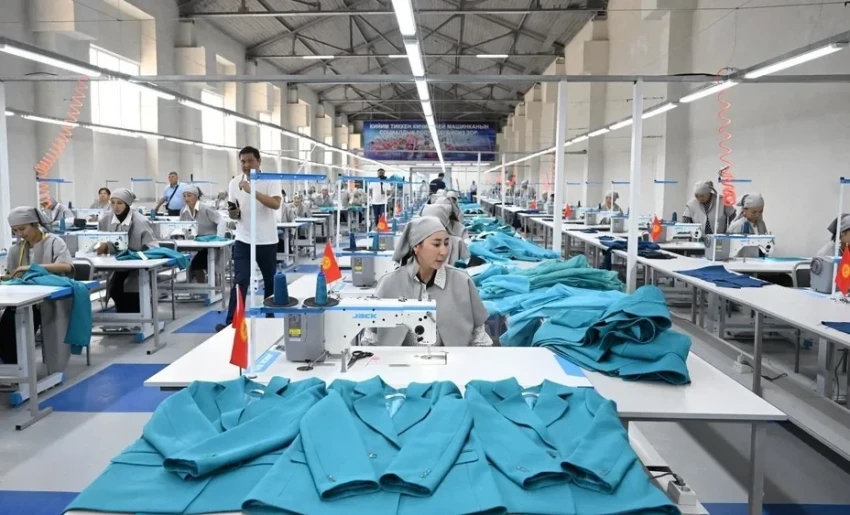
Russia has tightened its control. The Ministry of Economy explained why Kyrgyz sewing products are facing barriers when imported into Russia. The main reason for these changes has been the new control measures introduced by Russian authorities, leading to delays in the movement of goods, including products from Kyrgyzstan, at certain sections of the border, particularly at the Kazakhstan-Russia border.
Government Response: Actions of the Cabinet of Ministers and the Ministry of Economy
In light of the difficulties that have arisen, a meeting was held at the Ministry of Economy and Commerce of the Kyrgyz Republic under the leadership of the First Deputy Chairman of the Cabinet of Ministers Daniyar Amangeldiev, with the participation of representatives from government agencies and participants in the sewing industry. The main focus was on the issues related to the import of Kyrgyz products into Russia, as well as possible support measures for producers.
As a result of the discussions, the Ministry of Economy and Commerce was tasked with developing initiatives aimed at enhancing the competitiveness of the sewing industry, including issues of inter-agency cooperation, infrastructure development, training, and compliance with quality standards.
Negotiations with Russia and the Situation at the Border
On December 18, 2025, the Chairman of the Cabinet of Ministers Adylbek Kasymaliev commented on the situation, noting that the intensified inspections by Russia affected goods from several EAEU countries, including Kyrgyzstan. To study the situation on the ground, a delegation from the Ministry of Economy was sent, and a coordination headquarters was established.
The head of the Cabinet reported on ways to resolve the problem of cargo delays at the border with Russia. According to the head of the Cabinet, an active dialogue is being conducted with the Russian side. In particular, an agreement was reached to inspect goods from Kyrgyzstan by a single operator, which significantly expedited the cargo processing. The government estimates that there are no obstacles for sewing products supplied directly.
However, questions remain regarding goods sold through marketplaces Ozon and Wildberries, particularly concerning VAT administration. The Cabinet noted that the issue with Ozon has been resolved, while the matter with Wildberries is nearing completion, considering the readiness of the marketplaces to act as tax agents.
Organization of Explanatory Activities and Export Requirements
To adapt enterprises to new requirements, the Ministry of Economy and Commerce, together with industry associations, organized a practical seminar for representatives of the sewing industry. Participants were informed about taxation, accounting, electronic document management (ESF and ETTN), as well as certification and labeling requirements.
Enterprises in the sewing industry were informed about taxation, certification, and labeling issues. Special attention was paid to the technical regulation of the EAEU 017/2011 and the labeling system "Honest Sign," compliance with which is a necessary condition for unhindered access of products to the markets of EAEU countries and working with marketplaces.
Presidential Decree
On December 6, 2025, President Sadyr Japarov signed a Decree "On Measures to Support Certain Sectors of the Economy," which includes a number of initiatives to support the sewing industry.
In particular, the Cabinet of Ministers was instructed to submit draft laws to the Jogorku Kenesh within the established timeframe, which provide for:
- review and reduction of insurance contribution rates for entities in the sewing industry;
- reduction of insurance contribution rates for small and medium-sized businesses, including sewing production enterprises;
- establishment of a unified tax rate of 0.1% for activities conducted outside the territory of the Kyrgyz Republic, which is relevant for export-oriented sewing enterprises;
- establishment of a transaction tax of 0.1% for transactions conducted through banks of foreign states, which affects settlements for foreign economic activities.
The decree aims to reduce the fiscal burden, support exports, and create more favorable conditions for the operation of sewing enterprises.
Thus, in December 2025, the State Tax Service reported on the preparation of a draft law concerning the unification of taxation and insurance contribution conditions for sewing companies. It is proposed to introduce unified insurance payments and reduce income tax for workers in this sector.
Discussion in the Jogorku Kenesh and Current State of Affairs
On January 16, 2026, issues concerning the state of the sewing industry were discussed at a meeting of the "Ala-Too" parliamentary group with the participation of businessmen and representatives of government agencies. Topics such as the decrease in production volumes, the closure of several sewing workshops, dependence on raw material imports, and the lack of logistics and laboratory infrastructure were discussed.
Economy Minister Bakyt Sydykov reported that as of the end of 2024, 36,600 people were officially employed in this sector; however, considering related fields, the total number of employed is significantly higher. He also announced the launch of a preferential lending program for small and medium-sized businesses with an interest rate of 6% per annum for a term of up to 60 months.
In addition, it was confirmed that a trade and logistics center is planned to be built by 2028 in cooperation with the Wildberries marketplace, which should simplify logistics and export operations.
The events that occurred from autumn 2025 to early 2026 demonstrated the dependence of Kyrgyzstan's sewing industry on external markets and regulatory conditions within the EAEU. In response to the challenges, government agencies began negotiations with partners, conducted explanatory activities, and developed support measures. However, industry representatives continue to emphasize the need for systemic solutions, including infrastructure development, market diversification, and further improvement of business conditions.
Volume of Sewing Production
Regarding statistics, from January to November 2025, sewing enterprises in Kyrgyzstan produced clothing worth 18.7 billion soms, which is an increase compared to the same period in 2024 (15.3 billion soms). The physical volume index for the 11 months amounted to 115.8%, indicating an increase in production output in real terms.