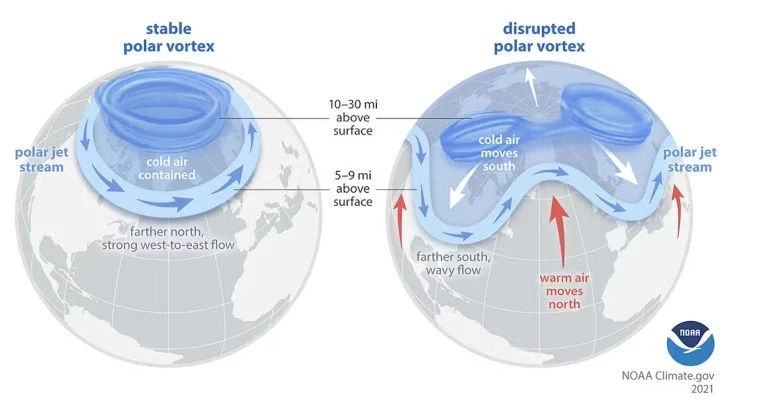
In mid-February 2026, a sudden stratospheric warming is expected, which may cause a collapse of the polar vortex and lead to the influx of Arctic air into North America and Europe.
According to the World Meteorological Organization, since 1950 there has been a decrease in the frequency and intensity of extreme cold events globally, while average winter temperatures continue to rise. However, despite long-term climate trends, this does not rule out the possibility of extreme weather conditions or localized cold waves.
A malfunctioning polar vortex, which has become more wavy, has initiated mass invasions of cold air into the mid-latitudes, causing sharp cooling in North America, Europe, and Asia, and contributing to the formation of destructive winter storms in January.
The polar vortex is a powerful flow of cold air and strong winds that typically surrounds the North Pole. When the vortex weakens, Arctic cold moves southward, while warmer air penetrates into the Arctic.
Some meteorological models suggest that the sudden stratospheric warming over the Arctic in early February may lead to a significant weakening of the polar vortex, creating dangerous conditions for the invasion of Arctic air into North America and Northern Europe by the end of February.