
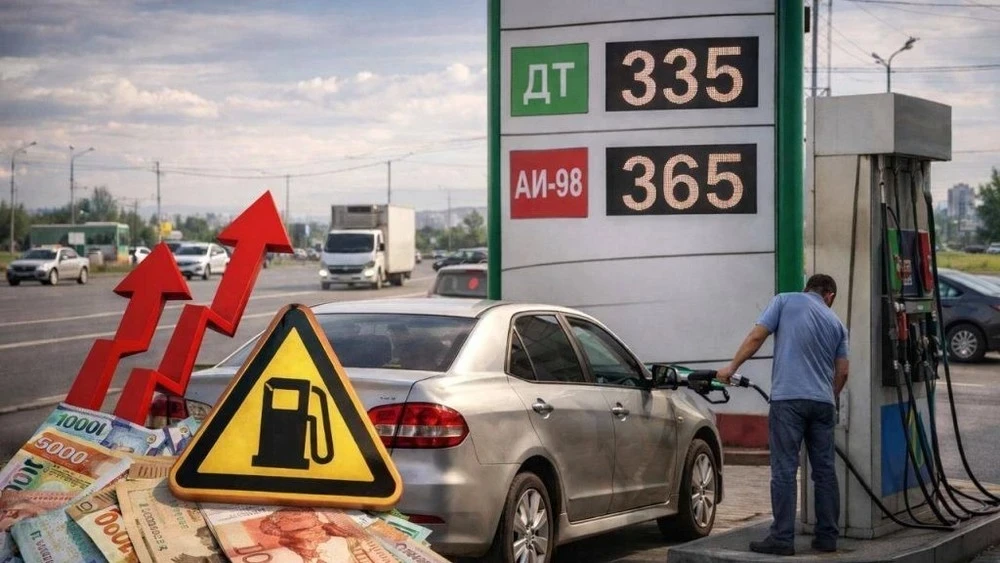
As of today, fuel prices remain at the same level; however, forecasts of a possible increase are alarming many drivers. In her analysis, Zhaniya Sandybai notes that a temporary moratorium on price increases for AI-92 and diesel has been introduced since October 2025, which will last until spring 2026. It is important to note that the average price for AI-92 is about 239 tenge per liter, while diesel fuel costs 335 tenge per liter. At the same time, the cost of premium gasoline brands continues to rise: as of January 19, 2026, the price of AI-95 has increased from 298 to 315 tenge, and AI-98 has risen from 325 to 365 tenge per liter. This means that the margin on AI-95 partially compensates for losses from AI-92 prices.
It should be noted that this moratorium is viewed as an anti-inflationary measure rather than a result of market mechanisms. After its expiration, it can be expected that the market will begin to "catch up" with prices, which may lead to a sharp rather than gradual increase in prices.
Furthermore, fixed low prices hinder the modernization of existing oil refineries (ORFs) and cast doubt on the necessity of constructing a new, fourth ORF, which has been discussed for several years. Even with full loading of the three main ORFs (PNHZ, PKOP, and ANPZ), Kazakhstan sometimes faces shortages of gasoline and diesel during peak seasons, such as planting and harvesting. Without attracting private capital and adequate processing tariffs, the country risks finding itself in a situation of "shortage despite having its own oil." Price increases are also necessary to enhance the depth of processing and improve fuel quality in accordance with European standards, which will help reduce dependence on the import of certain components.
It is also important to consider that in 2027, within the framework of the Eurasian Economic Union (EAEU), the creation of a common energy resource market is planned, which will require Kazakhstan to align its prices with those of Russia and other neighboring countries. Thus, the state's task is not to keep prices at any cost but to manage the transition to a market model, avoiding a repetition of the fuel crises observed in the past.
Based on all these factors, I expect that in 2026, fuel prices will rise. My forecast is as follows: the price of AI-92 may increase to 270–330 tenge per liter due to the prolonged "freeze," AI-95 to 340-400 tenge, and AI-98 to 380-450 tenge.
I recommend that businesses account for a 15–20% increase in fuel prices above the official inflation rate in their financial models. Therefore, if inflation is around 10%, the projected increase should be set at 25-30%.


