
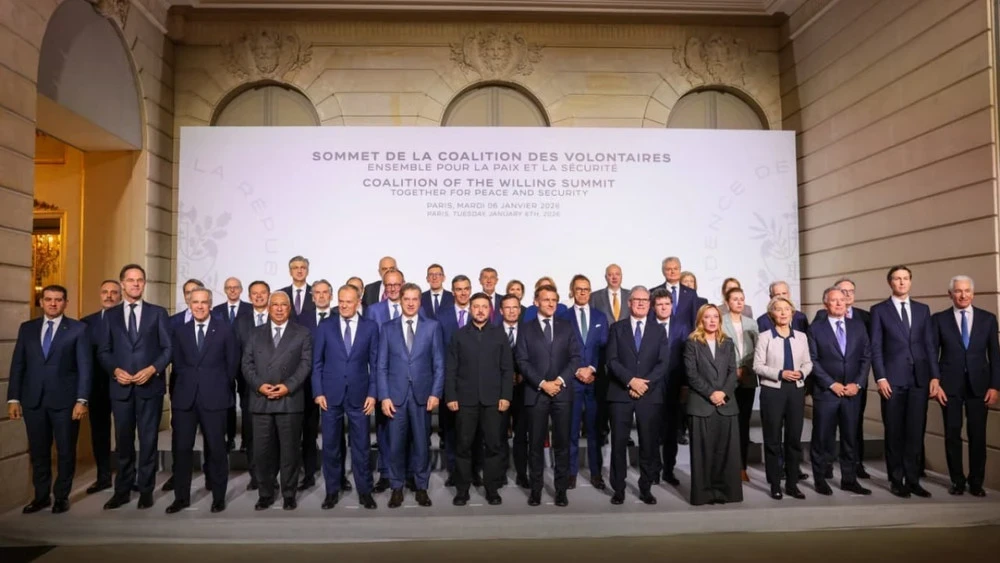
France and the United Kingdom have confirmed their intention to send troops to Ukraine to ensure peace after a possible end to the conflict with Russia, as reported by the BBC.
At the "coalition of the willing" summit held in Paris, Presidents Emmanuel Macron (France) and Volodymyr Zelensky (Ukraine), as well as UK Prime Minister Keir Starmer, signed an agreement on the deployment of a peacekeeping contingent.
Additionally, summit participants, including special representatives of US President Steve Witkoff and Jared Kushner, signed the "Paris Declaration," which expresses the intention to provide Ukraine with security guarantees.
Representatives from approximately 30 countries attended the negotiations, including Polish Prime Minister Donald Tusk and European Commission President Ursula von der Leyen, as well as NATO Secretary General Mark Rutte.
This summit took place shortly after a meeting between US President Donald Trump and Volodymyr Zelensky at Trump's residence in Mar-a-Lago, Florida, where they discussed a plan to end hostilities in Ukraine.
After the meeting, it was reported that the parties agreed to provide Ukraine with security guarantees from the US. However, the main issue remained unresolved: Russia's demands for the withdrawal of Ukrainian troops from the Donetsk region.
Zelensky noted that the peace plan is 90% agreed upon, but he acknowledged that the biggest disagreements concern territorial issues.
The main outcome of the summit was the "Paris Declaration," the text of which has been published on the Élysée Palace website.
The declaration includes five key points:
- The US will take on the coordination of monitoring compliance with the ceasefire. A special commission will also be established to respond to violations and determine the guilty parties.
- Members of the "coalition of the willing" will continue to support the Armed Forces of Ukraine, which are to become the "first line" in preventing new aggression from Russia. This includes funding, arms supplies, and assistance in building defensive structures.
- The deployment of multinational forces to Ukraine is planned, which will help restore the army and assist in deterrence. These forces will begin their work only after the end of hostilities, with possible assistance from the US.
- There is a commitment to support Ukraine in the event of a future Russian attack to restore peace. The countries signing the declaration will agree on the terms of such commitments in the future, including the use of military capabilities and the imposition of additional sanctions.
- A commitment to develop long-term defense cooperation with Ukraine, including training, joint arms production, and intelligence cooperation.
A trilateral declaration was also signed between France, the United Kingdom, and Ukraine, in which Paris and London expressed their readiness to send their troops to Ukraine in the event of the war's end.
Keir Starmer explained that this document "justifies the actions of British, French, and partner forces on Ukrainian territory."
"These forces will ensure the security of Ukrainian skies and seas, as well as assist in the restoration of the Ukrainian armed forces," Starmer noted. "After the ceasefire, Britain and France will create 'military hubs' in Ukraine and build secure facilities for storing weapons and military equipment to support the country's defense."
Russian authorities have previously stated that they cannot agree to the presence of foreign troops in Ukraine, viewing it as a threat to their security.
Leaders' Comments at the Press Conference
At the final press conference, summit participants characterized the event as an important step toward peace.
The Presidents of Ukraine and France, the Prime Minister of the United Kingdom, and the Chancellor of Germany, as well as Trump's special representatives — Steve Witkoff and Jared Kushner — spoke to journalists.
Macron, who organized the summit, emphasized that the "coalition of the willing" led by the US must provide Ukraine with legally binding security guarantees. He added that such guarantees should eliminate the possibility of a new threat to Ukraine, reminding of previous violations by Russia of peace agreements with Georgia, Moldova, and Ukraine.
Zelensky noted that territorial issues remain the main obstacle to a ceasefire. He emphasized that Ukraine is ready to sign security guarantee agreements with the US, but some issues still require resolution. "The biggest difficulties concern territories," concluded the Ukrainian president.
Trump's special envoy, Steve Witkoff, reiterated that the US president is committed to establishing peace in Ukraine and that his task is "to be a mediator in the peace settlement process." "We believe we have completed most of the work on the security protocols so that Ukrainians know: when the conflict ends, it will end forever," Witkoff stated.


