
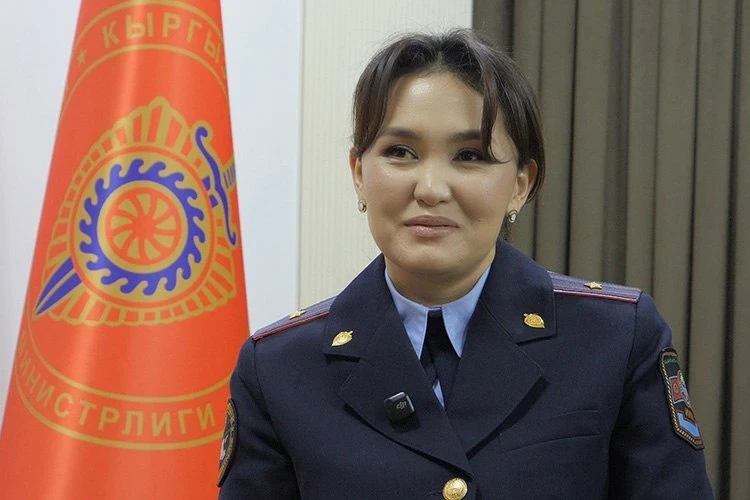
Journalists from 24.kg spoke with representatives of the Ministry of Internal Affairs of Kyrgyzstan. They shared their experiences, love for the profession, and discussed how modern technologies assist in solving crimes and finding missing persons.
Ensuring the safety of Bishkek
One of the key units is the situational center of the public safety service of the Bishkek City Police Department, which monitors order in the capital around the clock. The deputy head of the center, police lieutenant colonel Gulnara Sharshenalieva, noted that almost 90% of the staff are women.
Women are more attentive and patient, which allows them to notice even the smallest details. What might escape a man’s notice, they often see at first glance.
Gulnara Sharshenalieva
In Bishkek, there are about a thousand cameras in the "Safe City" system installed on streets, near schools, and kindergartens. These cameras not only help solve crimes but also prevent them, as well as quickly locate lost or runaway children.
The situational center is divided into two groups: monitoring and the 102 service. Monitoring staff keep an eye on events in the city and, if necessary, pass information to the 102 service, where it is recorded and sent to the nearest crew.
Every day, the 102 service receives more than 2000 calls, about 800 of which are related to offenses.
Modern technologies significantly simplify the coordination of patrol work, allowing real-time tracking of their movements using special heat maps.
Gulnara Sharshenalieva also noted that the implementation of digital systems contributes to an increase in the resolution of crimes. Staff can review camera footage, reconstruct the sequence of events, and identify violations more quickly.
Nurgul Isakova: choosing the police
Behind all the numbers and technologies are people who protect citizens every day, including children. Police major Nurgul Isakova, a mother of three, has been working in the field of juvenile rights protection for 17 years. She admits that the situational center significantly eases her work.In an interview, Nurgul talked about her journey into the police, how she balances service and motherhood, and what it’s like to return children to safe conditions.
— What inspired you to choose a profession in the police?
— I dreamed of working in law enforcement since childhood, and my family history influenced my choice: my grandfather was one of the first police officers in Kyrgyzstan. I decided to continue his legacy.
As a child, I played with boys, played "army," and instead of dolls, I read detective stories about Sherlock Holmes. I have always enjoyed solving mysteries and investigating crimes.
— Do you remember your grandfather?
— Unfortunately, no. But my mother often tells stories about his service and his fight against the Basmachis. His photographs are kept in the Ministry of Internal Affairs museum. One of the schools in the Kadamjai district is named after him.
— Do you think it is difficult for a woman to work in the police?
— Yes, it is not easy. We often have to prove our professional qualities. A strong character and stress resilience are needed. However, the work is difficult for everyone, and each of us bears the same responsibility. There is no division into "male" and "female" work here — we all perform one task.
— How do you balance work and family?
— It is difficult, but possible. The main thing is discipline. There are days when work is very exhausting, but at home, I try not to show my fatigue. When I come home from work, I switch to the role of wife and mother, not bringing work problems home.
Preventing offenses among children
— Tell us about your job responsibilities.— I supervise the work of juvenile inspection units in Bishkek, where 134 employees work. Our task is to coordinate their actions, provide methodological assistance, and monitor the implementation of laws in preventive work. We collect data and pass it on to the Ministry of Internal Affairs.
At the city level, we regularly meet with representatives of state and municipal authorities.
— How do your raids go?
— We usually conduct them several times a month. Our main goal is to ensure the safety of children, especially at night. We warn parents that children should not be on the streets without adults.
During the month of Orozo, children often sing Jaramazan, but unfortunately, sometimes this turns into begging. Children go out onto the road, and we talk to parents, and in case of repeated violations, we apply fines.
— Is it easier for children to communicate with female officers?
— Yes, there are more women in our department, and children feel more comfortable opening up to them. They see them as mother figures and find it easier to make contact.
— What are you proud of in your work?
— That our work protects children. We identify minors in difficult situations and try to prevent crimes.
The main goal of juvenile inspection units is to prevent a child from going down the wrong path.
Unfortunately, sometimes we have to take children from families where they are subjected to violence. Often, this is the reason for their running away.
Photo 24.kg. Police Major Nurgul Isakova
— Where do children who run away from home go?
— They are temporarily placed in special children's centers, where psychologists and social educators work. We also stay in contact with parents and relatives.
The main goal is to return the child to the family because that is where they should grow up. The commission for juvenile affairs usually provides three to six months for preventive work with the family.
— What qualities are necessary for a female leader in such an institution?
— She must be fair, principled, and moderately strict.
— How does your typical day go?
— In the morning, I take my children to school, and then I go to work. After service, I prepare dinner and discuss with my children how their day went, helping them with their homework.
— How do you manage to combine all this?
— Honestly, sometimes I don’t manage (laughs). It can be tough. But when you enjoy your work, you try to find a balance between roles.
Fate in service
— After 17 years of service, have you learned to control your emotions?— I try not to show my worries, but internally I process a lot. I have children, so I constantly think about what it’s like for a child to be alone on the street without adult support.
— Is there a story that particularly stuck with you?
— Yes, this happened at the beginning of my service when I had just graduated from the academy. In one of the schools, there were complaints about a third-grader who constantly ran away from home.
The boy's mother was in prison, and he was raised by his grandmother, sister, and brother. He often stole money and did not listen, and his grandmother sometimes abused alcohol.
We even temporarily took the boy from his family because he categorically did not want to return. I tried to support him, took him to clubs, and it turned out that he liked chess, so I enrolled him in a section.
Later, the boy was placed in a foster family, and he was lucky — the family turned out to be wonderful. A few years later, I met him again and did not recognize him — he had become a tall, well-mannered young man who studies well. He reconciled with his biological family and maintains contact with them.
— Do you keep in touch with the children you worked with?
— Sometimes. This boy even came to visit me and stayed overnight when he was afraid to go home.
— Do modern technologies help in finding children?
— Very much. The "Safe City" system operates in Bishkek, which allows tracking children's movements. Cameras are installed near schools and on many streets in the city.
The system recognizes faces, which significantly speeds up the search process.
If earlier the search could take days, now a child can be found within one to two hours.
— Where do children most often go?
— It varies: some go to relatives, some hang out in parks or shopping centers. Over time, staff develop a sort of professional intuition that helps them determine where to look for a child more quickly.
— At what age do children most often run away from home?
— Previously, this mainly happened at ages 15-16. Now, unfortunately, the age has decreased, and sometimes children run away at 10 years old.
— Is female intuition used in your work?
— Often. When communicating with children, you can sometimes notice that they are withholding something or even lying. You intuitively feel where the truth is and where it is not.
Tulips and International Women's Day
— What is most important to you in raising children?— Love, care, trust, and discipline.
— What is the secret of your energy?
— Inner discipline. I try to find time for sports — it helps a lot. I participate in training sessions and constantly improve my qualifications.
— How do you switch off after work?
— I used to struggle with this and brought work worries home. I realized that this negatively affects the family. Now I try not to discuss work at home, although sometimes calls still come in.
— How do you perceive the holiday of March 8?
— For me, it is a holiday of spring. In childhood, my dad always gave my mom a bucket of tulips, so these flowers are associated with March 8 for me.
On this wonderful spring day, I want to wish all women happiness, peace, self-love, and the achievement of all their goals!


