
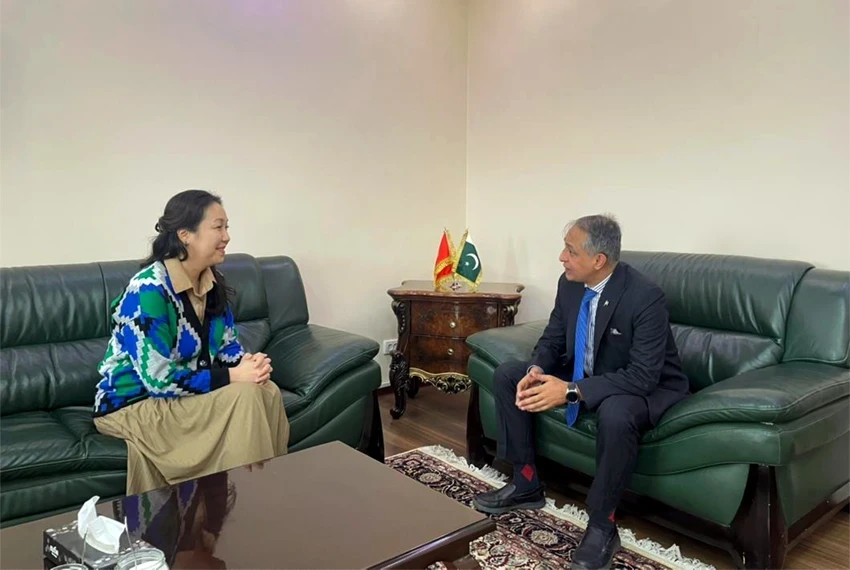
— What is the current number of Pakistani citizens in Kyrgyzstan?
— According to our information, it is about 12,000 people. However, to be honest, I prefer the data from the Kyrgyz Republic, as government agencies track the number of Pakistanis crossing the border more accurately. The difference in numbers is about three thousand, and in total, we are talking about approximately 15,000 Pakistani citizens.
Of these, approximately 10,000 are students, most of whom study in medical universities. About 5,000 belong to other categories, of which around 4,000 are workers. There are also businessmen and investors, although there are still few large investors.
— You mentioned investments. What is the volume of Pakistani investments in the economy of Kyrgyzstan?
— Overall, Pakistani investments can be estimated in the range of $200–300 million. Most investors are small companies with projects worth up to $10 million.
It is worth noting that recently, a large investor from Pakistan launched a project to build a petroleum processing plant in southern Kyrgyzstan with a total budget of about $400 million. Work has already started, and engineers from Pakistan have arrived at the site. It is expected that the construction of such a large-scale plant will take about two years, and it may start operating by 2029.
— In recent years, there has been a significant influx of Pakistani citizens into Kyrgyzstan. How do you explain this?
— I believe this is related to the rapid economic growth of Kyrgyzstan. The increase in GDP indicates the presence of jobs, businesses, and investments.
Moreover, many Kyrgyz citizens go to work in Russia or Kazakhstan, where wages are higher, leading to a labor shortage in the country and the need to attract workers from other countries.
— So, foreign workers are willing to work for lower wages than locals?
— Yes, exactly. If Kyrgyz citizens agreed to a salary of $300, entrepreneurs would prefer them. But many want to earn around $1,000, which is more common in Russia.
Pakistanis are willing to work for $500, which allows them to fill this niche and compensate for the labor shortage.
— In which sectors are they most often employed? Construction and the garment industry?
— Yes, about 95 percent of Pakistanis work in these sectors. Local entrepreneurs often note that Pakistanis are excellent workers.
They can work nine hours a day and do not require extra pay for additional hours. The garment industry is a true art. I don’t know if it’s related to genetics, but Pakistanis are great at sewing. It requires skills in cutting, a sense of form, and an understanding of fabrics.
There is also a growing need for wood specialists for furniture and carpentry production. Kyrgyz entrepreneurs have requested to consider attracting 100 workers from Pakistan, and I have sent the appropriate request.
— Why do students from Pakistan choose medical universities in Kyrgyzstan?
— The reason is the accessibility and cost of education. Studying in private medical universities in Pakistan is three times more expensive than in Kyrgyzstan, and admission is quite difficult due to high competition and exams.
In state universities, tuition costs about $100 per month, but only 30–40 percent of applicants pass. In private universities, the cost of education reaches $20–22 thousand per year.
In Kyrgyzstan, there are universities with an annual fee of about $7 thousand, and some offer education for just $1,500. On average, the cost is about $5 thousand, which is three to four times lower.
— How do you assess the contribution of Pakistani citizens to the economy of Kyrgyzstan?
— I do not consider this exclusively from an economic perspective. As an ambassador, for me, human connections, mutual understanding, and culture are more important.
If 10,000 students pay an average of $6 thousand a year, that’s about $60 million coming into Kyrgyzstan. If 3–4 thousand workers earn an average of $300–400 a month, then considering expenses, it’s about $25 million that goes to Pakistan. The difference is approximately $30 million.
However, these are not the sums that are crucial for states. Much more important is that 15,000 Pakistanis live here and can show Kyrgyz brothers and sisters what kind of people we really are, what our traditions are, and how we celebrate holidays.
This is a living cultural exchange. Today there are some people here, and tomorrow there will be others. Friends, connections, and families emerge. I know that some Pakistanis have already married in Kyrgyzstan.
— Is there any statistics on such marriages?
— There is no exact statistics, but I know of about 12–13 cases. They already have children, and they have settled here.
Some of them have started working at the universities where they studied, as teachers or in administrative positions. There are also doctors, about 30–40 people, who stayed after their studies. But most, of course, return home.
— Is further growth in the number of arrivals expected?
— This depends on whether the economic growth of Kyrgyzstan will continue. Major construction projects are planned in the near future, and if they are implemented, the demand for labor will increase. The same applies to the textile industry. As the economy grows, the demand for foreign workers grows.
— How are relations between Pakistanis and the local population? Are there any complaints?
— There are practically none. At a recent meeting with the Deputy Minister of Internal Affairs, I specifically asked this question. He said: “Mr. Ambassador, we have not received a single complaint from Kyrgyz citizens about Pakistanis.”
All complaints, if they arise, relate only to the Pakistani community itself. Yes, there was an incident in May 2024 between students, but it later turned out that Pakistanis were not involved. Now they live peacefully. In the two months I have been in Bishkek, I have not heard of any problems between Pakistanis and Kyrgyz.
— How difficult is it for Kyrgyz citizens to obtain a visa to Pakistan?
— We try to process visas within 2–3 hours. We have a simple online system: it’s enough to fill out a form, and there is no need to come in person.
If there are questions or discrepancies in the documents, we will invite for an interview. In 95 percent of cases, everything goes smoothly.
For Pakistanis, however, obtaining a visa to Kyrgyzstan takes at least five days.
— Have there been complaints from entrepreneurs that Pakistanis leave work without warning?
— I have not encountered such cases. I have heard that some entrepreneurs hold the passports of foreign workers. I want to emphasize: this is illegal.
If the working conditions are good, a Pakistani will not leave their job. We rarely receive inquiries about lost passports.
— What is the trade turnover between Pakistan and Kyrgyzstan?
— According to Pakistan, it is about $5 million a year. According to Kyrgyzstan, it is approximately $15 million. I tend to trust the figures from Kyrgyzstan more.
The situation is complicated by the fact that some goods are formally registered as exports to Afghanistan due to zero tariffs, and then enter Central Asian countries. In the documents, this looks different from reality.
But even $15 million is not an amount to be proud of.
— What goods are currently exported to Kyrgyzstan and from Kyrgyzstan to Pakistan?
— According to Kyrgyz data, of these $15 million in trade turnover, $13 million is exports from Pakistan to Kyrgyzstan, and only $2 million is exports from Kyrgyzstan to Pakistan.
From Pakistan, fruits, textile products, pharmaceuticals, and medical products are typically supplied. Certain surgical kits have also started to arrive.
From Kyrgyzstan, mainly animal skins are exported.
— After President Sadyr Japarov's visit to Pakistan, the parties announced their intention to increase trade turnover to $200 million. Is this realistic?
— For over 20 years, no head of state from Kyrgyzstan has visited Pakistan. In this context, President Sadyr Japarov's visit on December 3–4 last year was unique. As they say, better late than never to start cooperation. We are glad that such a visit took place. Our leaders agreed on the goal of increasing trade turnover to more than $200 million within two years.
Some may consider this a dream, but I assure you that it is quite realistic if there is political will and specific instructions for the responsible authorities.
I always tell Pakistanis: Kyrgyzstan is the gateway to Central Asia. Therefore, it is not worth limiting oneself to a population of 7 or 8 million, of which 2 million work in Russia, and comparing this, for example, with Lahore, which has a population of 15 million. Many may wonder why to explore such a small market?
It is important to remember that Kyrgyzstan is a member of the Eurasian Economic Union. Therefore, Kyrgyzstan should be viewed as a gateway not only to Central Asia but also beyond. Through it, a market of about 200 million people opens up.
There are goods that are available in Kyrgyzstan but not in Pakistan, and vice versa. I can give the example of honey. It exists in both your country and ours, but the potential for honey trade is enormous. You have seven varieties of honey here, while Pakistan has five. However, of those five, there are two varieties that are not available in your country. You have four varieties that are not in Pakistan, especially white mountain honey. Every Pakistani who has tried it once falls in love with it and asks, “Find me more, send it!”
— How is the logistics situation?
— The road is direct, which simplifies logistics. I once traveled from Islamabad to Bishkek in ten days, including time for rest and weather conditions. In fact, it can be done in 6–7 days.
Additionally, on December 4, a memorandum was signed between the governments that opens access for Kyrgyzstan to all maritime ports of Pakistan — Karachi, Gwadar, and others. This provides access to the Arabian Sea and the Indian Ocean.
Businessmen should take advantage of this. States create the necessary legal and regulatory conditions, and utilizing them correctly is the task of the private sector. Businessmen just need to inform each other.
— Are there direct flights?
— Yes, there is a flight from Bishkek to Lahore every week and a flight from Bishkek to Islamabad every two weeks. In December, permission was granted to open a flight from Bishkek to Karachi, which will be very beneficial for business.
Karachi is a large city with a population of about 30 million, and such cooperation will be advantageous. The total population of Pakistan is 250 million.
— According to Wikipedia, there are about 6,000 ethnic Kyrgyz living in Pakistan, mainly in the Chitral and Gilgit-Baltistan regions. How reliable is this data?
— I think so. But it is difficult to say for sure. If people do not use Kyrgyz surnames, it becomes harder to establish their origin.
Pakistan is a multi-ethnic country, and it is not customary for anyone to live separately. After a couple of generations, people assimilate.
When communicating with Pakistani students in Kyrgyzstan, I always ask: have you learned the Kyrgyz language? They respond: no. Russian? Also no. I ask why, and they say that education is in English. But studying takes only 5–6 hours a day, and the other 18 hours you spend among people.
I tell them: yes, I am the Ambassador of Pakistan, but you are all ambassadors too. People will judge Pakistan by you. Communication is important. Language is not just words; it is culture, literature, a way of life, and a different perspective on the world.
There is a Russian proverb: “The more languages you know, the more lives you live.” And it is indeed true.
— How did you learn the Russian language?
— When entering the Ministry of Foreign Affairs, we are required to study one foreign language besides English. English is not considered a foreign language; it is a legacy of the British colonial period. Almost everyone in Pakistan knows English. I chose Russian.
I studied for a year in Moscow at Moscow State University, then worked for four years in Tajikistan, and later in Tashkent within the SCO structure. I had been to Bishkek 10–15 times before my appointment. My acquaintances joke: “You are a Central Asian guy with a Pakistani passport.”
— In conclusion, what do you think is the tourism potential of Kyrgyzstan for Pakistanis?
— Huge. Even Issyk-Kul alone offers colossal opportunities. You have real nature, not artificial. High, yet accessible mountains. In half an hour, you are already there.
But it is necessary to be very careful. The main thing is not to harm the ecology. If everything is built up with resorts, the effect will be lost. But this is already the opinion of a foreigner who sincerely admires your country.


