
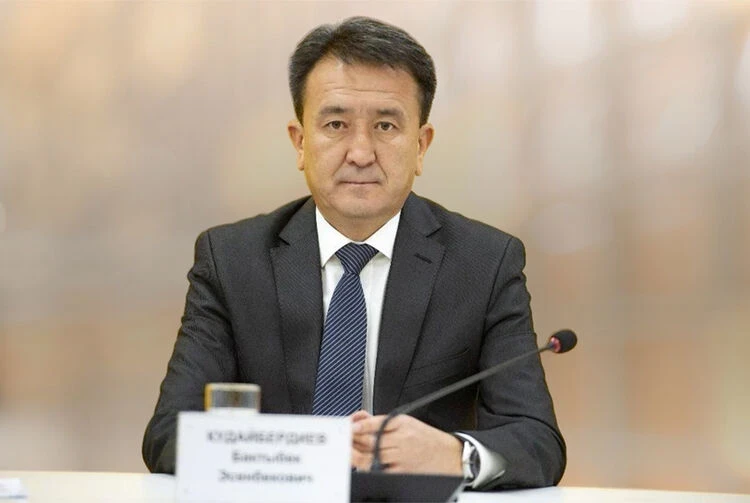
Every year, more and more residents of Kyrgyzstan are seeking employment opportunities abroad. Baktybek Kudayberdiev, the director of the Employment Center for Citizens Abroad at the Ministry of Labor, Social Security, and Migration, spoke about which countries offer legal work, how the selection process works, what challenges migrants face, and how to protect themselves from fraudsters.
— Which countries are currently open for Kyrgyz workers? What can we expect in 2026?
— Currently, we have two main directions: South Korea and the United Kingdom. We have been cooperating with Korea for eight years, and it is a stable government program. We started working with the UK in 2022. Initially, the quota was limited to 1,000 people, but we actually sent about 1,500. In 2025, more than 11,000 citizens of Kyrgyzstan went to work on farms in the UK.
These figures emphasize that Kyrgyzstan has established itself as a reliable partner, largely due to the migrants themselves.
Features of working in the UK
— How did you manage to gain the trust of the British side, considering the strict requirements?
— The main factor is strict compliance with migration norms. Each contract clearly implies the obligation to return home after the work is completed, and our citizens adhere to this rule in 99.99% of cases.
The exceptions are a few individuals, mainly women, who apply for political asylum, citing pressure from families or coercion into marriage. The British authorities take such situations very seriously.
Throughout our cooperation, only 75–77 citizens of Kyrgyzstan have remained in the UK, while in some neighboring countries this figure reaches 1%, which raises serious concerns.
— It is said that getting a job in England is a real challenge. How true is this?
— There are indeed difficulties, but they are not critical. Previously, the registration process was complicated: people gathered from all corners of the country, forming huge queues, and sometimes conflicts arose.
Today, registration is done entirely online, although there are nuances. Earlier, the British side would open the system for only 10–15 minutes, during which about two thousand people managed to register. We achieved a change so that the site would open for several hours, allowing all interested parties to submit applications.
As a result, about 79,000 applications were registered, of which approximately 6,000 passed the selection, and about half of them went to work.
— Do fraudsters become active at this moment?
— Of course. Soon, intermediaries appeared who promised "guaranteed" registration for 20–30 thousand soms. We constantly emphasize that all government programs are free, and no payments are required.
Currently, there is a strict rule: one phone number — one IP address — one application. If several people register from one Wi-Fi, the system will only accept one. This is done to prevent fraud.
— Is registration just the first step?
— Yes, and it is far from the easiest stage. Initially, applications are checked automatically. Any errors or discrepancies are immediately filtered out. Then, video confirmation is required — a short video where the candidate talks about themselves and their goals.
The British side considers this one of the most important requirements. After that, employers come for personal interviews.
— Is it necessary to know English?
— No. It is sufficient to be proficient in Russian. There are foremen from Romania, Bulgaria, and other Eastern European countries working on the farms, most of whom speak Russian fluently.
— What are the strictest requirements?
— Age, knowledge of the Russian language, and the ability to work with a smartphone. Having a driver's license or a tractor operator's certificate is also a big plus.
Some farms only hire women, for example, mushroom farms, while others only hire men. The optimal age for work is 25-30 years, which corresponds to physical endurance and psychological readiness for the workload.
How much can one earn in England?
On average, one can earn about £12 per hour, which amounts to about 300,000 soms per month for an eight-hour workday. Over six months, this is approximately 1.8 million soms.
All travel expenses are paid by the migrant.
— Are there cases of early return?
— Yes, the work is physically demanding. Sometimes people are offered to move to another farm. But if someone cannot handle the workload or violates discipline, for example, by consuming alcohol or refusing to work, the contract is terminated, and arrangements are made for their return home.
— Are there success stories that you share with migrants to motivate them?
— I often talk about the "1+1" scheme that operates in the UK. Initially, one person goes. If they prove to be a responsible worker, they are invited again, directly, without our involvement. They do not need to go through registration and interviews again. Moreover, they can take another person with them, for whom they are willing to vouch.
I share this information with those who are going for the first time. For example, there is a guy from the Aravan district who has secured jobs for almost his entire family: his wife, brothers, sister, and even his mother. She, despite being 60 years old, cooked for the whole family, which allowed them to save time on household chores and increase productivity. The employer was satisfied and will invite them every season.
South Korea: Knowledge is more important than certificates
— Why does South Korea remain popular?
— Here, one can work while studying. The main requirement is knowledge of the Korean language and good health.
Previously, we required certificates, but the market situation changed: documents began to be sold. More than 80% of candidates with certificates did not pass the tests. Now, the main thing is real knowledge.
Registration is done online and includes a language test, physical endurance check, and a color blindness test. Out of two thousand registered, about 200–250 people pass, whose applications are included in the Ministry of Labor's registry in Korea.
Where do Kyrgyzstanis work in South Korea?
Primarily in manufacturing: packaging, harvesting, and machine operation.
Salary starts from $1,500.
Housing and food are most often paid for by the employer.
— Is there no corruption?
— Absolutely. The selection is done through an auction system: the employer sets parameters, and the computer selects candidates from a database that includes applicants from 17 countries. First, an audiovisual resume is reviewed, then a photo — everything is transparent. Many migrants buy cars after work and send them to Kyrgyzstan for additional income.
Turkey remains highly popular
— Is Turkey still attractive for employment?
— Yes, it is in demand mainly in the hotel and tourism sectors. Contracts are usually signed for six months. Previously, private agencies actively worked here, taking up to 50% of the migrant's first salary.
This year, we launched a pilot government project, under which registration is completely free. Working conditions are similar to those offered by private agencies: waiters, housekeepers, cooks, and reception staff.
Knowledge of languages is very important. The more languages a person knows, the higher their income. On average, employers are willing to pay about $100 for each additional language.
Control of private agencies
The center issues licenses for the right to employ citizens abroad if their documents are in order. The main requirement is the presence of an agreement with the receiving party. The decision to issue a permit is made by an interdepartmental commission, which includes tax services, law enforcement agencies, and lawyers.
Private agencies play an important role: they are more mobile and can quickly organize the selection of workers. For example, we have 22 people working in our center, while some agencies have 40-50 employees, which significantly increases our capabilities.
The Persian Gulf, Slovakia, and Sardinia
— How is employment in Qatar? What are the employers' requirements?
— One needs to have a good command of English, as work in the service sector requires communication with tourists. Those who speak English go abroad even without our involvement. The market is competitive, but the earnings are commensurate.
— In 2025, you opened a new direction — Slovakia. What is this program?
— Yes, on January 7, we sent the first 10 people to Slovakia under a direct contract. These are passenger transport drivers. The Slovak side plans to accept about 100 people in total.
At the end of January and early February, we will form new groups of 10-15 people. This is an excellent example of targeted professional migration, where specific skills are in demand.
— In 2023, you signed a contract with the island of Sardinia. What is the format of work?
— The format is similar to that in the UK — agriculture. The Italian side conducted the selection itself, and we only accompanied the process.
However, a problem arose: our citizens were not issued visas. We found out that it was not the candidates' fault, but the employer's. The working conditions did not meet standards, and the employer refused to invest in their improvement. Therefore, the cooperation was terminated.
Japan and labor migration
— Is there labor migration to Japan?
— Yes, but in small volumes. Every year, 10-11 people go there. The law requires a good command of the Japanese language.
In 2025, we signed an agreement with the Ministry of Health of Japan. To invite a foreign worker, companies need to obtain permits from three ministries — this is a complicated and lengthy process.
In August, we launched a free Japanese language learning program. By December, all 30 participants received certificates and submitted applications for testing. Salaries there are high, and there are prospects for career growth. I have seen our guys who have reached managerial positions in hotels.
Russia and blacklists
— Are people still leaving for Russia in large numbers? Do you help migrants find work?
— We have more than 25 agreements with Russia. Despite good earnings, there are few who want to take advantage of these offers. Mainly, people go based on recommendations from relatives and acquaintances. According to our estimates, about 300,000 citizens of Kyrgyzstan work in Russia.
But there is a serious problem — the so-called blacklists. We receive daily inquiries from 600-700 people who face entry bans to Russia. The main reasons are unpaid fines, loans, and administrative violations. We always advise checking one’s status in advance to avoid problems at the border.
— If a person ends up on a blacklist, can you help them?
— In this case, our task is to inform. Removal from the blacklist occurs through our ministry's representation in Russia. Citizens must apply there in writing. However, practice shows that it is extremely difficult to get off the list.
“Safe Migration Caravan”
— How do you inform the population? There is a lot of dubious advertising about work abroad on the internet...
— We conduct the “Safe Migration Caravan.” We travel to cities and villages, meet with people, explain how to behave abroad and avoid fraudsters. We remind them of the importance of returning home. If migrants start to remain en masse in the host country, it may lead to the closure of programs, and others will not be able to find work.
We conducted an experiment: hired actors and set up a booth with a sign “Work in England.” Out of 100 people who responded to the ad, 10 were ready to pay $1,000 to “intermediaries” immediately, without asking questions.
— Are there accidents among migrants who leave under government programs? How do you act in such cases?
— Unfortunately, yes. For example, in 2025, a girl died in the UK. She lived alone, while most are placed in pairs. At first, she complained of feeling unwell, but it turned out she was consuming alcohol. The employer took responsibility for organizing the return of the body.
Our agency is not only engaged in employment — we fully cover the repatriation of “cargo 200,” so that the citizen's body returns home without extra costs for the family.
Where to get information about registration for work abroad?
— Only on official resources, including the website migrant.kg. We have attracted qualified specialists who have modernized the website and the Instagram page. They have high traffic and good feedback.
— What would you advise those who are just planning to go abroad for work?
— Legal labor migration is a real chance to earn, support the family, and see the world. The main thing is to follow the rules. That is why Kyrgyzstan is trusted, and new quotas and directions are opened.


