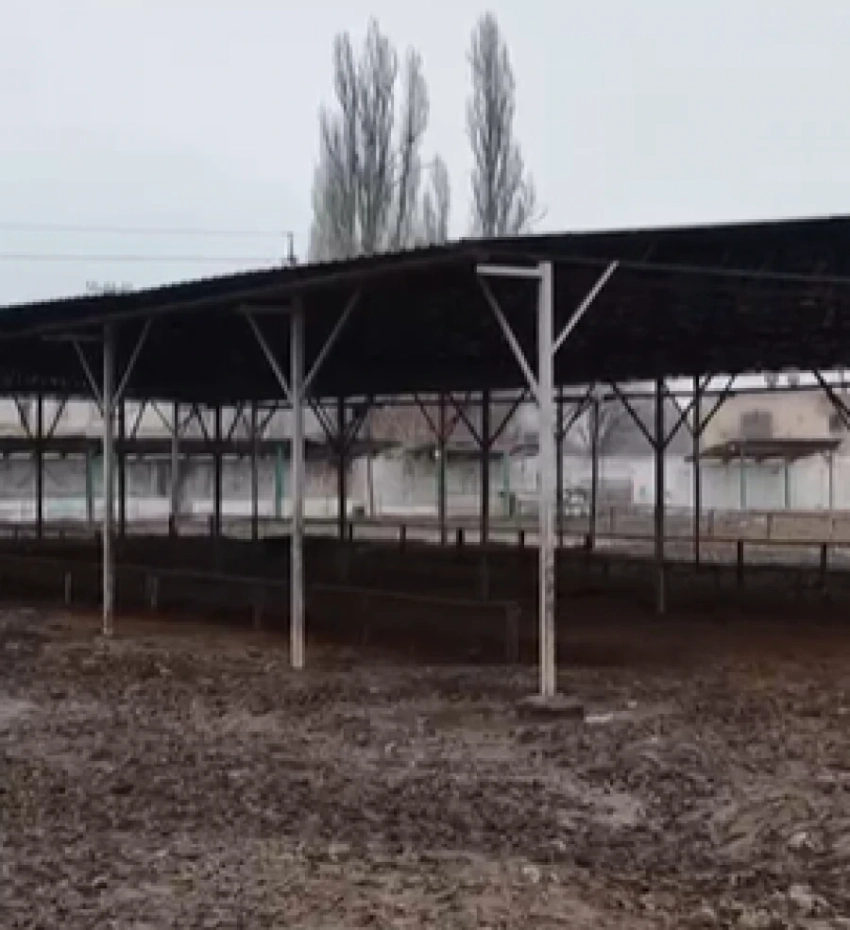
Currently, construction work has begun in Chym-Korgon, located in the Kemin district, on a site of 11 hectares that will be used for the new livestock market.
Earlier, Turmush reported on the construction of an unplanned livestock market in the village of Vinogradnoye in the Chui district, where work is also underway to lay gravel and improve the area.
The head of the Chym-Korgon rural council, Almazbek Dubanaev, stated that out of the allocated 11 hectares, 5 hectares are designated specifically for the livestock market, while the remaining 6 hectares are intended for a cafeteria, shops, and other trade facilities.
“The construction of the livestock market began thanks to funding from the district development fund, and local youth are actively participating in this work,” he noted.
Residents of Chym-Korgon emphasize that both markets are being created as temporary facilities within the framework of a pilot project.
“It is expected that the market, which will be more convenient for local residents, will continue to operate on a permanent basis, while the other will be closed. Therefore, both sides are making efforts to ensure their market remains, and local residents are actively participating in the construction, urging each other to make quick progress,” the message states.
Turmush reported in December 2025 that the livestock market in Tokmok will be relocated to a new site, where modern multifunctional facilities are planned to be built. This was stated by Mayor Altynbek Ergeshov during a meeting with traders.
The livestock market in Tokmok is the largest in northern Kyrgyzstan and a key point for livestock trading, where various animals, including cows, sheep, horses, and bulls, are sold.
According to the mayor, the current market does not meet sanitary and veterinary requirements, and its location near the highway and residential areas poses threats to the safety and comfort of citizens.
In this regard, a decision was made to relocate the market to a nearby site, but away from the road and residential zones, which will ensure safety for buyers and sellers.
The mayor also noted that the site of the current market has great potential for development, and in the future, there are plans to attract investors for new projects.
The project includes the construction of multifunctional buildings and the creation of a business space focused on innovation and entrepreneurship.
According to local authorities, the city administration will provide the necessary conditions at the new livestock market, including modern infrastructure and compliance with sanitary standards.
Representatives of the Chui District State Administration reported that the new market will be built in the eastern part of the village of Vinogradnoye. However, there is currently no precise information about the area and the timeline for the start of work, as the project is in the planning stage.
Traders involved in livestock sales noted that the Tokmok market had an important advantage — its proximity to food and spontaneous markets, where other purchases could be made simultaneously. “If the new market is conveniently located and meets the standards, we will get used to it. However, the old market provided convenience in terms of access to other goods,” the traders shared their opinions.
Turmush previously reported on the closure of the private livestock market in Tokmok starting January 1, 2026, which was the result of an inspection that revealed violations in its operation.
As a result of the control, it was established that the market was operating on a commercial basis without the necessary investments in infrastructure.
The closure occurred due to systematic violations of sanitary and veterinary standards, as well as non-compliance with safety requirements.
Despite the authorities' directives, the owners did not take measures to improve the situation.
Livestock trading at this site is being discontinued, and farmers are advised to seek other markets or use online platforms to sell their animals.