
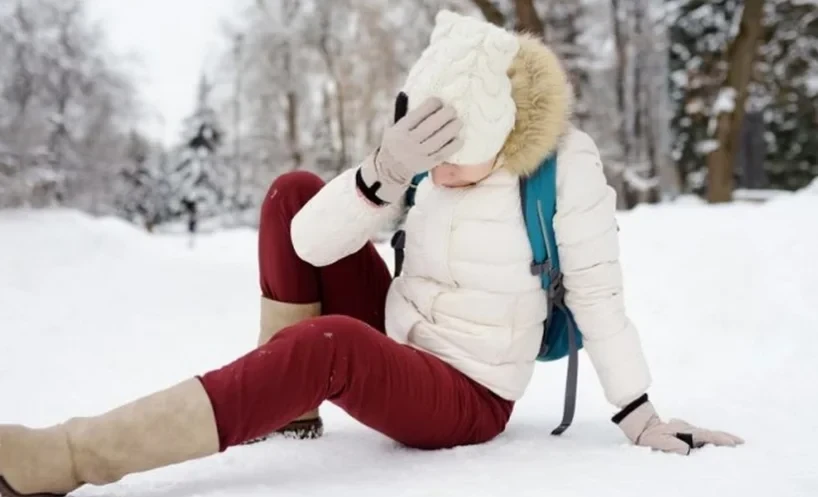
The specialists of the Republican Center for Health Promotion and Mass Communication reminded about precautionary measures that can help people avoid injuries in icy conditions.
The first recommendation from doctors is to limit outdoor activities in inclement weather whenever possible. If going outside is unavoidable, it is advisable to choose safe routes, such as well-lit roads with minimal ice and sanded surfaces. The most hazardous areas are sidewalks located near roadways, as well as icy manhole covers and steps in stores and other establishments. When climbing stairs, it is important to hold onto the handrails and, in conditions of severe ice, place both feet on each step.
Particular attention should be paid to the choice of footwear. It should have a non-slip and stable sole, preferably made of rubber or textured material. Doctors advise against wearing high-heeled shoes. It is also possible to use special spiked attachments—ice grips—or temporarily stick adhesive tape crosswise on the sole.
When moving on ice, one should do so cautiously, taking small sliding steps, placing the foot fully on the surface and not lifting it too high. The length of the step should correspond to the size of the foot. It is recommended not to keep hands in pockets to ensure the ability to brace oneself in case of a fall.
For elderly people, doctors advise using a cane with a pointed end for better stability, while pregnant women should avoid walking alone. Extra caution is necessary on roadways: crossing the street should be done slowly, as the braking distance for vehicles significantly increases in icy conditions.
When exiting public transport, it is important to hold onto handrails and not to rush to catch a departing bus or trolleybus. Doctors also warn of an increased risk of injury when on icy streets while under the influence of alcohol.
Citizens are advised to avoid areas where icicles may fall, choosing safer paths.
If a fall is unavoidable, experts recommend adopting a fetal position to soften the impact: tuck the head into the shoulders, press the chin to the chest, bend the knees, and tense the muscles. Falling on the side is considered the safest; however, elderly individuals should be particularly cautious due to the risk of hip fractures.
Doctors emphasize that if headaches, dizziness, nausea, joint pain, or swelling occur after a fall, medical assistance should be sought immediately.


