
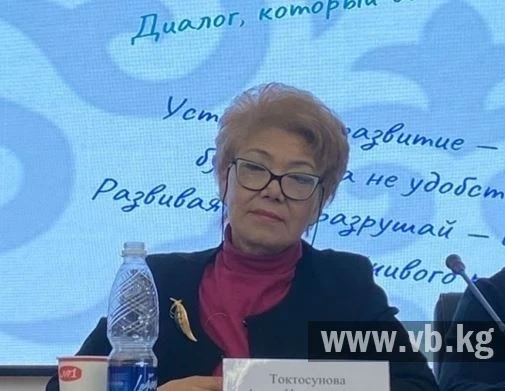
Interview with Adash Toktosunova, Doctor of Political Sciences and Professor, began with a discussion on a topic that may seem distant from her professional field at first glance — ecology. In particular, we talked about the importance of ecological education and awareness in the school curriculum. Adash Iskenderovna, a well-known philosopher and the first former head of the UNESCO office in Kyrgyzstan, actively raises issues of conflict, security, and sustainable development in her academic work.
Why did you, as a Doctor of Political Sciences and a philosopher, decide to focus on ecological education for children?
- It is important to note that this is not just about education, but also about upbringing. Nowadays, these concepts in the school system, in my observation, are practically unrelated. There is no separate subject "ecology" in the curricula, and therefore, we cannot speak of the presence of educators who could conduct ecological upbringing. Nevertheless, many schoolchildren show interest in issues of ecology, genetics, and microclimate, but there is no one to work with them. Simple calls to protect nature do not give our children the necessary understanding and awareness.
Recently, I approached the Ministry of Education and suggested to Minister Dogdurkul Kendirbaeva to consider the possibility of introducing an ecology subject into the school curriculum. The knowledge gained in ecology classes will help children become more sensitive to nature conservation, regardless of the field they will work in the future. This will be the main outcome of ecological education received in school.
I also handed the minister my book "Mysteries and Lessons of Nature," co-authored with my brother Narynbek Toktosunov, where we connect the history and culture of the Kyrgyz people living on the shores of Issyk-Kul with ecological issues. We analyzed numerous historical documents and studies from the 19th and 20th centuries to understand how our ancestors related to nature. For them, nature was sacred, and they considered Umay-ene — the earth as a mother, and Tеңир — the sky as a father, which defined their attitude toward the surrounding world.
Knowing one's history, especially for the youth, is extremely important. As they say, those who do not know the past have no future. Our culture and traditions are inextricably linked to nature, and even the names of months and rituals reflect this unity.
As for your question about why I, as a philosopher, became interested in ecology, philosophy has always been concerned with studying the world and its problems. Even in the 21st century, we, philosophers, must explore socio-natural processes and reflect on social development.
Additionally, I was raised from childhood to care about everything around me. At 14, I saw the film "Everything Remains for People," and its ideas became important to me. At that time, I decided to join the Komsomol to do something good for people. These words have stayed with me for life, and now, as an adult, I want to do something useful for my community in Issyk-Kul and for future generations.
How did you meet the ministry's reaction to your initiative?
- I received support. Minister Dogdurkul Sharshievna agreed with my point of view and is ready to promote the idea of integrating ecology into school education. This is indeed necessary for shaping the youth's consciousness about environmental protection. Even if our book is not used as a textbook, it is important for ecology to be included in the school curriculum.
At the end of last year, you organized a scientific forum "From Conflict to Dialogue of Cultures and Civilizations: Issues of Security and Sustainable Development," where ecological safety was discussed. Do you believe that ecology in our country is under threat?
- The situation with ecology in Kyrgyzstan is quite strange. Although ecology is often talked about now, the real attitude toward nature remains the same. Ecological problems are only accumulating, and they cannot be solved without effort. We are facing climate changes, but this is not as critical as the irresponsible attitude toward the environment, our pastures, and the unique Issyk-Kul Lake, which may disappear in the next 20-30 years if we do not start taking action.
The forum's topic covers a wide range of issues, and the ecological agenda has become key. Reports on the state of Issyk-Kul Lake were quite alarming and showed that we do not care for our natural heritage. We, the Kyrgyz, are simply destroying Issyk-Kul, which faces serious ecological threats, including transitioning to a mesotrophic state, which means a deterioration in water quality and ecosystem.
International experience shows that even the wealthiest countries cannot cope with ecological disasters. We have a chance to prevent a crisis rather than be its victims.
The situation is exacerbated by the discharge of untreated wastewater, which threatens biodiversity and the lake's purity. Many treatment facilities are in emergency condition, while the number of tourists is increasing. Professor Emil Shukurov emphasized that the lake cannot withstand more than two million tourists a year, but unfortunately, there are plans to increase this number to fifteen million. We are destroying nature for profit, and unfortunately, this can lead to sad consequences.
It is necessary to develop the area, but it is important to make balanced decisions to preserve the amazing nature of Issyk-Kul. Only a reasonable approach will ensure sustainable development for the region and the country as a whole.
Why do you think we do not appreciate what we have?
- A person strives for a comfortable life and social well-being, which is normal. However, it is abnormal to ignore nature and not care for it. We need to realize our place in harmony with the surrounding world. Caring for ecology starts with our environment. Each of us should understand that life goes on, and it is important to think about the future.
I will give an example from my experience. I bought a neglected house in the village of Chon-Sary-Oy, where residents were throwing garbage. My friends tried to dissuade me from this idea, but I decided to clean the area of garbage and turn it into an ethnovillage where tourists could come. Unfortunately, my enthusiasm met with misunderstanding from the local residents, who continued to pollute the area. But I still brought the plot in order, and now flowers and trees grow there. I also try to sort waste and compost organic waste, as they do in Switzerland. We must strive for cleanliness and order to preserve nature and improve life in our village.
I am proud of what I have achieved and hope that Chon-Sary-Oy will become a beautiful place where people will care for nature and realize their connection to it, as everything we do will remain for the people.
Photo provided by Professor Toktosunova.


