
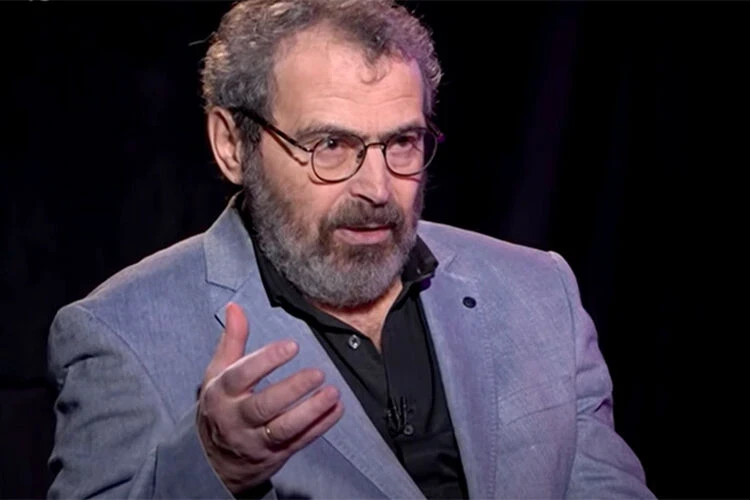
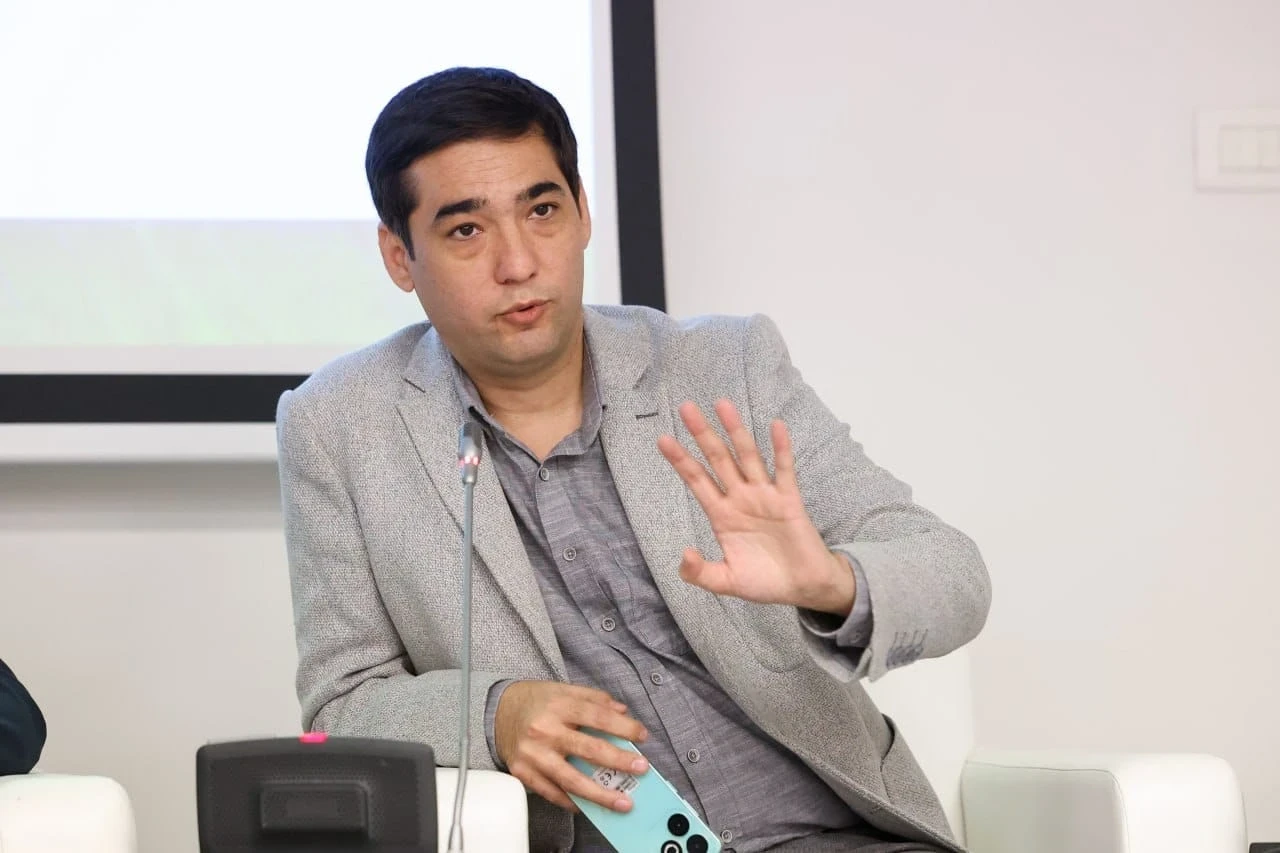
Sherali Rizoion, Political Scientist:
Photo from the archive of Sherali Rizoion. Sherali Rizoion
— The increase in U.S. presence in Central Asia opens new horizons for our countries and is a positive development, as it allows the regions to balance their foreign policies and diversify sources of foreign investment.
It is important to note that the activation of the policies of major and medium players in Central Asia brings both challenges and opportunities.
Sherali Rizoion
The lack of interest from significant players may lead to the dominance of individual countries, which contradicts the strengthening of the sovereignty of Central Asian states.
I view Washington's attention to critical minerals in Central Asia as a positive step that could inspire both traditional partners and U.S. competitors to become more active in the extraction of these resources. This could mark the beginning of new opportunities for the countries in the region in the production and processing of minerals.
Anuar Bakhtikhanov, Political Scientist:
— The growing interest of the U.S. in this region, especially in the context of critical minerals, demonstrates a desire to diversify global supply chains and reduce dependence on China. Central Asia is seen as a key source of raw materials for the transition to sustainable energy, high technology, and the defense industry.
This could present a significant opportunity for the countries of Central Asia: an influx of investments, technologies, and the chance to move beyond raw material dependency through the development of processing and industrial cooperation.
However, the lack of a clear state and regional strategy may lead to the risk of increased raw material dependency, environmental issues, and the involvement of the region in the geopolitical rivalry of major powers.
The main question is whether Central Asia can act as an independent player and use the interest of external forces for its long-term development, rather than just for short-term gain.
Arkadi Dubnov, Central Asia Expert:
Photo from the internet. Arkadi Dubnov
— The U.S. is seriously returning to post-Soviet Central Asia for the second time. The first time was in the early 2000s when Americans were interested in the region primarily as a rear base for operations in Afghanistan. Now the situation has changed: the foreign policy concept of the 47th U.S. president does not imply achieving goals through ground military actions. However, this does not exclude U.S. interest in accessing the military infrastructure of individual countries for conducting operations.
Reports from informed sources indicate that during the visit of the U.S. Special Envoy for South and Central Asia, Sergio Ghor, to Ashgabat in January, he was interested in the possibility of using one of the airfields in Turkmenistan for the needs of the U.S. Air Force.
The situation regarding the U.S. return to Central Asia today differs from previous periods. Current geopolitical realities require countering the growing influence of China, while Russia, weakened by events in Ukraine, has ceased to be a primary threat to the U.S.
According to Trump, the issue of countering the Russian threat is now a headache for Europe, not America. Central Asia, on the contrary, is becoming a key area of interest where the U.S. must counter China's influence.
Arkadi Dubnov
The process of consolidating Central Asia under such conditions will obviously be of interest to Washington, which explains its active efforts to hold C5+U.S. summits.
The main directions of U.S. policy can be divided into three aspects: economy, politics, and security, with economic interaction currently taking precedence. The main players in this direction are Uzbekistan and Kazakhstan.
The U.S. interest in the development and access to critical mineral reserves in Central Asia is just the beginning of forming a new model of relations with the region.
For the ruling elites of Central Asia, the absence of ideological demands from the U.S. Republican administration, which does not insist on democratization and human rights compliance, focusing instead on business and economic cooperation, may be attractive. Against this backdrop, competition with China could become successful.
Stanislav Belkovsky, Writer:

— The interest of the U.S. administration in Central Asia is primarily driven by the formation of a new world order. On December 4 of last year, the U.S. presented a new security strategy that marked the end of the era of an America-centric world that began with the fall of the Berlin Wall on November 9, 1989. In the world that began to disintegrate around 2014, when Russia annexed Crimea, the U.S. was a global moderator, and the international hierarchy was built around its dominance.
Today, the world is becoming fragmented, without stable rules and a clear hierarchy.
The modern world resembles a highway where no one follows the rules, everyone moves at their own speed and in their own lane, and the only question is how powerful your car is.
Stanislav Belkovsky
If you have a powerful car, then you are allowed more on the road than others. Today, the U.S. acts not as a global moderator but as the most powerful car on this road, needing resources from various regions of the world, including Central Asia, which is rich in both rare earth metals and traditional energy sources.
Moreover, the U.S. is in competitive struggle with China. Since Central Asia is geographically located within the framework of China's "One Belt, One Road" project, it is important for the U.S. to intercept influence in this region so that Central Asian countries see themselves not as participants in the Chinese project but as partners in initiatives proposed by the current administration.
In conclusion
The U.S. is returning to Central Asia, but not through military bases as in the early 2000s, but through investments, critical minerals, and economic cooperation. Experts agree that the region is becoming an important part of the strategic confrontation between Washington and Beijing.
For the countries of Central Asia, this is both a chance to expand external ties, develop processing and industrial cooperation, and a risk of increasing raw material dependency and involvement in the competition of major powers.
The main question remains: will the region be able to use the interest of external players to strengthen its subjectivity, or will it remain merely a source of resources for foreign strategies?


