
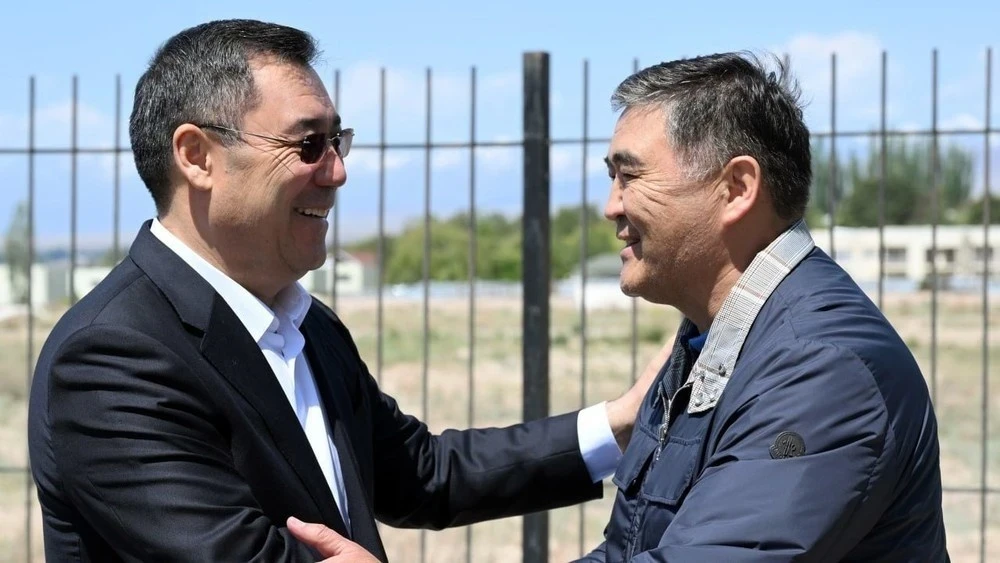
On the night of February 13, former head of the State National Security Committee, General Colonel Tashiev, returned from Germany, where he was undergoing treatment. According to unconfirmed information, he headed to the state residence immediately after his arrival.
Meanwhile, among "independent journalists," there were active speculations about whether he would return. Many believed he would stay in Europe or go to Bakiev in Minsk or to his son in Aleppo, fearing arrest and harsh reprisals upon his return.
Particularly notable was the "exiled journalist" Leila Saralaeva, who openly expressed her dislike for Tashiev, reminding everyone how he once persecuted her for her anti-state actions. She presented her version of events, talking about some "imbalance" in state governance allegedly caused by a letter from Edil Baysalov. According to her, the arrest of more than fifty employees of the State National Security Committee is expected, which is supposedly aimed at the moral and physical destruction of General Tashiev.
Another exile, Bolot Temirov, diligently followed Tashiev's movements, commenting on every step: "He hasn't landed, heading to Almaty"… "No, actually to Bishkek." "Flight trackers can be deceived," he added.
Nevertheless, Kamchybek Kydyrshaevich did not hide anything and did not plan to flee abroad. According to sources, his return was provoked by the current situation, although he had not yet completed his treatment in Germany. He was confident in his innocence and that the president had no claims against him, and that he was not threatened by any forceful measures.
The resignation of the head of the State National Security Committee not only sparked local interest but also active discussions among foreign experts, who apparently felt fear of Tashiev. Kazakh political scientists and some Russian media even called him "the main Russophobe of Kyrgyzstan," hinting at possible reasons for his dismissal.
Accusing Tashiev of Russophobia is like suspecting Saralaeva of not loving art. The general has repeatedly emphasized the strategic importance of relations with Russia, and even during his studies in Russia, he always spoke in Russian.
The essence of the matter is not in what he is called, but in the fact that over five years, the Kyrgyz people have been convinced that they have a leader capable of solving problems and ensuring stability.
President Sadyr Japarov supported Tashiev, entrusting him with broad powers, and during their cooperation, neither betrayed the interests of the state. Those who hope for the collapse of their tandem are clearly jumping to conclusions. Sadyr Japarov and Kamchybek Tashiev are not the kind of people who can seriously fall out over personal ambitions. The president clearly expressed his position: he has no questions for Tashiev; all difficulties are related to the actions of those who acted in his name.
The decision to reorganize the security agency was made by Japarov to avoid a split in society. For the president, serving the state will always be more important than any personal relationships. Tashiev supported this position, stating that loyalty to the oath and state discipline are above personal interests.
Kamchybek Tashiev continues to hold the rank of general colonel and occupies the positions of president of the Kyrgyz Football Union, vice president of the Boxing Federation, chairman of the Board of Trustees of KRSU, and co-chairman of the Ata-Jurt party. This opens doors for him to return to big politics.


