
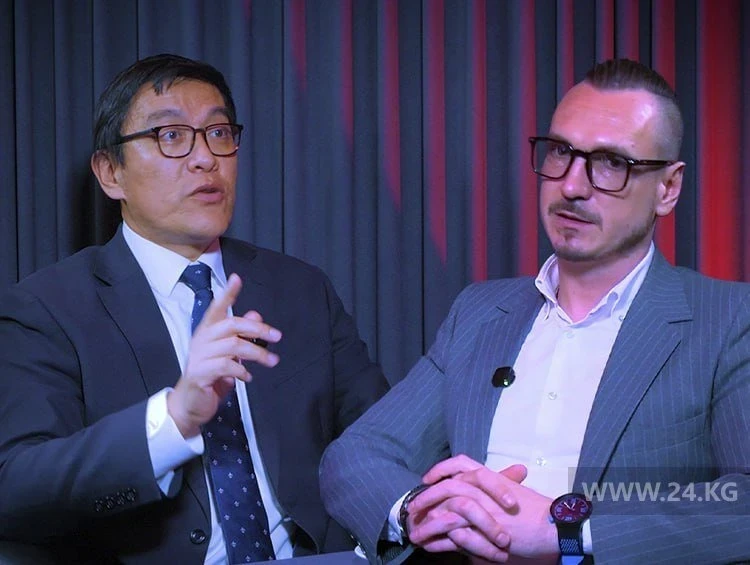
In the studio of 24.kg, Deputy Prime Minister of Kyrgyzstan Edil Baisalov, responsible for social policy, gave an open interview where he discussed important current issues. The conversation touched on many topics, including criticism from human rights activists regarding his political transformation, freedom of speech, as well as issues of the cost of living, the housing crisis in Bishkek, the shortage of medical personnel, education reforms, migration, and the controversial formulation about the "Russian world".
Photo 24.kg. Edil Baisalov (left) and Maxim Poletaev
Edil Baisalov did not shy away from tough questions, acknowledging the reality of rising prices, explaining why social networks "harm" society, and emphasizing that criticism of the authorities is acceptable, but inciting hatred is an unacceptable boundary.
— Thank you for taking the time for this conversation. By the way, the questions were not agreed upon in advance.
— That’s right. The discussion should be natural.
— Many remember you as a human rights defender who left the country under pressure in 2007 and then returned. Some NGOs claim that "Baisalov was for freedoms, but now he is for restrictions." How do you explain this transformation?
— This is quite natural. We have been living in an independent country for 35 years, and most of the population was born after 1991; for them, many aspects of political history seem distant. But it is important to note that I do not change my principles. I still believe that I defend rights and freedoms.
— Where, in your opinion, did the gap in perception occur? Why has your opinion come to be perceived differently?
— Because freedom has begun to be confused with the right to incite hatred. Often, hysteria and toxicity are called freedom, undermining trust and trying to "explode" society. The maturity of a nation lies in its ability to distinguish between constructive criticism and destructive behavior.
— Why did you leave back then?
— I left out of responsibility for my family. I had a small daughter, a young wife, and elderly parents. I understood that I could "heroically" stay and leave them without support. It was a forced decision.
— How have you changed while in Sweden?
— I realized that the idea of "everyone for themselves" does not correspond to reality even in a capitalist system. The balance of interests is important: family, children, and society. This strengthened my socially oriented approach.
— You described the period of the parliamentary republic as "pseudo-parliamentarism." Why did this model turn out to be ineffective?
— It was incomplete. In practice, under the guise of parliamentarism, we observed elite games, bargaining, and the distribution of positions, where decisions were made by narrow groups. People noticed this, and the term "democracy" began to be perceived negatively. This is dangerous.
— What is the main conclusion you drew from this period?
— Democracy is not a competition for the loudest grievances. The main task of the state is to improve the lives of citizens, not to engage in constant hysteria around personalities.
— What forms of criticism of the authorities are acceptable today?
— Any. Kyrgyzstan is a free state, and every citizen has the right to their opinion, even if it does not coincide with the opinion of the authorities.
— But you stipulate that there is a "but." Where are the boundaries?
— The red line is inciting hatred and threatening social unity. Informational hygiene is also important. Social networks are not just a platform for discussions. One post can become a spark.
— Do you acknowledge that sometimes "a little something — they invite you to addresses"?
— Yes, that happens sometimes. And I don’t always like it either. But freedom of speech is a common good and the foundation for successful development.
— You have a phrase: "We will live two to three times better, but we can become ten times unhappier." What does this mean?
— It’s about the toxic atmosphere and algorithms that inflate negativity. At the Olympics in Paris, I noticed that instead of pride, there was hysteria over fakes. If society is not protected from toxicity, economic successes will not matter if people continue to live in anger.
— Do you believe this is the state's responsibility?
— Yes. The government should care not only about material well-being but also about the moral state of society.
— People say: "Life is getting more expensive faster than salaries." What is your response?
— I do not deny this feeling. However, real income growth exceeds the level of inflation. It is important to note that the exchange rate is not the result of "printed money." High prices are mainly imported. But yes, we see that many families are struggling.
— Why does the irritation not go away?
— Because income growth is unevenly distributed, and the main expenses — food, housing, and utilities — "consume" the feeling of increase.
— Housing and rental prices are rising in Bishkek. How do you assess the situation?
— We need not only mortgage programs but also social and service housing, where people could rent from the state rather than private owners. We also need to increase construction volumes — demand is much higher than supply due to demographic changes and urbanization.
— You mentioned student dormitories.
— Yes, we are working on a long-term program. Students simply lack housing; this is also part of the housing issue.
— Your statements about school education have caused a resonance. The Ministry of Education speaks of a shortage of teachers, while you talk about quality. What is the conflict?
— I intentionally raised this issue. There are people who accidentally ended up in schools and do not meet the requirements. Parents vote with their feet, transferring children to other schools because the neighboring one does not provide the necessary quality.
— How do you explain the admission of people without pedagogical education into schools?
— This is a common practice. If an engineer can teach physics better than a certified teacher, he should be given a chance. But with the necessary training, courses, and certification. We must proceed from the interests of children.
— The Ministry of Health speaks of a shortage of medical workers. What is the reason?
— Salaries are important and will grow. But two key points are housing for young specialists and the infrastructure of medical institutions. Young doctors want to work in modern conditions, and most of our infrastructure is outdated, sometimes without conveniences. Doctors see the reality and burn out.
— When will people feel changes?
— We will not be able to change everything in five years. But within ten years, district hospitals and clinics should look different to change people's perceptions.
— Blacklists in Russia, insurance issues, and within Kyrgyzstan — workers from Bangladesh, Pakistan, China. How to explain this?
— The number of our migrants in Russia has decreased. Migration will remain, but its meaning must change: it is not a disaster but an opportunity to learn and bring skills. Within the EAEU, we will insist on the principles of free movement of labor and equal conditions. This is not the case now, but we will work on it.
— Why has Kyrgyzstan started accepting workers?
— The economy developed faster than discipline in the labor market. Construction projects need people immediately. This is a new challenge: we will launch programs on qualification and cultural aspects of labor.
— Your phrase "we are part of the Russian world" has sparked much discussion. What did you mean?
— I spoke about the cultural-informational reality: about the content that people consume, in what language, what films and news. This does not mean rejecting one's identity. On the contrary, we need world-class content in the Kyrgyz language so that the language is used not only in lessons but also in everyday life.
— What is your opinion on the debates surrounding Chingiz Aitmatov?
— Chingiz Aitmatov is a great son of the people. But I am against the cult of personality, where people use his name as a weapon without reading his works. The centenary of his birth should be celebrated at the international level, but without turning the author into a statue.
— What do you want to achieve by 2026? Do you plan to leave your position?
— Yes, I want to finish my work in this presidential term with dignity. The main thing is to lay the foundations that do not depend on surnames. The most challenging and important task is education reform. This concerns one and a half million children, thousands of schools, and tens of thousands of teachers. There will be mistakes, but we cannot deviate from the course: the results will be visible in 15 years.


