A recent conversation of "Evening Bishkek" with Professor Rustam Tukhvatshin, a laureate of the State Prize of Kyrgyzstan in the field of science and technology, attracted public attention and revealed important issues in the scientific community, particularly in medicine. This underscores the relevance of the topic of supporting scientists in their innovative activities.
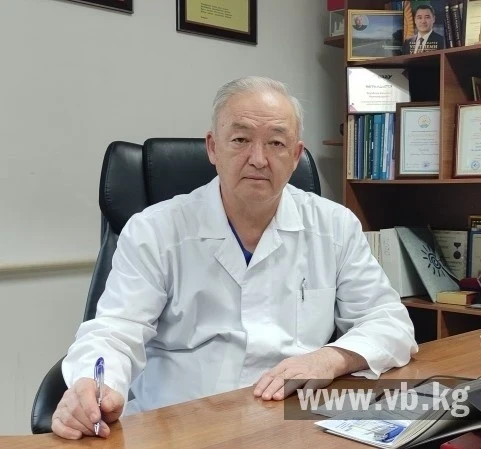
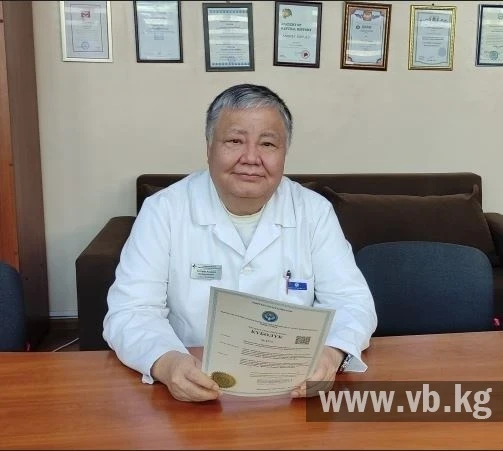
Continuing the discussion, VB.KG met with Professor Akylbek Usupbaev, who is the director of the Republican Scientific Center of Urology at the National Hospital and the head of the Department of Urology and Andrology at KGMA. Akylbek Cholponkulovich is one of the leading innovators in the country.
Akylbek Cholponkulovich, there is active inventiveness in various fields in Kyrgyzstan, but authors often complain about the lack of practical application of their ideas. What is this related to? What difficulties arise in the implementation of new technologies?
- I have 56 patents registered, and some of them have attracted the interest of well-known medical publications, which request materials about my developments in surgical urology. My colleagues and I are developing and proposing new treatment methods, which is the main value of our inventions. However, to promote them internationally and implement them in practice, support from the state is necessary, particularly from "Kyrgyzpatent."
Unfortunately, we, as inventors, do not feel such support. The situation, in my opinion, is extremely strange. Previously, there was a team of experts at "Kyrgyzpatent" that evaluated innovative technologies. Now they pass our developments to the Eurasian Patent Organization, and only if they receive approval there will "Kyrgyzpatent" issue a patent. A procedure that used to take a year now takes three.
This is wrong, as any innovations should remain in the country of the inventor until they are officially approved. Now our ideas leave the country without waiting for evaluation by local experts. Scientific technologies should belong to our republic, and it is our specialists who should assess their significance. We are essentially giving away our ideas for free, receiving nothing in return.
Thus, inventiveness does not bring the desired benefits?
- Ideas are not insured and not promoted. "Kyrgyzpatent" should be engaged in evaluation and promotion, but this support is absent. As a result, it becomes an intermediary between inventors and international organizations.
What about the patents that have already been obtained?
- In most cases, patents remain with the inventors themselves, as the implementation of technologies faces numerous obstacles, primarily of a financial nature. Inventiveness in our country is not a profitable endeavor and is often even unprofitable. The costs that should be recouped, in our case, unfortunately, are recouped extremely rarely. Patents are not in high demand in the market. However, their usefulness in medicine lies in improving diagnosis and treatment. We, urologist surgeons, conduct medical conferences and master classes, teaching colleagues new methods. Thus, even if patents do not bring financial benefits, they still provide moral satisfaction.
Nevertheless, while innovations are successfully implemented in large cities like Bishkek, doctors in the periphery face a lack of equipment. In the Talas region, for example, there is only one urologist, and attracting young specialists is complicated due to the lack of necessary equipment, depriving them of prospects for professional growth. Young doctors want to master new technologies and work with modern equipment to keep up with progress.
What motivates you to continue inventing despite the lack of profit?
- It is a love for the profession. Despite its banality, it is true. Many of us cannot imagine our lives without medical practice. I derive immense moral satisfaction from successfully performed surgeries and created technologies, as I see how they help patients.
We successfully apply new treatment methods, but, as you noted, patents do not bring us benefits. They certainly do for the patient, but for the authors, there is no reward system. Academic and scientific organizations force us to publish our developments in international journals like Scopus. Without these publications, patents and scientific data are not recognized. However, publication requires compliance with numerous requirements and significant financial costs — from one to five thousand dollars, which is an unbearable amount for most of our specialists and graduate students.
Together with Doctor of Medical Sciences Renat Kurmanaliev, we developed a surgical method for treating stenosis of the renal pelvis-ureter segment. We used autoplasty, stitching a piece from the scrotal membranes, which successfully integrated and yielded excellent results. Several American journals showed interest in our method. However, we do not know how to promote and sell our ideas. I can create a new method and apply it successfully, but I do not know how to promote it. Moreover, there is no time to engage in this. Professor Tukhvatshin is right — this happens to many scientists.
At "Kyrgyzpatent," there should be specialists who can promote and sell our ideas. This would significantly enhance the image of Kyrgyzstan and bring profit to both the country and the authors. Even if the inventor received ten percent of the profit, that would already be good. Otherwise, we have several patents and do not know what to do with them. The only consolation is that we can teach colleagues methods that help patients.