
A recent article in "Evening Bishkek" titled "Inventions with a Stunning Effect Are Not Used in the Country," published on December 20, 2025, attracted significant public attention.
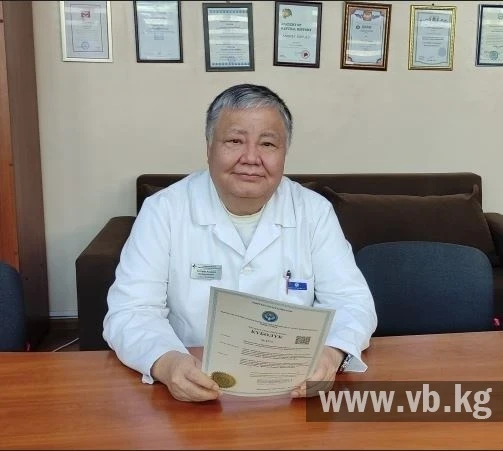
Andrey Asankulovich Sopuev, an outstanding physician, Doctor of Medical Sciences, and head of the Department of Hospital Surgery at the I.K. Akhunbaev Medical Academy, as well as an academician of several scientific organizations, including KGMA and the Russian Academy of Natural Sciences, shared his analysis of the situation in an interview for vb.kg.
- Let’s not hide the truth: our medicine is significantly lagging behind international standards, by at least a quarter of a century. We are unable to implement the latest methods developed outside the country, especially in the field of surgery. How can we think about new inventions if we haven’t even mastered what already exists?
I am convinced that my colleagues have the potential for creativity; however, the level of foreign innovations and our capabilities are simply incomparable. Funding and access to modern equipment also play an important role. Robotic technologies have been actively used worldwide for over 20 years, but there is not a single robot in Kyrgyzstan. Why? Because the cost of such equipment is at least five million dollars. Six months ago, the idea arose at the National Surgical Center to acquire a Da Vinci robot, which is considered the best in surgery. We were full of enthusiasm, as our state could allocate such funds. However, the cost of consumables and the services of specialists from the company producing this equipment would amount to two million dollars a year. Where can we get such money? Again, we will have to ask, and it’s not guaranteed that we will receive help. Therefore, the robot remains just a dream.
Another example: a little over a year ago, the president announced the idea of conducting free liver transplant surgeries. Significant amounts were allocated for this, renovations were made, and equipment was purchased. During Vladimir Putin's visit to Kyrgyzstan, our center was visited by academician Sergey Gotye, the chief transplantologist of Russia, who approved our preparations. He believes that we are ready to independently perform liver transplant surgeries.
Nevertheless, the difficulty lies in the fact that post-operative care for one patient requires two million soms. The president ordered free transplants, and now we are looking for funds. They promise to allocate them, but when? Of course, sooner or later this will happen, but only for one patient. And there are no funds for the others. We have all the conditions – specialists, equipment, and patients – but we cannot start the surgeries.
According to statistics, every year, at least five thousand applications for inventions are submitted by doctors in the post-Soviet space. However, how many of these developments are truly in demand and have international recognition? Very few! Although talented scientists have been and remain in both Russia and Kyrgyzstan. But only some of them have achieved recognition in world medicine. For example, Professor Nikolai Pirogov, the founder of military field surgery, and Vasily Kolesov, who performed the world's first mammary coronary bypass in 1964. The name of Gavriil Ilizarov, who developed a device for bone lengthening, is also well-known. Lasers invented by Alexander Prokhorov and Nikolai Basov are used in medicine worldwide, and they received the Nobel Prize in 1964.
Kyrgyzstan also has talented physician-inventors, but it is difficult for us to compete with developed countries, especially due to financial constraints. Only 0.08% of the budget is allocated for science in our country, while in Western countries this figure is 2-3%. Considering that the US budget amounts to trillions of dollars, what kind of competition can we talk about? While we are trying to create something, our foreign colleagues have already taken a step forward. Moreover, they have material incentives.
My colleagues have several inventions; I have 15, two of which were registered back in the USSR and approved by the State Committee for Inventions. Recently, I was awarded a certificate for my latest invention. But what does this give? Patents do not bring any benefits to the inventor. There is no incentive, and this leads to a lack of desire among doctors to engage in scientific activities.
Andrey Asankulovich, are your inventions in demand in medicine? Which of them were approved during Soviet times? It was very difficult to get the "go-ahead" back then.
- In 1986, during my postgraduate studies at the A.V. Vishnevsky Institute of Surgery, pneumothermocoagulation was successfully applied for the first time in the USSR during liver surgeries. I also introduced a polymer drainage sorbent, Gelevin, which is used for treating purulent wounds. We managed to improve the method of open treatment of acute destructive pancreatitis.
Some of these methods we continue to use in practice.
I heard that the Ministry of Health will now finance medical science. If it starts to evaluate inventions and pay for them, could this increase the interest of researchers?
- Even if the Ministry of Health begins to evaluate developments, it will not lead to significant changes. Large-scale research requiring substantial investments is necessary for the implementation of innovations. We do not have enough funds even for salaries for researchers, and the best of them leave for practical medicine, where it is possible to earn more. Abdominal surgery requires great effort, but there is no profit.
Nevertheless, many inventions continue to emerge, and doctors are improving known techniques. What drives you and your colleagues in this direction? It would be possible to follow already known paths...
- All our innovations are based on personal experience and aimed at improving surgical outcomes and more accurate diagnostics. In my opinion, there are no inventions in Kyrgyzstan that could cause a real "wow effect." We mainly apply the developments of our foreign colleagues.
Nevertheless, the technologies of our doctors, for example, in microsurgery, also attract interest abroad.
- I agree. The work of microsurgeon Musa Mateev, who unfortunately passed away from coronavirus, always amazed at international congresses. Our surgeons have unique technologies for treating echinococcosis and alveococcosis that truly help patients. However, this is only a small number of methods that have received recognition in medicine.


