Photo 24.kg. Political scientist Vladimir Lubyanko
One of the most significant outcomes of this time was the completion of the border delimitation with Uzbekistan. In January 2023, both countries exchanged ratification letters, which put an end to years of territorial disputes.
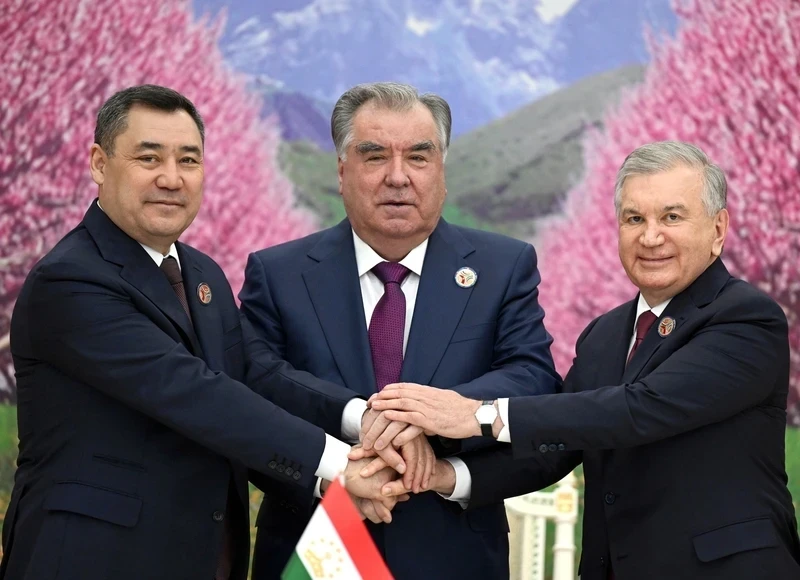
In March 2025, a final package of agreements was signed with Tajikistan, effectively resolving the conflict in one of the most tense sections of the border in Central Asia. Lubyanko emphasizes that a task that had eluded the previous three presidents for nearly 30 years was successfully resolved in a short period.
From 2021 to 2025, President Japarov and Russian leader Putin held at least eight meetings. In November 2025, Putin made a three-day state visit to Bishkek, which was a significant event.
Cooperation with China is also actively ongoing: in December 2024, construction began on a railway connecting China, Kyrgyzstan, and Uzbekistan, and the volume of bilateral trade reached $20 billion.
Kyrgyzstan has significantly strengthened its position within the EAEU and CSTO, and in 2025 it took the chairmanship of the SCO.
The country's economic indicators during this period demonstrate impressive growth:
- GDP increased by 10.2% over the 11 months of 2025;
- Budget revenues rose from 308 to 687 billion soms;
- The poverty rate decreased by almost 4 percentage points.
After "Kumtor" was transferred under state control, it generated a profit of $300 million over 2.5 years, which is three times higher than the previous 27 years.
According to the expert, over five years it was possible to:
- Return more than 20 billion soms to the budget;
- Transfer about 70% of illegally appropriated assets to the state;
- Hold a number of former high-ranking officials and criminal structures accountable.
The constitutional reform of 2021 finally established the presidential model of governance. Lubyanko noted that "the vertical of power allowed for comprehensive transformations that were impossible under a parliamentary system." The expert concludes that Kyrgyzstan has confidently overcome the period of post-revolutionary uncertainty: the country has clearly defined borders, an active foreign policy, a growing economy, and a stable management course.
In the context of Eurasian cooperation, Kyrgyzstan has become "a more predictable and reliable partner" for the EAEU and CSTO countries, Lubyanko summarized.