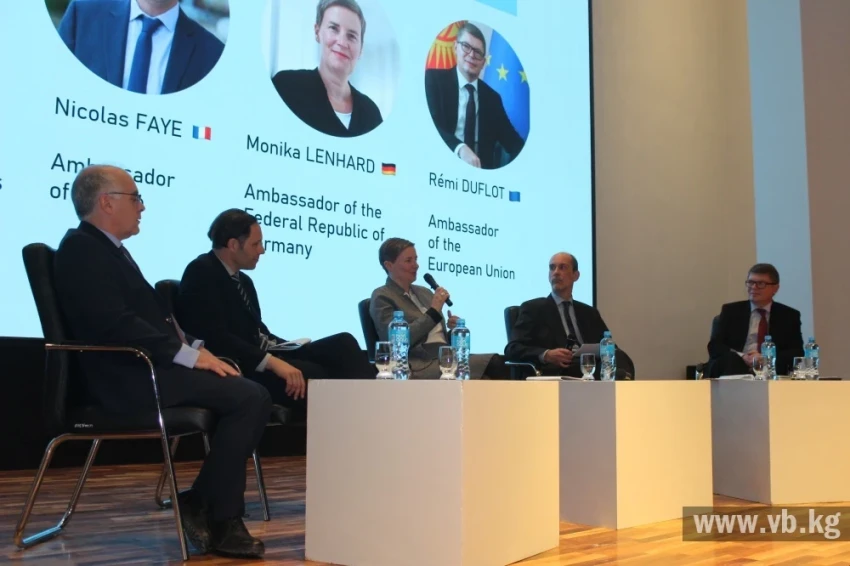
- How does the Aachen Treaty affect the cooperation between France and Germany in Kyrgyzstan? What joint projects are planned?
- The Aachen Treaty, signed on January 22, 2019, is a continuation of the Élysée Treaty of 1963, which laid the foundation for reconciliation between France and Germany after World War II. This historic document put an end to the idea of hostility between the two states and opened the way for friendship and integration in Europe. Within the framework of the Aachen Treaty, the countries reaffirmed their commitment to deepened cooperation, which is certainly reflected in our efforts in third countries, including Kyrgyzstan.
In particular, Bishkek was mentioned as one of four cities where an integrated Franco-German cultural institute will be established. This project elevates our cultural interaction to a new level. The official opening of the institute is scheduled for the second half of this year; however, the FGCI (Franco-German Cultural Institute) has already begun its activities in Kyrgyzstan. Over the past four years, we have organized numerous joint cultural events aimed at youth and creative industries, such as film, video games, and animation. We aim to reach not only Bishkek but also other regions of the country.
- What impact does this treaty have on the EU's foreign policy in Kyrgyzstan and Central Asia?
- Cooperation between Germany and France is fundamental for the European Union, and it has become the basis for European integration. Without reconciliation between our countries, often referred to as the "engine of Europe," it would be impossible to speak of joint efforts on the international stage.
In 2007, Germany and France played a key role in developing the first EU strategy for Central Asia, updated in 2019. Our priorities include regional cooperation, sustainable development, and strengthening ties in this important region. We actively engage with the EU delegation and other member states to support Kyrgyzstan in these areas.
The signing of the Agreement on Enhanced Partnership and Cooperation (EPCA) in June 2024 marked a significant milestone for deepening our interaction. We are confident that its ratification by all EU countries and Kyrgyzstan will occur soon. We also look forward to the first "EU-Central Asia" summit, which will take place in April 2025 in Samarkand, where strategic partnership relations will be discussed.
Close cooperation at all levels—from local to international—in the fields of security, economy, culture, and science can serve as an example for broader integration and cooperation in the region. We also welcome the recent successes in the peaceful resolution of border conflicts in Central Asia, which is an important step towards stability and prosperity.
In the context of global rising violence, it is especially important to maintain the spirit of constructive cooperation and to respect the principles of the UN Charter.
- Does this affect security issues and strategic partnerships in Central Asia?
- Germany and France are confident that cooperation between the EU and Central Asia should aim at creating a more resilient and interconnected economic and political space. The European Union has long been a reliable partner for Central Asia in the field of security.
Key areas of cooperation include cybersecurity, countering radicalization and terrorism, strengthening border security, and combating drug and human trafficking. It is important to note that our partnership is not exclusive and includes engagement with international organizations such as the OSCE and the UN, which are actively working in this region.
- Can the Aachen Treaty become the basis for a new security architecture in Europe, especially in light of the current situation around Greenland?
- As members of the EU and NATO, our countries pay significant attention to security and defense issues. The conclusions of the Franco-German Security and Defense Council, held in Toulon in August 2025, confirm the need to strengthen bilateral cooperation in these areas, especially in the context of maintaining the international order.
We strive to create a Europe that will be more responsible for its own defense and able to respond swiftly to emerging threats. This topic is also addressed in the Franco-German economic program adopted at the ministerial council meeting in Toulon, which outlines the principles for creating a more sovereign Europe.
In light of conflicts and hybrid threats in Europe, we are convinced that NATO remains the foundation of Euro-Atlantic security, and we are ready to support its strengthening, including through enhancing the European wing of the Alliance. It is important to remember that Greenland, being part of the Kingdom of Denmark, also concerns the interests of all NATO countries.