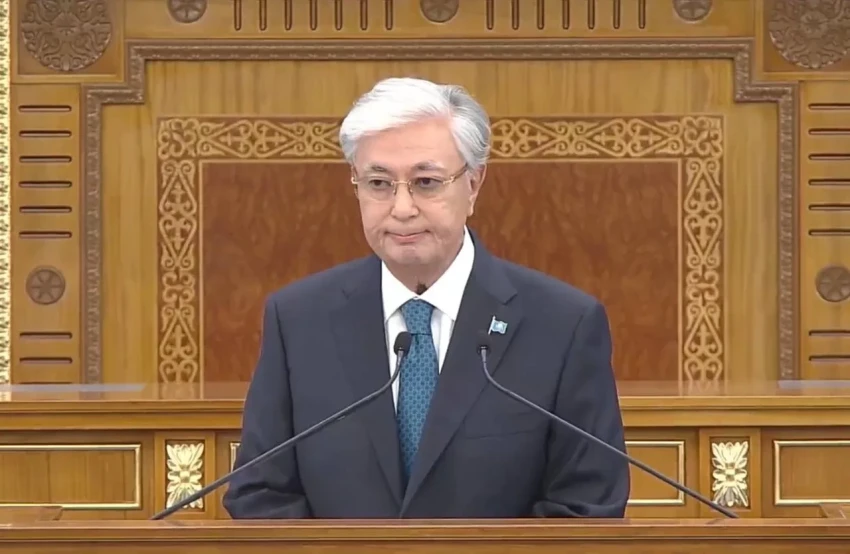
In Kyrgyzstan, a similar position existed at the dawn of independence but lasted only a short time. The editorial team of Kaktus.media recalls the events that preceded its abolition and when it was remembered again.
The Vice Presidency in Kyrgyzstan in the 1990s
The position of Vice President was introduced in December 1990, during changes in state structures against the backdrop of all-union transformations. The first person to hold this post in the Kyrgyz SSR was Nasirdin Isanov. He was a prominent political figure, finishing second in the first presidential elections in 1990, after Askar Akayev. However, his vice presidency turned out to be short-lived: on January 21, 1991, he was appointed Chairman of the Council of Ministers, and after gaining independence on August 31, 1991, he became the first Prime Minister of the new Kyrgyzstan.Formally, the Vice President in the 1990s was planned as the deputy to the president and his potential successor in case of a crisis, but in practice, his role was blurred. He did not have clearly defined functions and lacked independent power. The Vice President was neither the head of government nor the leader of parliament, which made his role less significant. For example, German Kuznitsyev, while serving as Vice President, oversaw only certain aspects of economic policy but did not influence key decisions.
There was also another political risk: the presence of a Vice President was perceived as a threat to presidential power. This created conditions for rivalry among elites for the support of the second person. Examples from post-Soviet history show that vice presidents, such as Gennady Yanayev in the USSR or Alexander Rutskoy in Russia, used their statuses for political struggle. Kyrgyzstan avoided such scenarios; however, the principle of "dual legitimacy" created vulnerability for the institution of power, which led to its abolition in 1993 as part of strengthening presidential authority.
Discussion of the Vice Presidency in Kyrgyzstan
After 1993, the question of restoring the vice presidency was not raised for a long time, neither under Askar Akayev nor under his successors. The current leaders did not want to create potential competition within their teams. Nevertheless, from time to time, political figures and experts raised the topic of reinstating this position.The first significant discussion took place after the "Tulip Revolution" of 2005. During this period, an informal alliance formed between Kurmanbek Bakiev and Felix Kulov, which helped stabilize the country. However, such a union turned out to be temporary. In 2011, public figure Rasul Umbetaliev proposed establishing the post of Vice President to institutionalize the tandem and ensure legitimacy for the second person. He suggested that the Vice President be the candidate who finished second in the elections, reminiscent of the 18th-century model in the USA. However, this initiative did not lead to further action in 2011.
At the end of 2020, after the events in October and the rise to power of Sadyr Japarov, a new wave of discussions about the Vice President occurred. During the work on the new Constitution, the proposal to introduce this position was raised again. Syrgak Kadyraliev, an associate professor at AUCA, argued for the need for a Vice President, taking into account the regional factor in governance. He believed that such a model could contribute to national unity. However, many members of the constitutional council expressed doubts, focusing on the legal aspects of the reform. As a result, the new Constitution adopted in 2021 did not include the position of Vice President, maintaining the traditional scheme where the head of parliament is the "first deputy" of the president.
Throughout independence, ideas about restoring the vice presidency have been raised several times, especially during political crises. However, none of them have been realized, partly due to the fear of repeating the negative experience of the 1990s, which showed that without clear rules and political culture, this institution could become a source of conflict.
Global Examples of the Vice Presidency
The vice presidency in different countries is intended to ensure continuity of power and prevent a vacuum in case of the sudden departure of the president. In countries with such a system, the "second in command" begins to perform their duties without delay, according to a pre-established constitutional procedure.A classic example is the USA, where the institution of the vice presidency is considered a key element of stability. The Vice President not only represents the executive power but also actively participates in the legislative process, presiding over the Senate and possessing a decisive vote in case of a tie. This structure ensures both continuity and active participation in governance.
In Latin America and other regions, the Vice President is also intended to support the continuity of the course chosen by voters. For example, in Brazil, two newly elected presidents died before taking office, and the Vice President automatically became president, allowing the mandate to be preserved and avoiding a governance crisis.
There are also examples of introducing the vice presidency as part of executive power reforms. For instance, in 2018, Turkey abolished the post of Prime Minister and established the position of Vice President under a strong president, which effectively corresponds to a classic presidential system.
However, the vice presidency can also create problems. An improper construction of this position can lead to competing centers of influence. Critics point to the risk of duplication and conflicts. Maintaining the post of Prime Minister alongside the Vice President can create a triad: president, vice president, and head of government, which, under conditions of weak party discipline, can lead to hidden conflicts.
Post-Soviet practice confirms this. Yeryk Asanbayev, the only Vice President of Kazakhstan, retrospectively acknowledged that such a model turned out to be ineffective, creating several overlapping centers of influence without clear boundaries of authority. This caused internal conflicts rather than stability.
Another important aspect is the "successor problem." If the Constitution clearly stipulates who becomes the new president in case of early departure, this can lead to attempts by elites to use the Vice President as an alternative source of legitimacy in crisis situations. Examples from the post-Soviet space show that the Vice President can shift from the role of "insurance" to a center of opposition.
No less important remains the question of the structure of executive power: which position can be abolished to avoid increasing bureaucracy. For example, Kazakhstan decided to abolish the post of presidential advisor.
There are also more radical options, such as merging the Vice President and Prime Minister into one position. This would simplify the hierarchy but would mean a transition to a model of a classic presidential republic, where the government is directly subordinate to the president.
Moreover, in some cases, the institution of the vice presidency is used not to ensure stability but as a tool to strengthen personal power. A striking example is Azerbaijan, where in 2017 the post of First Vice President was created, held by the wife of President Ilham Aliyev, which effectively solidified the dynastic principle of power inheritance.