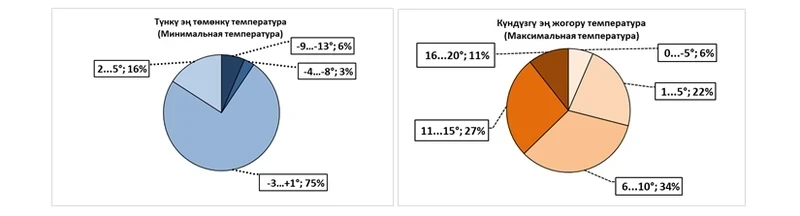
Abdrakhmatov noted that the Institute of Water Problems and Hydropower is actively engaged in issues related to global climate change.
“The main task of the institute is to study problems related to water resources and the reduction of glaciers. Our dependence on the quantity and condition of glacial areas is enormous. Research shows that the situation is bleak worldwide,” he emphasized.
In his opinion, if the average temperature on the planet has increased by 1.5 degrees due to global warming, in our region this figure reaches 2-3 degrees. If this trend continues, we can expect the disappearance of some glaciers, especially those smaller than 1 km², within 30 years.
The glaciers that remain will significantly shrink in size and length. Unfortunately, no one can currently offer a real way to preserve them. Some suggest covering the glaciers with something, but this will not solve the problem, as we have over 6,000 glaciers, and there are not enough resources for that. We must be prepared for the consequences today.
Today, the state of Issyk-Kul was also discussed. This is a very relevant topic, as the lake is not only decreasing in size but also suffering from significant anthropogenic pollution. Blue-green algae, which are actively multiplying, have become a real problem. Moreover, it seems to me that wastewater treatment facilities exist only in Cholpon-Ata and Balakchy, while in other settlements there are none, and all pollution ends up in the lake.
Issyk-Kul is a closed lake. Previously, about 88 rivers flowed into it, but now only 35, and no river flows out. Everything that enters the lake either settles or is processed.
If such rates of pollution continue, in a few decades we may see a terrible picture: the lake will become foul-smelling and unsuitable for swimming, and there will be no fish in it. Despite rumors that the lake may dry up, it will not disappear, as its structure is unique — the depth reaches about 700 meters. But its condition may become critical.
It is important to consider ecological capacity. When it is said that there were 3 million tourists last year, the question arises: how many can Issyk-Kul actually withstand? We need to have an understanding of this in order to take timely measures.
We understand that people need jobs, and this brings income. But Issyk-Kul requires a special approach. For example, we could stop accepting tourists from the end of August, but we do not have such a practice — only calls to develop winter sports.
While I support development, it should be based on real indicators: ecological capacity, the presence of wastewater treatment facilities, and water resources.
I was born in Issyk-Kul, in Kadji-Sai. I remember crossing full-flowing rivers in my childhood, and now many of them have disappeared, as the glaciers that fed them have also vanished. In Kyzyl-Suu, there used to be a real river, but now there is barely any water flowing there.
This is a serious problem that needs to be addressed at the state level. A strict program is necessary. There are only five people working in the biosphere territory of Issyk-Kul.
Previously, it was prohibited to park cars near the water in the biosphere territory, but now temporary guesthouses have been built on the southern side. They say this is temporary, but the number of houses has reached thirty. And where do the waste go?
In my opinion, the law on the biosphere territory is not being enforced. Until there is strict state control, the situation will not change. It should not be the case that everything starts working only when “the general arrives.”
The system must function independently. All elements must work in unison, and that is the system,” he concluded.