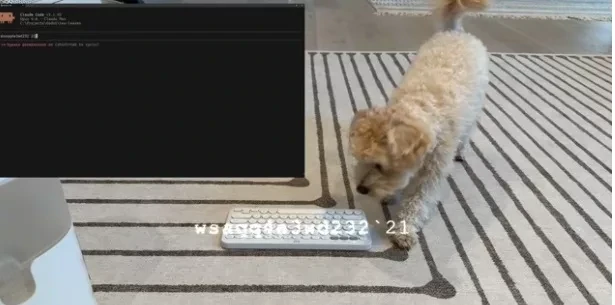
Caleb Leak, the author of a YouTube channel, conceived an unusual experiment: to make a neural network create code for a game based on commands it received from his dog. Momo, by playing with her paws on the keyboard, sent random symbols that the AI turned into a finished project on the Godot engine.
For this experiment, Caleb chose a dog named Momo, a Cavapoo breed. The owner placed a Bluetooth keyboard on the floor, which was connected to a Raspberry Pi 5. Every time Momo stepped on the keys, a special feeder rewarded her with a treat.
However, the key presses were not wasted. An application written in Rust transmitted each press to the neural network service Anthropic Claude Code, which interpreted the commands as random symbols: "skfjhsd#$%" and similar.
To prevent the neural network from rejecting these meaningless sequences, Caleb devised a legend in which the AI was to consider itself an eccentric game designer communicating in encrypted commands. The task of the neural network was to decode these commands and write code for the game.
The experiment was successful. The process from the first paw presses to the finished game took between one to two hours. Development was conducted on the Godot 4.6 engine, and the logic was programmed in C#.
As a result of the experiment, a game called Quasar Saz was created. The game's plot revolves around the heroine Zara, who battles distorted sound. The game features six levels and a final boss battle. The visual style of the game is stylized after the eighties.
This experiment demonstrates that modern neural networks are capable of generating functional code even based on requests containing random and meaningless symbols.
[img]https://www.youtube.com/embed/8BbPlPou3Bg?feature=oembed[/img]