
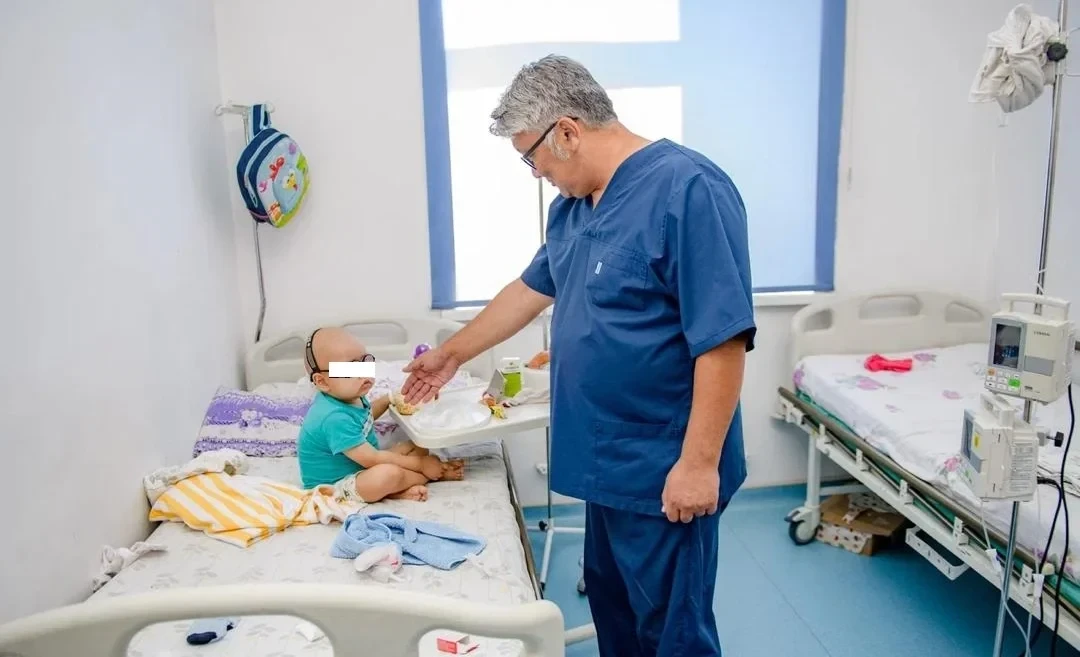
– There are indeed serious problems in the field of pediatric oncology. Even with sufficient funding, this area of medicine remains one of the most challenging. This year, we are completing an important project that includes preparations for conducting independent bone marrow transplants. This will be a significant step forward, as currently such operations are mainly performed in other countries, such as Turkey or India.
– What conditions are necessary for this?
– First of all, we need special rooms with laminar ventilation to ensure high sterility. Currently, the equipping of such facilities is nearing completion, and we expect to be able to perform bone marrow transplants at our institution soon.
– How is laboratory diagnostics, which is the foundation of modern oncology, progressing?
– We need molecular diagnostics, immunohistochemistry, a FISH laboratory, and, importantly, qualified specialists. In children, tumors often look the same under a microscope, so without modern methods, it is impossible to establish an accurate diagnosis and select appropriate treatment.
Immunohistochemistry is used worldwide; however, for our department, it is economically unfeasible to have a complete set of equipment, as we observe only about 80 patients annually. Therefore, we hope for the development of this technology at the National Oncology Center. If it is implemented there, we will turn to them for assistance. The same situation applies to radiotherapy.
– Are these areas included in state plans?
– Yes, this is reflected in the strategy. The development of both immunohistochemistry and radiotherapy is planned. Recently, we signed a contract for the supply of radiation equipment from India, which opens good prospects for treating our patients.
– Are there timelines for the implementation of these plans?
– We expect this to happen this year. Although I do not have all the details, I know for sure that the process has been initiated, and we are moving forward. We have also developed a project to create a FISH laboratory, which will allow us to identify tumor mutations. This will enable us to determine in advance whether a tumor will be resistant to standard chemotherapy and to start more effective treatment immediately. The equipment for this already exists, and we expect to have our own FISH laboratory within a year, significantly increasing the chances of saving children.
The key strength of Western medicine lies in its high level of laboratory equipment. They can determine the presence of mutations in tumors in advance, which can affect the effectiveness of treatment. Based on this, the doctor decides to switch the patient to more complex methods, such as targeted therapy or radiotherapy.
In our country, diagnoses are most often made based on histological data. We see the tumor, know its type, and apply standard treatment regimens. However, the protocols indicate that there are specific groups of tumors that require an individual approach, which cannot be achieved without molecular diagnostics.
– What is needed for the implementation of immunohistochemistry? Is it just equipment, or are specialists also needed?
– First of all, equipment is necessary. But in our projects, we always consider the need for training. Laboratory technicians must undergo training and learn to work with modern methods.
– But for now, parents have to send tests abroad, which delays the process and creates additional financial difficulties. Do you accept research results conducted outside the country?
– Yes, we take such results into account when assessing risks and choosing treatment regimens. We strive to compensate as much as possible for the lag in pediatric oncology, understanding that this area requires special attention, unlike adult oncology, where prevention is possible.
– So screening programs are ineffective here?
– Correct. Preventing pediatric oncology is impossible. Children do not smoke and do not work in harmful industries. In most cases, it is the result of random genetic mutations. The effectiveness of screening programs worldwide has shown zero results, as documented in WHO reports.
– What should be emphasized?
– Early detection and strengthening the primary care level – pediatricians. We are developing a system where, if two or more symptoms of pediatric oncology are present in the electronic outpatient card, a "red flag" will be automatically signaled, and the child will be referred to an oncologist. Since there are no pediatric oncologists in clinics, pediatricians play a key role, and their qualifications must be improved.
– How is the staffing situation? Are there enough doctors in pediatric oncology?
– We would like to increase the staff. If the number were expanded, we could attract more doctors.
– Is the problem of staff shortages related to low salaries?
– Both of these problems exist. But now doctors are starting to come into pediatric oncology. Although salaries remain low, they have significantly increased compared to what they were before.
– But is that enough for such a responsible job?
– Certainly, it is a great responsibility, and working with parents can be very difficult. They often perceive the situation very acutely and may blame the doctors. Nevertheless, compared to what it was before, the level of medicine has significantly increased. We even perform endoprosthetics independently.
– Speaking of endoprosthetics, it is known that in neighboring countries, such as Kazakhstan, Uzbekistan, and Russia, endoprosthetics for children with bone sarcomas are provided by the state. Unfortunately, in Kyrgyzstan, there is no such support, and the cost of one endoprosthesis can reach 20 thousand dollars, which is a serious financial burden for families. Are you working on solving this problem, and what prospects exist?
– We are discussing this issue and looking for suppliers. If companies start registering oncological endoprostheses in Kyrgyzstan on a permanent basis, there may be the following mechanism: the state will allocate a certain amount, and as needed, prostheses of the required size for a specific child will be purchased – funds will be allocated from this fund.
– Is the government ready to allocate such funds?
– These funds can be included in the general budget for chemotherapy drugs. Based on the average number of children with such diagnoses per year, it is quite feasible to plan these expenses.
This year, we plan to negotiate with several companies so that they approach "Kyrgyzpharmacy" and start registering oncological endoprostheses, which will allow them to be included in applications for the high-tech fund.
– Who are the potential suppliers?
– Primarily Turkey and Germany; we are also considering the possibility of cooperation with China.
– How has funding for pediatric oncology changed in recent years?
– Significantly. If 5–6 years ago about 10 million soms were allocated for medication, now it is from 100 to 200 million soms per year. There has been a centralization of procurement, and today we are treating diseases that we could not treat before.
– Nevertheless, posts regularly appear on social networks where parents or children ask for help, raising money for treatment abroad. Why does this happen?
– This mainly concerns patients who require second-line treatment. Previously, children simply did not survive to this stage. Now we can bring them into remission, but unfortunately, relapses occur. Treating relapses requires high technologies, and therefore families have to seek funds and go abroad.
– What innovative technologies do you consider a priority for implementation?
– Robotic surgery, molecular diagnostics, targeted therapy, and much more. In pediatric oncology, we are talking about high technologies. If previously the survival rate was about 20%, now it has approached 50%. According to forecasts, this number may reach 60%.
– You mentioned international projects. How significant are they?
– It is extremely important for us to enter the global WHO platform and St. Jude's clinic. If we manage to win, we will be able to provide medications for primary treatment, and the freed-up funds can be directed to high-tech medicine.
– What budget do you think is necessary for treating pediatric oncology?
– At least 300–400 million soms per year, and preferably more. For example, the treatment of one patient with neuroblastoma, which remains our "pain point," costs about 300 thousand dollars abroad. More than 10 children with this diagnosis are registered annually in Kyrgyzstan. At the same time, very expensive medications are required: the price of one vial is about 50 thousand dollars. One patient undergoes six courses, each requiring two vials. In total, the amount becomes astronomical.
– How do you cope with this situation without the necessary funding?
– We strictly follow protocols. In the case of high-risk neuroblastoma, bone marrow transplantation offers a chance of cure for about 40% of children. If we add one immunotherapy drug, this figure rises to 60%, and with another, it reaches 80%. If effectiveness reached 100%, the government would certainly purchase these drugs. But neuroblastoma remains one of the most challenging tumors to treat in the world, and there are only a few clinics that have achieved good results; it mainly comes down to financial capabilities.
– How closely do you adhere to treatment protocols, and how do they align with global standards?
– We cannot fully comply with global standards. We adapt protocols to our real conditions. This is practiced in all countries, even in places like Turkey or Russia, where adapted versions of protocols are used. In most cases, we meet the requirements; however, there are diseases where this is extremely difficult due to high technologies: expensive drugs, cyber-knife, and complex equipment. Such technologies are currently unavailable to us, but if we compare the current state with what it was before, the progress is evident.


