
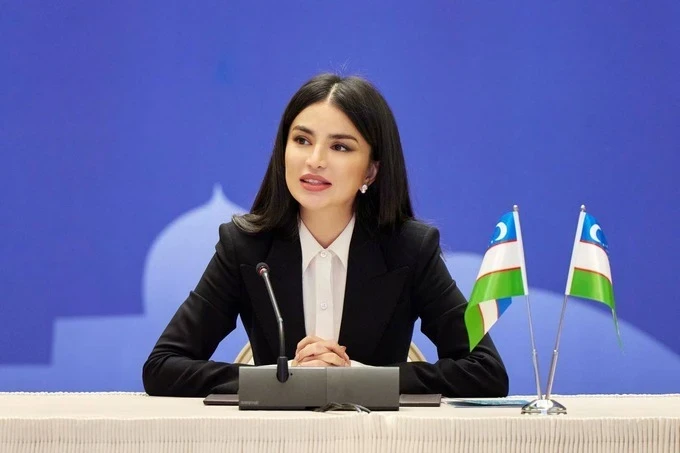
In Ibrahimova's article, it is emphasized that as the initial positive results of the reforms began to fade, the government of Uzbekistan started to use proven practices from Karimov's past. For instance, the growing influence of family ties on state decision-making is becoming increasingly noticeable. Under Karimov, his daughter Gulnara played a significant role, and now Mirziyoyev is following the same path—his elder daughter Saida recently headed the presidential administration, effectively becoming the second person in the country.
Thus, Mirziyoyev's rule, which was initially positioned as a rejection of Karimov's legacy, is starting to resemble a continuation of old practices with minor changes.
The cult remains, the fear has gone
Throughout his years in power, Mirziyoyev has portrayed himself as a reformer opening Uzbekistan to the world, in contrast to Karimov's isolated rule. The reforms known as "Uzbekistan 2.0" included economic liberalization, free currency conversion, reforming the banking and tax sectors, privatizing state enterprises, and expanding political freedoms.
The reforms yielded quick results: the country became attractive for foreign investments, active construction began, business processes were simplified, tourism developed, and unemployment and poverty levels decreased. Uzbekistan is actively developing international ties and hosting various events.
There was also a slight reduction in the atmosphere of fear characteristic of Karimov's era. The powers of the State Security Service were significantly reduced, and its head was replaced by the president's in-law, Batyr Tursunov. The National Guard, composed of Interior Ministry personnel, began to play a key role in the country's security system.
Mirziyoyev gathered around him young technocrats who introduced new practices, such as active use of social media and engagement with society. Regional authorities were given more powers, allowing them to manage budgets more freely, and businesses became more active in foreign markets.
However, over time, the positive results of the reforms began to fade, and the authorities preferred not to continue them but to return to old methods. In particular, the powers of the regions were curtailed, as the redistribution of power led to decisions being made by often less competent and corrupt officials.
It is noticeable that officials have begun to use the rhetoric of the president's predecessor more frequently, rather than speaking about the need to strengthen other branches of power. Loyalty to the president became the main guarantee of retaining positions, and public speeches by officials began with lengthy expressions of gratitude to the head of state.
A similar situation is observed in the state's attitude towards business. At the beginning of his rule, Mirziyoyev aimed to create a layer of modern entrepreneurs who were to become a source of legitimacy for the regime. However, it soon became clear that liberalization and market mechanisms do not guarantee the loyalty of the business community, leading to the incompleteness of many reforms.
The system of distributing benefits and subsidies also remained the same: instead of reforming, the authorities preferred to distribute them based on loyalty, while businesses showing independence faced increased taxes and inspections.
Overall, the deepening of Mirziyoyev's reforms would require strengthening other branches of power and business, which the regime was not prepared for. As a result, the logic of consolidating power overshadowed the initial reformist approach.
Family as a source of power
Another feature of Mirziyoyev's rule, reminiscent of Karimov's methods, has been the active involvement of family members in the governance of the country. The president's elder daughter Saida soon after her father's rise to power headed the communications sector in the administration, while her husband Oybek Tursunov became the deputy head of this department.
The younger daughter Shakhnaz was appointed as the first deputy head of the National Agency for Social Protection, and her husband Otobek Umarov took the position of deputy head of the State Security Service. The president's wife Ziroatkhon Khoshimova also gained significant influence, overseeing healthcare and pharmaceuticals, as well as impacting personnel decisions. Other family members also acquired large business assets or took important positions in state structures.
This resembles the times of Karimov when his relatives had significant influence. Gulnara controlled large businesses, and Timur Tillyaev, the husband of the younger daughter Lola, owned a significant market in Tashkent. However, the political influence of the Karimov family remained limited, and Gulnara's attempt to expand her role ended in conflict and arrest.
The Mirziyoyev family, unlike Karimov's, appears more united, and the president likely sees it as a reliable support, especially at the beginning of his rule when he had few trusted allies. The family's role became particularly noticeable after two crises: the first in Karakalpakstan in 2022, when protests against constitutional changes were suppressed by force, and the second—the energy crisis in the winter of 2022-2023, when the gas shortage left people without heating.
These events seriously undermined Mirziyoyev's image as a reformer and liberal and heightened his distrust of the bureaucracy, leading to an increased role for the family, particularly Saida. She took control of the implementation of presidential decisions in Karakalpakstan and expanded her powers, overseeing various projects.
Saida quickly became the president's main confidante, her powers grew, and in practical terms, she surpassed any minister. However, this elevation did not come without friction within the family, which surfaced after an assassination attempt on Komil Allamjonov, Saida's mentor. Otobek Umarov was considered a likely mastermind, indicating internal conflicts.
As a result, Saida strengthened her position by heading the presidential administration in 2025 and institutionalizing her role in the power system.
Prospects
Today, Saida Mirziyoyeva is seen as a potential successor to the president, although there are no formal grounds for this—the constitutional reform reset Mirziyoyev's terms, allowing him to remain in power until 2037. Nevertheless, discussions about the possibility of hereditary power transfer continue.
The strengthening of Saida's role is also a result of the centralization and personalization of the president's power. In ten years in office, he has not created a team of trusted allies or expanded the powers of state institutions, leaving control in the hands of a narrow circle. Starting as a reformer, Mirziyoyev risks becoming another autocrat.
It is clear that relying on family for Mirziyoyev is an attempt to ensure security in case of losing power, but such methods have repeatedly demonstrated their ineffectiveness. In the long term, the current management system, based on the absence of strong institutions, cannot guarantee stability. The transfer of power by inheritance is a complex task, and the arrival of a new leader can quickly disrupt informal rules. The fate of Gulnara Karimova and other members of the first president of Uzbekistan's family serves as a vivid example of this.


