
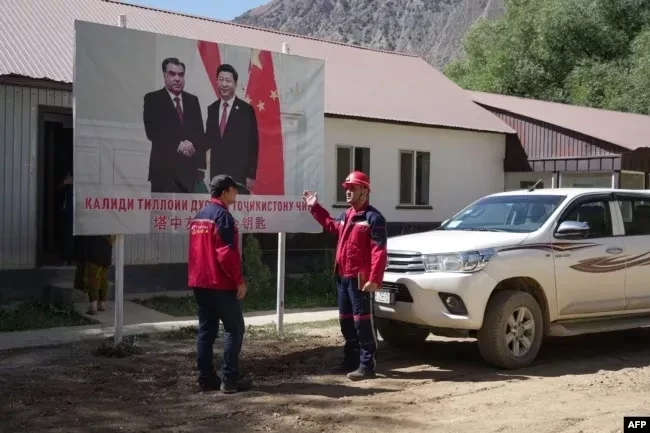
In Tajikistan, where Chinese companies are actively developing the mining sector, road construction, and industrial projects, they are now facing growing discontent from local communities, reports Ozodi.
One recent incident involved employees of the Zarafshan gold mining enterprise, located near Penjikent — one of the largest mining operations managed by Chinese investors. In November, a group of workers expressed dissatisfaction with their salary levels and appealed to management for a raise.
The workers stated that "the current salary level does not correspond" to the rising prices and does not take into account the pay gap with their Chinese colleagues. This marked a rare instance of collective protest for miners working in one of the country's toughest industries.
According to two anonymous employees who spoke to RFE/RL, miners' salaries range from 2000 to 4000 somoni (approximately 215-430 USD). However, their demands for a salary increase and the elimination of the pay gap were rejected by the Zarafshan mining company.
“The work here is physically demanding and dangerous. We expect our salaries to reflect that,” shared one of the miners.
This conflict highlights the growing tension at Zarafshan, which has become a symbol of both opportunity and perceived inequality since its opening in 2007.
The Zarafshan complex, which accounts for 70% of all gold production in Tajikistan, is of strategic importance to the country's government. President Emomali Rahmon praised its contribution during his visit in July 2023.
Local workers also complain about the lack of transparency in management and the significant wage disparity between Tajik and Chinese workers.
In response to the workers' appeals, the company's director stated that a decision to raise the base salary would not be made. Instead, a new bonus system was proposed, set to take effect in 2026.
Under this program, workers will receive additional payments: 200 somoni (21 USD) on their birthday, 300 somoni (32 USD) for New Year's, and 500 somoni (53 USD) for Navruz, the celebration of the spring equinox.
Employees who spoke with RFE/RL expressed doubts about the effectiveness of these proposals and noted that tensions between Tajik and Chinese workers continue to escalate.
“Bonuses are good, but they are not enough to improve our lives,” noted one of the miners.
DISSATISFACTION IN THE FLAGSHIP PROJECT
China is the largest foreign investor in Tajikistan, having invested over 5.1 billion USD since 2007. More than 700 Chinese enterprises operate in the country. In 2024, Tajik lawmakers ratified an investment protection agreement with China, providing additional legal guarantees for Chinese investors.
However, Chinese-involved projects face challenges.
An Ozodi investigation in 2024 revealed environmental issues in several Chinese mining and agricultural zones, including Zarafshan. Locals reported health problems, suffering from premature births and respiratory illnesses, although Tajik authorities denied these allegations.
Conflicts underscore the growing distrust between local communities and the authorities overseeing foreign projects. There are concerns that Chinese companies operate without adequate oversight from Tajik authorities.
At Zarafshan, there is tension between Tajik workers and Chinese specialists, who mainly hold technical and administrative positions, with their salaries remaining undisclosed to the public.
One Tajik employee of Zarafshan, who wished to remain anonymous, reported that after complaints about low wages, the company divided the accounting department into two sections: one for Chinese workers and another for Tajik workers.
According to him, a retired finance department employee spoke of a significant pay gap between Tajik and Chinese engineers.
“If a Tajik engineer earns between 5000 and 7000 somoni, his Chinese counterpart can earn up to 30,000-40,000 somoni,” he explained. “Chinese employees work eight hours, while some Tajik workers have to work up to 11 hours a day to earn more, although the standard workday is eight hours.”
RFE/RL was unable to verify this information, and the Zarafshan company did not respond to requests for comments.
Allegations and a lack of transparency contribute to a widespread perception in Tajikistan that Chinese workers receive preferential treatment. Tensions between workers sometimes escalate to the point where Tajik authorities need to intervene.
In 2025, at the request of the Penjikent prosecutor's office, Zarafshan transferred over 1000 Tajik workers from a contract system to permanent employment.
On January 13, the Penjikent prosecutor confirmed the existence of "various violations of labor rights" at the mine, but did not provide further details.
OUTBREAKS OF VIOLENCE AND UNCERTAINTY AROUND INVESTMENTS
Labor conflicts coincided with growing concerns about the safety of Chinese projects across the country.
Since December 1, work on a crucial section of the Dushanbe–China road has been suspended due to two deadly attacks near the Afghan border.
On November 30, armed assaults resulted in the deaths of two Chinese workers and injuries to two others at a construction site in the Darvaz district, prompting Beijing to urge Dushanbe to enhance protection for its citizens.
Tajik authorities blamed the attacks on "armed terrorist groups," without providing further details. Just days before, three Chinese nationals were killed in another attack at a gold washing site in the Shamsiddin Shohin district. According to authorities, both attacks were organized from Afghan territory.
These incidents have raised concerns among Chinese contractors working along the strategic Dushanbe–Kulma route, which passes through remote areas to China's Xinjiang region. President Emomali Rahmon mentioned partial completion of the route by mid-2025; however, construction delays and new security measures cast doubt on the project's timely completion.
A wave of instability could negatively impact relations with Beijing and reduce the willingness of Chinese companies to continue their investments, which, in turn, would affect Tajikistan's economy.
Today, Chinese firms control 84% of gold production in the country, according to official data.
In addition to Zarafshan, major projects include the Pokrud gold deposit located south of Dushanbe and the TALCO Gold mine, valued at 136 million USD, developed in partnership with the Chinese company Tibet Huayu Mining. The development of this sector has contributed to increased exports for one of the poorest countries in Central Asia, but has simultaneously heightened its dependence on Chinese investments.
Meanwhile, for workers at Zarafshan, rising prices and the lack of salary increases remain pressing issues.
“We do the hardest work, but the fruits of our labor go to others,” claims one of the Tajik workers at the mine who spoke with RFE/RL.


