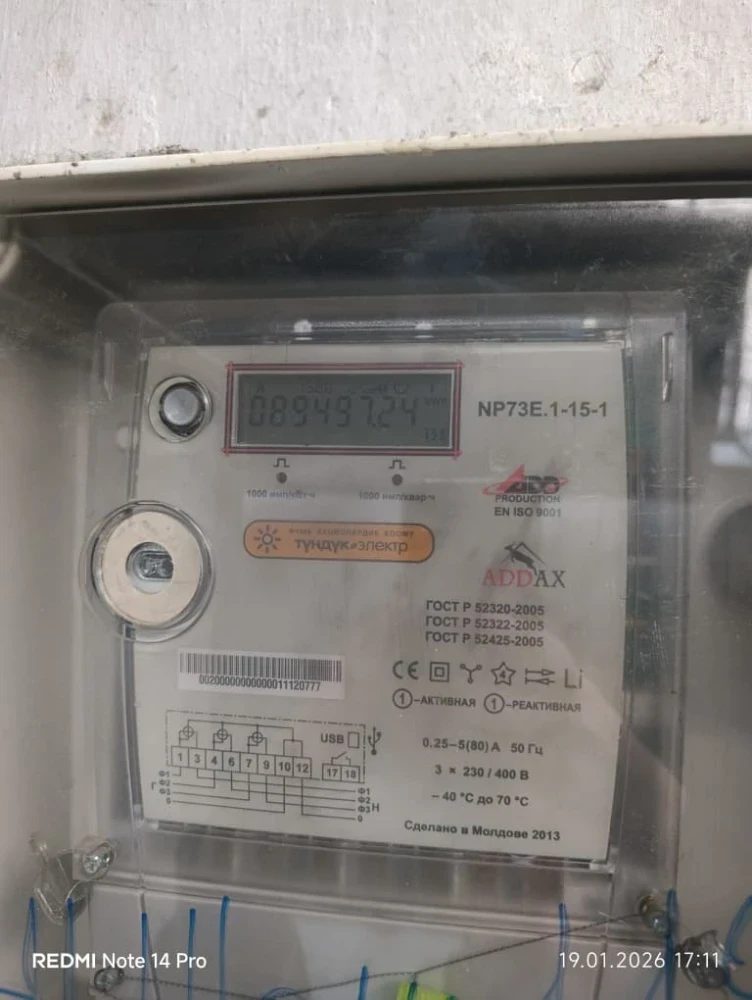
As of 2025, electricity consumption increased to 19,094.8 million kWh, which is 4.7% more than in 2024, when this figure was 18,235.0 million kWh. The main reasons for the increase in consumption are the construction of new residential and industrial facilities, as well as the growth in the number of users and the connection of new consumers to the power grids.
As of January 1, 2026, the total number of consumers reached 1,621,292, of which 1,503,813 are residential and 117,479 are non-residential. In 2025, the number of consumers increased by 36,287, including 30,976 from the residential sector and 5,311 from the non-residential sector.
Kaktus.media conducted an analysis of the winter season 2025-2026 and compared it with the official data from the Ministry of Energy.
Limits: Pros and Cons
Let's start with the discussion of limits. The Ministry of Energy explained that they were introduced due to the low water level in the Toktogul reservoir to ensure stable electricity supply. During peak consumption hours (from 06:00 to 09:00 and from 18:00 to 22:00), the power supply was restricted.Specifically:
- the power for single-phase consumers was reduced from 5 kW to 3 kW;
- for three-phase consumers - from 8 kW to 5 kW.
Thanks to the prompt actions of energy workers, such risks were successfully eliminated.Nevertheless, residents of the country began to express dissatisfaction with the reduction of limits even before the official announcement about them. Energy workers did not report the introduced restrictions for a long time. When discontent became widespread, they confirmed the existence of limits.
This caused significant inconveniences: people had to choose what to turn on - the kettle, the washing machine, or the electric stove, as they could not operate simultaneously. Those with "smart" meters had it easier - they could immediately restore power when it was cut off.
Subscribers with regular electronic meters found it more difficult. In the regions, power was reduced for the entire network during peak hours, leading to flickering even of energy-saving bulbs. Forget about boilers, electric stoves, and kettles.
Were there outages? Two opinions on one situation
In the energy workers' report, there is a statement that caused confusion: there were no power outages during the winter season. But what happened on cold days? Ah, those were "regulatory measures."In September of last year, Minister of Energy Talaybek Ibraev mentioned the critically low water level in three reservoirs and predicted that the upcoming winter would be very challenging. Almost immediately after this statement, complaints about constant power outages began to arrive. The Chui Electric Networks enterprise reported the introduction of temporary regulatory measures due to the repair of electrical equipment at the intersystem substation. This situation was observed not only in the Chui region but throughout the country.
Moreover, power outages occurred not only due to regulatory measures but also because of repairs. Throughout the winter, certain areas suffered from outages for several hours for this reason. Energy workers conducted both planned and unplanned work. While in previous years all repairs ceased in November, this winter season was different.
Although officially there were no outages. This is indeed the case.
Repair and Construction of Stations
The Ministry of Energy believes that the preparation for the winter season was successful."The increase in capacity was made possible by updating outdated equipment and reconstructing major hydropower plants, as well as constructing small hydropower plants and substations," representatives of the ministry reported.
About the launch and repair of which power plants Kaktus.media reported from September 2025 to March 2026:
- On December 24, 2025, President of Kyrgyzstan Sadyr Japarov participated in the opening of the first solar power plant with a capacity of 100 MW in the Kemin district. Investments amounted to $56 million;
- A small hydropower plant "Shamshy" was launched in the Chui region. $1 million was allocated for the project;
- At the Toktogul and Uch-Kurgan hydropower plants, the reconstruction of hydro units was completed. This allowed increasing the capacity of the Toktogul hydropower plant from 1,200 to 1,440 MW, as well as implementing a modern automated control system. At the Uch-Kurgan hydropower plant, one hydro unit was completely replaced and a second was modernized, which increased its capacity by 18 MW. The reconstruction of the remaining two units is planned to be completed in 2026, which will ultimately increase the total capacity of the hydropower plant by 36 MW;
- The Karakul hydropower plant was launched, equipped with two hydro units with a total capacity of 18 MW. The project was implemented by a domestic investor - LLC "Zhagalmai" - for $25 million, and the hydropower plant will be transferred to the state after 15 years of operation;
- At the Uch-Kurgan hydropower plant, the modernization of two hydro units is being carried out simultaneously, which is a continuation of the work to increase the capacity of the station.