Money transfers and the increase in gold and foreign exchange reserves help maintain the payment balance at a stable level.
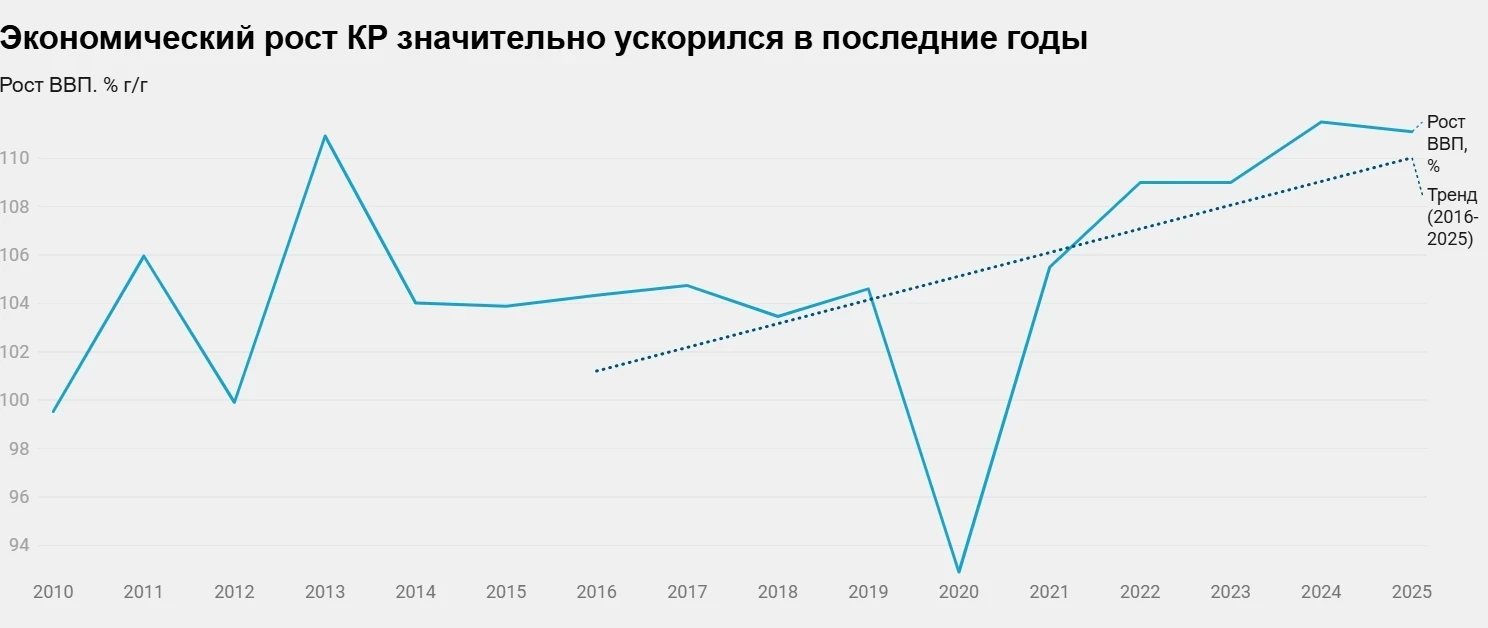
According to the results of last year, the economy of Kyrgyzstan grew by 11.1% in real terms. Despite the existing trade balance deficit of $10.1 billion, the payment position remains balanced thanks to money transfers and the rapid increase in gold and foreign exchange reserves, as reported by Alisher Karimov, lead analyst at Kursiv Research.
Macroeconomic Indicators
The economy of the Kyrgyz Republic (KR) continues to demonstrate high growth rates, projected at 9.2% per year from 2021 to 2025. According to preliminary data from the National Statistical Committee of the KR, in 2025 the country's GDP may reach nearly 2 trillion soms (about $22.6 billion), which is 13 times less than the corresponding figure for Kazakhstan. The high growth rates in recent years are explained by the effect of a low base.
Kyrgyzstan has benefited from changes in the region in recent years: many relocators have arrived in the country (up to 340,000 from 2022 to 2023), and the demand for labor migrants in Russia has significantly increased. According to the World Bank, from 2010 to 2024, the volume of money transfers to Kyrgyzstan amounted to about 28.1% of GDP.
In the first quarter of 2025, the number of registered labor migrants from Kyrgyzstan in Russia increased by 6.6%, rising from 352,000 to 377,000 people (according to estimates from the International Organization for Migration), meaning that one in eight working-age citizens of Kyrgyzstan worked in the Russian Federation.
As a result, the volume of money transfers to Kyrgyzstan in the first nine months of 2025 increased by almost 25% compared to the same period last year. These funds, along with income from gray re-exports, helped balance the payment balance and contributed to the growth of international reserves of the National Bank of the KR (NB KR) due to favorable conditions in the gold market.
Structure of the Economy
The service sector constitutes a significant part of Kyrgyzstan's economy, accounting for 51.2% of GDP in 2025. Last year, this sector demonstrated steady growth: value added increased by 10.9% year-on-year, and the volume of market services reached 2.9 trillion soms (an increase of 14.8%).
Trade remains the main driver of economic growth, accounting for 76.3% of all services, with turnover increasing by 17.8% to 2.2 trillion soms. The financial sector and insurance rank second in importance, amounting to 290.7 billion soms (9.9% of all services) with a slight increase of 0.8%. Logistics (+6.5%) and HoReCa (+14.3%) also showed positive results.
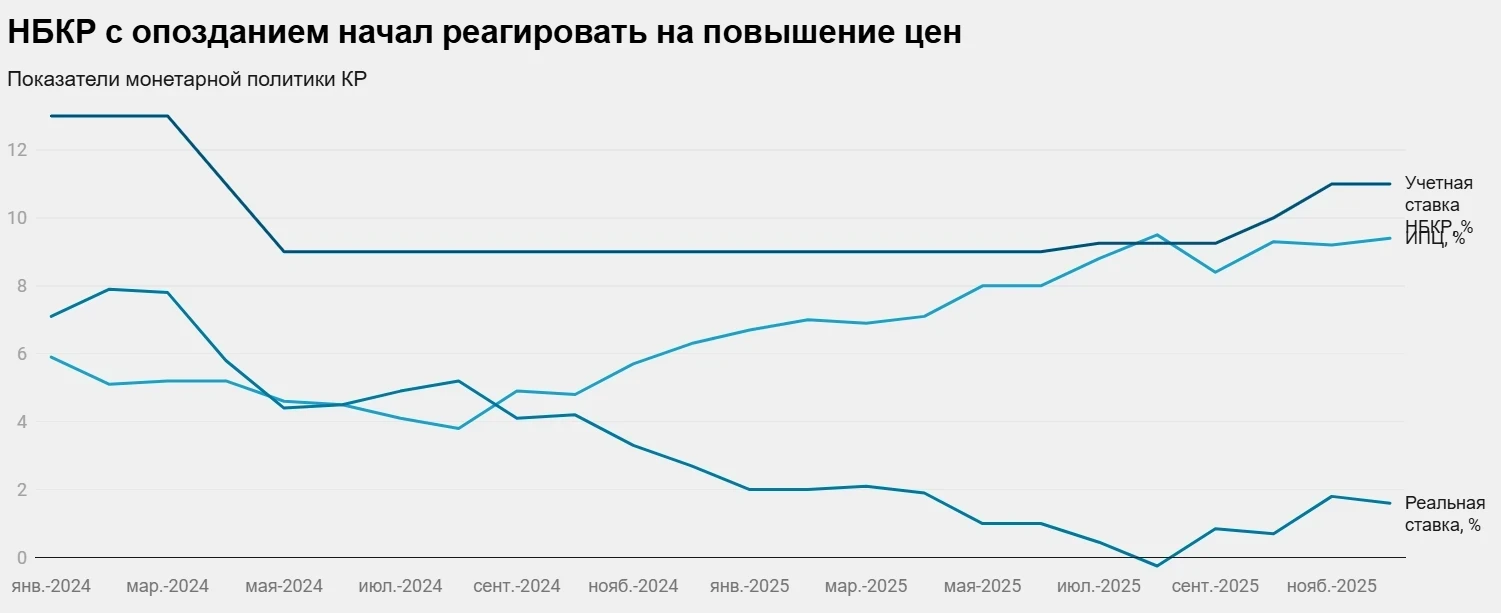
The growth of the service sector is largely due to increased household incomes. On average across the economy, nominal wages increased by 18.9%, while inflation at the end of the year was 9.4%. Consumer activity is supported by stable money transfers and accessible consumer loans.
The manufacturing industry ranks second in the economy, accounting for 13.7% of GDP, with growth rates of 9.8%. The main sectors, which make up 90% of the total volume, are metallurgy, food industry, and the production of rubber products. Metallurgy holds the largest share – 62.2% of the total processing volume, while the food industry saw a growth of 30.1% due to increased production of soft drinks, pasta, and distilled alcoholic beverages.
The construction sector, which accounts for 8.7% of GDP, has shown growth of over 20% for the second consecutive year, driven by large state projects in infrastructure, energy, and housing construction, including the construction of the Kambarata HPP-1.
By the end of 2025, the volume of investments in fixed capital reached 374.6 billion soms, increasing by 18.4% in real terms.
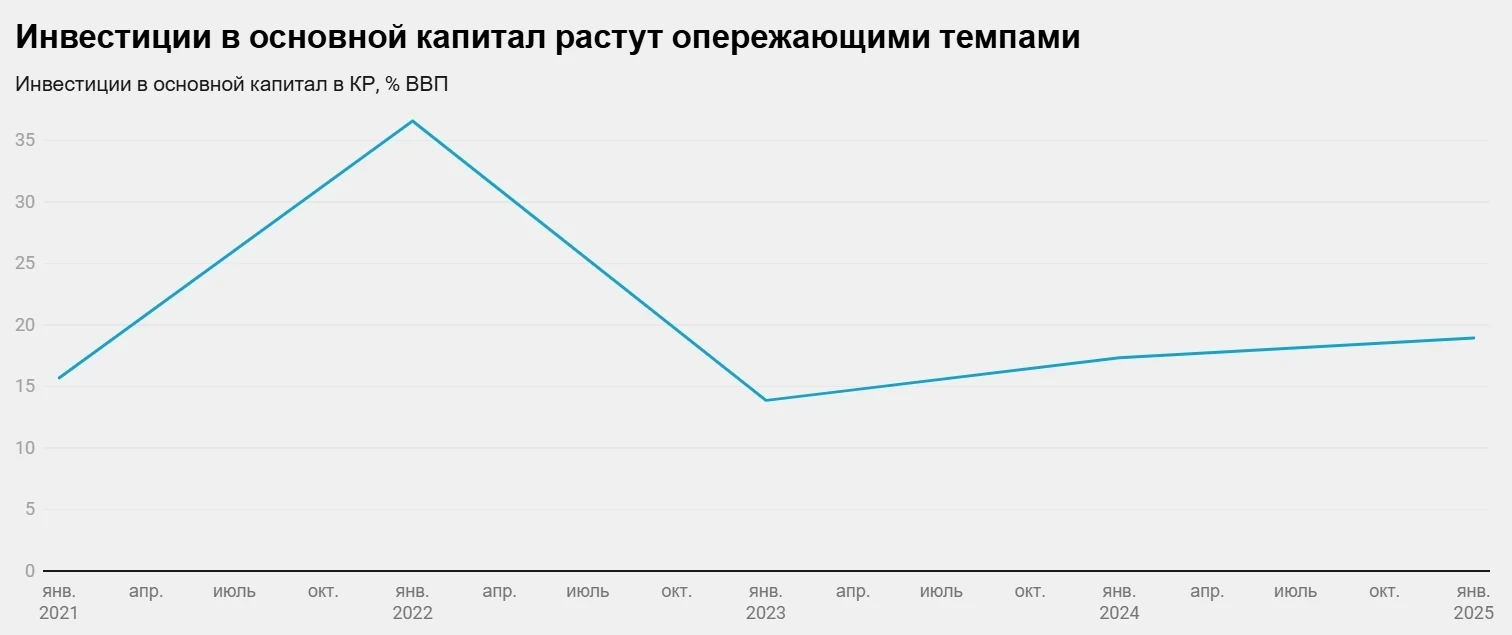
In the structure of investments, there is a decrease in the share of the mining sector, from 18-22% in 2020-2024 to 7.8% in 2025. At the same time, the share of investments in transport and logistics has significantly increased from 8-12% to 17.5%.
Inflation and Monetary Policy
The monetary policy of the NB KR in 2025 was aimed at maintaining price stability in the context of high domestic demand and instability in global markets. The medium-term inflation target is set at 5-7%.
In the first half of 2025, the rate remained at 9%, despite a slight inflation overshoot. The main factors driving price growth were household incomes and remittances from abroad. The situation worsened after tariff increases in May, leading to the real rate entering negative territory.
The exchange rate of the som to the dollar remained stable throughout 2025, with regular interventions by the NB KR, which intervened in currency trading, with a total amount of $853 million. Imports ($13.0 billion) significantly exceeded exports ($2.9 billion), contributing to the trade balance deficit. Gold exports decreased by 72.8%, while supplies of ores and concentrates of precious metals increased.
By the end of 2025, the trade balance deficit amounted to $10.1 billion, equivalent to 44.3% of GDP, partially compensated by remittances from migrants.
Fiscal Policy and Forecasts
In 2025, the state budget was executed with a surplus of 50.2 billion soms. The expenditure part of the budget increased by 45.9%, while revenues grew by 44.9%.
Forecasts for 2026 from the EDB suggest economic growth of 9.5%, while the IMF and the World Bank expect more modest growth rates of 5.3-5.5%.
IMF analysts warn of a possible weakening of the re-export effect and an increase in the deficit in case of rising equipment imports. Prices for gold and energy resources are also at risk.
By the end of 2025, nominal GDP per capita approached $2,800, and the unemployment rate decreased to 3.7%.
The government sets ambitious goals for 2030, including increasing GDP per capita to $4,000-4,500 and the total volume of the economy to $30 billion.
photo www