
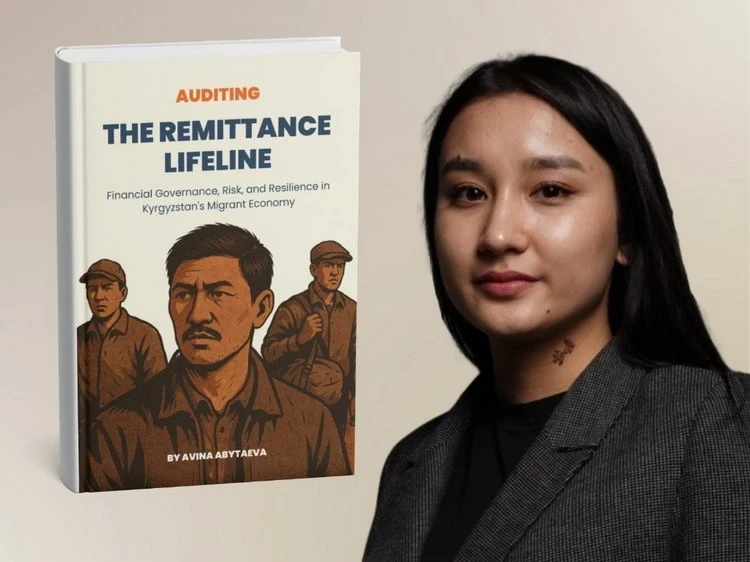
In a context where sanctions and international restrictions create difficulties, Avina's work becomes particularly relevant. She demonstrates with specific examples how to make the remittance system more reliable so that money reaches recipients on time and without loss, regardless of global crises. Avina shares her years of experience and offers solutions that can protect the financial well-being of thousands of families in Kyrgyzstan.
— Avina, how would you describe yourself to those who are meeting you for the first time? What is your professional specialization?
— I deal with issues of auditing, risk management, and ensuring the reliability of financial processes. My goal is to simplify complex systems so that they become understandable through verifiable criteria: what are the dependencies, what exceptions are influenced by the decisions made, how can we assess resilience, and what indicators truly reflect the quality of work. I tend to look not at how things should be, but at how they actually are, based on facts. That’s why I am interested in topics where formal correctness does not always correspond to real resilience.
Photo from personal archive
— Why did you choose the topic of cross-border remittances for individuals as your professional field?
— I believe this is one of the most striking examples of how a financial service becomes a pillar for the economy and society. For many households, such remittances are not a one-time assistance, but a regular and expected source of income.
When a service becomes widespread, it ceases to be just a product and turns into infrastructure.
It was important for me to study this topic from a professional perspective: what factors ensure reliability, what undermines trust, where the system may be vulnerable due to external factors, and how this can be measured. I view this area as expert-driven, as it intersects risks, technologies, regulatory norms, and human behavior.
— What led you to define remittances as infrastructure rather than just a financial flow?
— At some point, I realized that in a number of countries, cross-border remittances for individuals effectively function as a primary payment service: they are regular, large-scale, and expected. Under such conditions, remittances become not just an additional option, but an important part of the infrastructure upon which the daily financial decisions of households depend.
Infrastructure is formed when people begin to perceive remittances not as random events, but as a guaranteed element of their financial reality.
Avina Abytayeva
As an auditor, I assess this from the perspective of resilience requirements. If a service has an infrastructural role, it must meet minimum reliability standards that can be practically defined:
- availability under normal and stressful conditions;
- clear rules for users;
- manageable dependencies on partners and infrastructure;
- ability to withstand failures and recover with verified results.
It is important to note: if a failure leads to a chain reaction at the household level and undermines trust in formal channels, it becomes not just a private problem, but a systemic risk. Therefore, approaching this topic from an infrastructure perspective allows us to speak the language of resilience rather than general assessments.
— Where do you think real vulnerabilities most often lie: in technologies, processes, or management?
— I start with analyzing the service chain and its dependencies, as that is where real risk is formed. Then I examine how rules and technologies function in real exceptions, rather than in ideal conditions. Only after that do I assess how the system affects user behavior, as a mass shift to alternative methods is often a result of opacity and unpredictability. This order is important, as it allows for a systematic identification of the causes of problems and determines what exactly needs to change.
— What aspects do you consider key when evaluating such remittances as a critically important service?
— I would highlight several areas that are necessary for a comprehensive professional assessment. First of all, it is worth checking:
- the ability to maintain service continuity under restrictions, including the availability of alternative routes and scenarios;
- the manageability of critical dependencies on infrastructure and partners, so that bottlenecks are known and controllable;
- the transparency of terms and clarity of final costs for the recipient, to avoid the "surprise" effect;
- the demonstrability of recovery after incidents, including documenting causes and actual results of measures taken.
— Why do you so insistently link resilience with transparency and understanding for users?
— Because resilience manifests not in reports, but in the real experiences of users. If people do not understand why conditions have changed, how the final amount was formed, how long conversion took, or why the operation was delayed, it undermines predictability. And predictability is the foundation of trust. When trust declines, the system faces additional risk — users begin to seek alternatives that may be less transparent and harder to control. Therefore, transparency for me is not just "service quality," but an important element of resilience and risk management.
— How would you formulate your expert position in one clear conclusion?
— I believe that cross-border remittances for individuals in some countries should be considered critical infrastructure, and therefore their resilience and reliability must be assessed based on specific data. This requires a shift from merely discussing volumes to verifying actual functionality: where dependencies lie, how decisions are made under constraints, how the system recovers, and how clear the rules are for people. Under the pressure of sanctions, this becomes not a theoretical task, but a practical necessity. The sooner system participants adopt this logic, the less unpredictability there will be for households, and the higher the trust in formal channels will be.


