

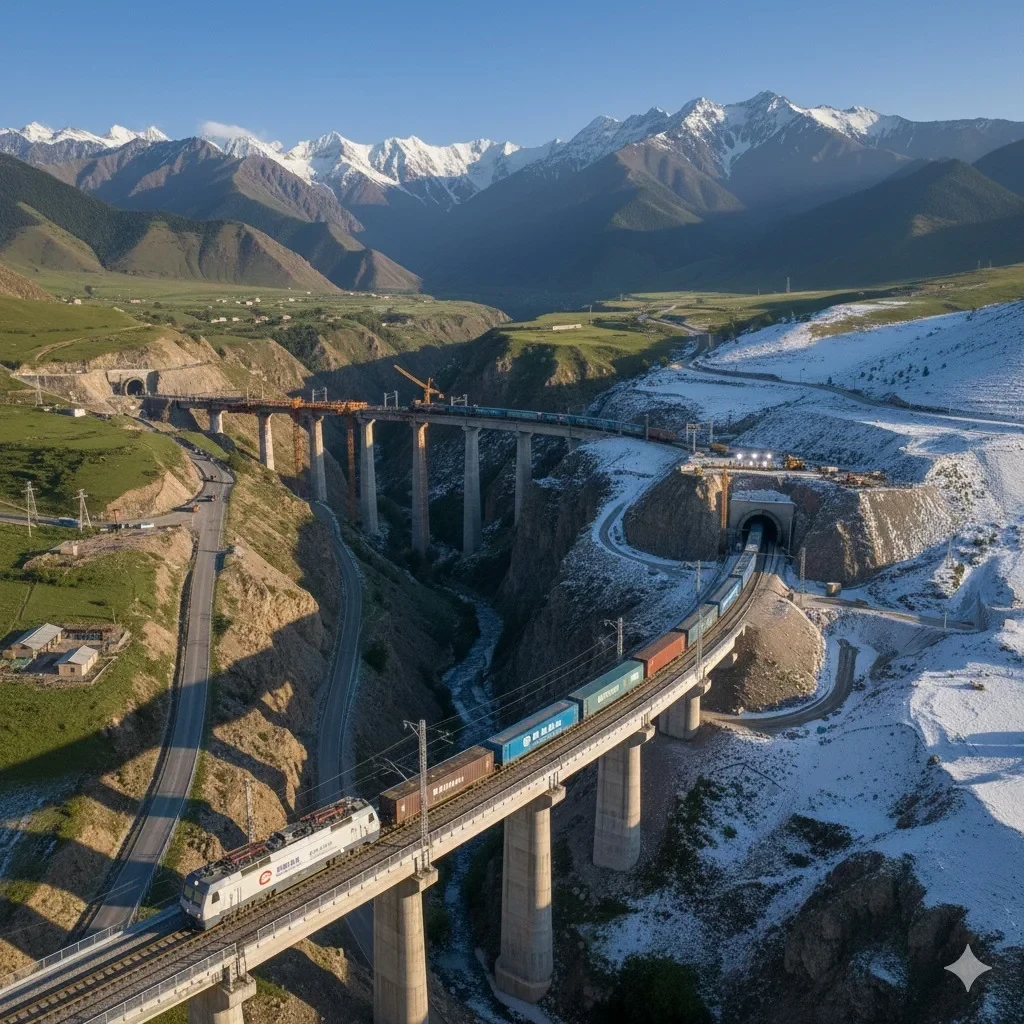


Spring of this year will mark the beginning of active actions for the implementation of the transcontinental railway passing through Kyrgyzstan. All necessary geodetic works have been completed, and financial issues have been resolved. Thus, the project is moving into the active execution phase.
The benefits that this highway will bring to Kyrgyzstan have been discussed many times. It will provide access to the sea and become the shortest connecting link between the two largest transport systems of the continent. However, these aspects only partially reflect the true scale of significance that opens up before our country. The implementation of the project will change the paradigm of development, as transit opportunities are just the tip of the iceberg.
The impact of this project will be felt in the logistics of all of Eurasia. The railway will create unique conditions for domestic industry, ensuring the import of new technologies. This project will act as a catalyst for the growth of other sectors of the economy, opening new horizons. Experts emphasize that this is not only about changing the development paradigm but also about new geopolitical opportunities.
Esin Usubaliev, Dean of the Faculty of International Relations at the Kyrgyz National University, notes that Kyrgyzstan must prepare for a transition to a qualitatively new level of interaction with international partners.

In this regard, the question arises about the country's readiness for the upcoming changes. One of the key areas becomes education — it is necessary to prepare qualified personnel in the context of the new reality.
Foreign policy requires a new generation of diplomats with knowledge in hydroenergy, water resource distribution, and transport communications, including digitalization. Usubaliev emphasizes the importance of training relevant specialists within the framework of Kyrgyzstan's participation in major international projects.
It is important to note that the railway project in Kyrgyzstan is unique due to the challenging mountainous conditions. It is considered one of the largest projects in the world, as a significant portion of the 311 kilometers of the route will pass through mountain ranges. Builders will have to construct 90 bridges and lay about 50 tunnels with a total length of over 200 kilometers.
The total costs of the project will amount to approximately 4.7 billion dollars. Initially, it was planned that construction would take 5–6 years; however, modern technologies allow for a significant acceleration of the process, and experts claim that completion within 3–4 years is possible.
“The timeframes are tightening, pushing the region towards the accelerated implementation of infrastructure projects,” noted in an interview with IA “Kabar” Yue Hefu, a senior analyst on economic and trade cooperation between China and Kyrgyzstan.
He also added that “large-scale works” will begin in the spring of 2026.

According to the latest report, of the total length of the railway of about 480 km, the section on the territory of Kyrgyzstan is 311.75 km. The geological conditions here are extremely challenging, as the route passes through the high mountains of the Tien Shan. More than 50 tunnels and over 90 bridges are planned along the entire line, with their share exceeding 80%. The tunnels through the Fergana Range and Torugart are considered particularly challenging, where work did not stop even in the winter of 2025, thanks to modern equipment.
With the rise in temperature in March 2026 and the thawing of permafrost, full-scale construction will begin. According to the Ministry of Transport's plans, this summer more than 3,000 units of heavy machinery will be deployed to construction sites in the Naryn and Jalal-Abad regions, with the main task being to complete earthworks on the high-altitude Arpa plateau and construct the infrastructure for the Makmal transshipment station.
Thus, the spring of 2026 will mark the beginning not only of large-scale works but also of a "major battle" in the history of infrastructure development in Kyrgyzstan,” concluded Yue Hefu.
A professor from China considered the economic prospects of Kyrgyzstan after the launch of the railway. According to him, the scale of changes and transformations that are already occurring is not yet fully realized. The exit from the transport deadlock will accelerate the arrival of a new economic reality, and experts are already seeing the outlines of the future.
“Previously, the understanding of the economic benefits of the railway was limited to 'transit fees.' While this income is indeed significant, conservative estimates suggest that at the beginning of operation, the annual volume of freight traffic will be between 5 and 8 million tons, and in the long term will reach 13-15 million tons. This could provide the Kyrgyz budget with about 200 million dollars in annual transit income, which will become a stable source of funding for the state.
However, focusing solely on transit fees underestimates the multiplicative effect that this railway will bring.
Firstly, it is the 'unlocking' of resources. The Naryn and Jalal-Abad regions, through which the highway passes, have significant reserves of gold, coal, and non-ferrous metals that could not previously be commercially extracted due to high transportation costs. The opening of the railway will provide access to international markets for the Kara-Keche coal mine and neighboring energy enterprises, turning 'illiquid assets' into 'working capital.'

Finally, the benefits from the export of agricultural products will also be significant. China is a huge market with 1.4 billion consumers. Previously, high-quality Kyrgyz honey, cherries, and meat products could not reach the Chinese market in large volumes due to transportation delays. The completion of the railway construction will allow our products to be delivered to Xinjiang in 24 hours and to coastal cities in China in three days. This will create a 'golden corridor' that will ensure the 'industrial modernization' of Kyrgyzstan's agriculture,” summarizes Yue Hefu.
Kyrgyzstan is actively integrating into a new geo-economic format of interaction with its closest and historical partners. Over the past few years, the country has made significant strides in its development, and the next stage is a transition to a new level.


