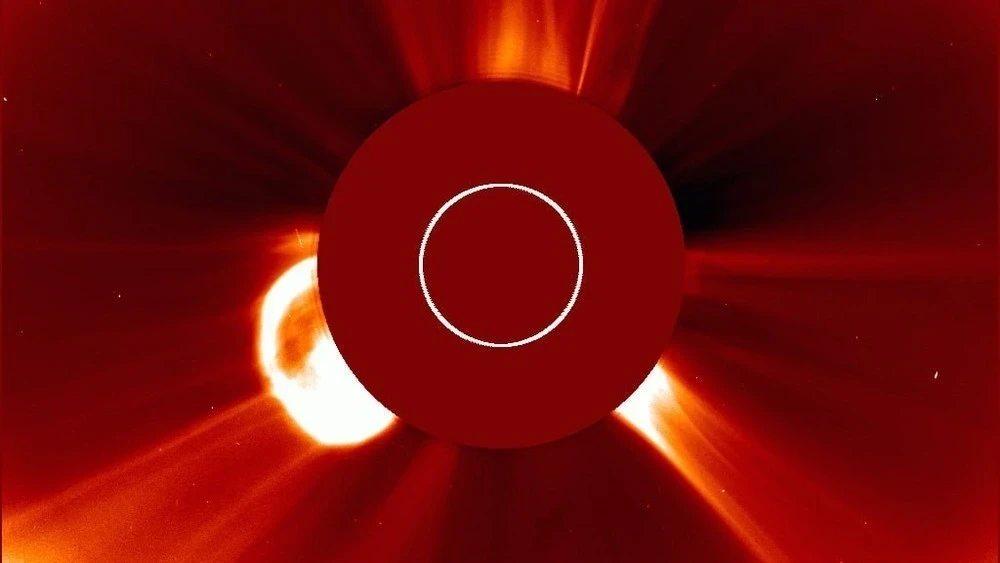
Currently, a significant ejection event is being observed on the Sun, confirmed by data from coronagraphs and analysis of X-ray radiation, researchers report.
This situation draws attention in connection with the upcoming lunar mission: a crew of four will venture beyond the Earth's magnetic field for the first time since 1972. Unlike low Earth orbit, where the influence of space weather is minimal, on distant orbits, the spacecraft may find itself in close proximity to a cloud of solar plasma.
Experts emphasize that solar activity will be monitored particularly closely in the coming days, although at this moment, the likelihood of the plasma cloud reaching Earth is considered low.
Preliminary data shows that the main part of the ejection is directed at an angle of about 60 degrees relative to Earth and is shifted downward, which suggests that only possible tangential impacts from the peripheral parts of the cloud are expected.
Nevertheless, scientists are recording an overall increase in solar activity, which may continue over the next week. If this trend is confirmed, it will be taken into account in the preparation of space missions.