
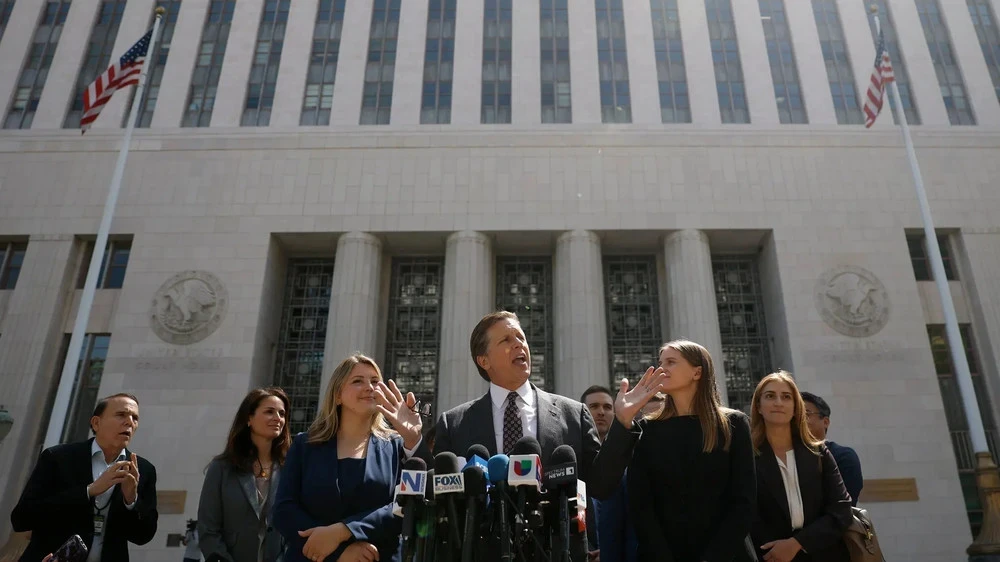
Attorney Mark Lanier, representing the plaintiff who was awarded $6 million against Meta and YouTube, spoke at the court in Los Angeles.
In the United States, two high-profile court cases have occurred in which juries found major tech companies responsible for the negative impact on underage users. This is reported in an article by The New York Times.
These rulings could represent a significant step forward in regulating social networks, considering that Congress has long struggled to develop effective measures to protect children.
Recently, a court in Los Angeles ruled in favor of a young woman who claimed that Meta and YouTube's algorithms caused her addiction and negatively affected her mental health. As a result, the jury found the company guilty and awarded her $6 million in compensation.
At the same time, in New Mexico, another court also ruled against Meta, stating that the company failed to protect underage users from potentially dangerous individuals, resulting in a fine of $375 million. These rulings reflect growing concerns about the impact of social networks on teenagers and create pressure on lawmakers.
Despite numerous hearings and proposed bills, such as the Kids Online Safety Act, no real changes in regulation have occurred yet. Lawyers emphasize that these court rulings could set precedents: social networks may now be viewed as products capable of causing harm, similar to the tobacco or pharmaceutical industries. In particular, attention is drawn to features such as infinite scrolling and autoplay videos, which contribute to user addiction.
However, companies reject all accusations: Meta stated that mental health cannot be linked to the use of one specific app, while Google representatives emphasize that YouTube is a streaming platform, not a social network. Both companies plan to appeal the rulings.
Although experts believe it is too early to discuss long-term consequences, it is already clear that tech giants are facing new legal risks. Thousands of similar lawsuits are pending, and a potential series of court cases could fundamentally change the rules of the game in this industry.
Thus, in the context of legislative stagnation, the judicial system is beginning to play an important role in attempts to limit the influence of social networks on children and teenagers.


