
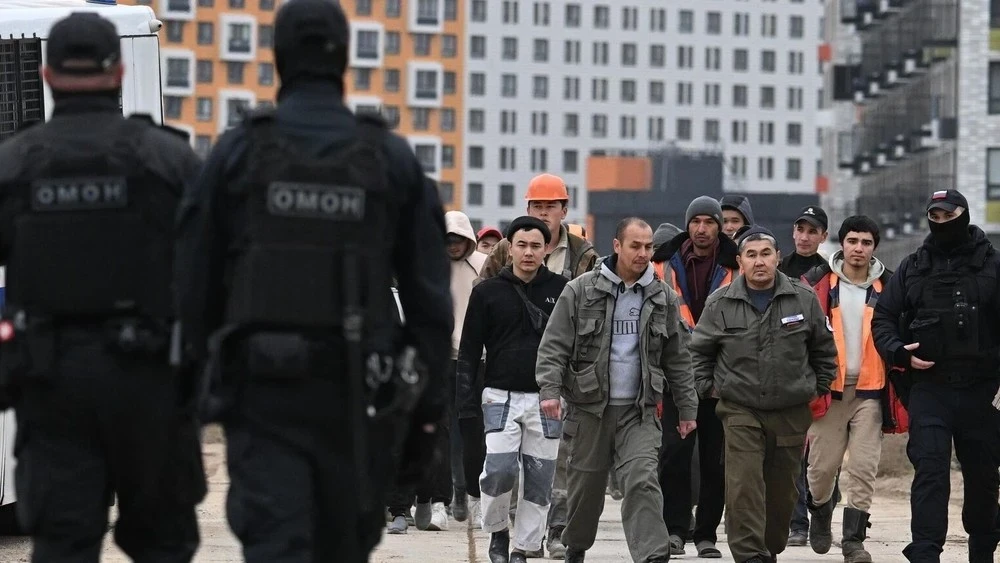
Migrants in the Russian Federation
The Ministry of Internal Affairs of Russia has developed a draft law that provides for the mandatory expulsion of foreigners from the country for 20 types of offenses.
According to "Kommersant," this draft amendment to the Administrative Offenses Code of the Russian Federation was discussed on March 16 at a meeting of the government commission on legislative activity.
According to the document, courts will be able to impose deportation as a penalty for violations of the state of emergency regime, participation in the activities of undesirable organizations, participation in unauthorized rallies, coercion to participate in or refrain from participating in strikes, as well as for petty hooliganism related to disobedience to the police.
The explanatory note emphasizes the necessity of these changes due to the "intensification of illegal activities" by foreigners. It is noted that in Russia "cases of mass brawls and riots" involving them continue to be recorded.
Vadim Kozhenov, head of the Migrant Assistance Center, noted in an interview with "Kommersant" that labor migrants are not prone to mass violations for which stricter measures are proposed, and for fights, they are already punished with expulsion for 30-40 years.
According to the FSB of Russia, in 2025, foreigners, mainly from Kazakhstan, Uzbekistan, and China, made 15.6 million trips to Russia (in 2024 — 16.7 million). According to the Ministry of Internal Affairs, as of the beginning of 2026, the number of foreign citizens in the country decreased to 5.7 million, which is 10% less compared to the previous year.
After the terrorist attack at the "Crocus City Hall" in the Moscow region in March 2024, Russian authorities began to tighten migration policy. In particular, a register of controlled individuals was created, into which one could mistakenly end up, and a mandatory Russian language test was introduced for foreigners whose children are enrolling in schools. Additionally, the conditions for obtaining a residence permit in a simplified manner for spouses of Russian citizens and children of foreigners have been further tightened if they do not have their own work permit.


