
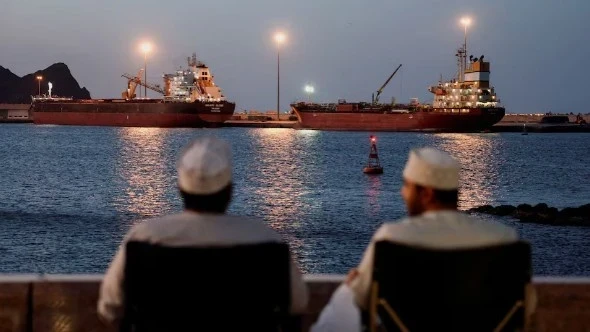
The bulk carrier Galaxy Globe and the tanker Luojiashan are anchored in Muscat (Oman) after Iran promised to close the Strait of Hormuz. Photo Reuters / Benoit Tessier.
The escalation of the conflict surrounding Iran continues: the United States and Israel are carrying out the largest airstrikes since the beginning of the war, while Tehran is launching missile and drone strikes on American facilities, threatening to block oil exports from the Persian Gulf. Despite the deteriorating situation, global financial markets remain optimistic, believing that the conflict may end soon, as reported by Reuters.
Intensive Airstrikes
Last Tuesday saw strikes that the Pentagon and local residents described as the most powerful of the entire conflict.US Secretary of Defense Pete Hegseth stated that this day marked "the day of the most massive attacks on Iran" using a greater number of fighters and bombers, as well as more precise intelligence.
Shortly after, US President Donald Trump announced on his Truth Social account the "complete destruction" of ten Iranian warships, without specifying the locations of the strikes.
Iranian Retaliation Against the US
The Islamic Revolutionary Guard Corps stated that on Tuesday evening, Iran launched missile strikes on American bases in the Middle East. The bases "Al-Udeid" in Qatar and "Al-Harir" in Iraqi Kurdistan were targeted. Later, drone attacks on US facilities were also recorded, including on the "Al-Dhafra" airbase in the UAE and the naval base "Juffair" in Bahrain.Iranian state media reported new attacks on American facilities in Bahrain.
Missile Strikes on Israel
On Wednesday night, Iran launched several missiles at central areas of Israel. Alarm signals were heard in several localities, residents sought shelter, and air defense systems intercepted the missiles. There was no immediate information about damage on the ground following the attacks.Meanwhile, Israel continued to strike Beirut, attempting to weaken the influence of the Iranian group "Hezbollah," which is conducting shelling from Lebanon.
Threat of Oil Supply Blockade
The Islamic Revolutionary Guard Corps warned that Iran could block oil exports from the Persian Gulf as long as attacks from the US and Israel continue.This refers to a possible blockade of the Strait of Hormuz, which is a key route for global oil and liquefied natural gas supplies, through which approximately 20% of the world's exports pass.
In response, the White House stated its readiness to take tough measures in case of attempts to disrupt shipping in the strait and, if necessary, to ensure the protection of tankers with naval forces.
The Situation in Tehran from the Perspective of Locals
Residents of Tehran, whom Reuters reporters spoke to, described the last night as the worst since the beginning of the conflict. "It was like hell. Bombing everywhere, throughout Tehran. Now my children are afraid to fall asleep," shared one of the locals.In the eastern part of the capital, missiles destroyed two five-story residential buildings. Rescuers continued to extract bodies from the rubble when a new explosion occurred.
Market Optimism Regarding the End of the Conflict
Despite the growing tension, financial markets are showing confidence that the conflict may end soon.The price of Brent crude oil fell below $90 again on Tuesday after a sharp spike to nearly $120 per barrel on Monday. European and Asian stock markets partially recovered after a sharp decline.
The White House also noted that oil and gas prices could quickly decrease after military operation goals are achieved.
According to sources familiar with Israel's plans, the Israeli military aims to inflict maximum damage on Iranian infrastructure before Donald Trump decides to end the military campaign.
Iran's Position in the Current Situation
High-ranking Iranian officials made stern statements on Tuesday. Parliament Speaker Mohammad Bagher Ghalibaf stated that Tehran does not intend to cease fire: "The aggressor should be met with a harsh response so that they learn their lesson."Foreign Minister Abbas Araghchi added that the resumption of negotiations with the US is unlikely.
Casualties and Destruction Due to the Conflict
According to Iranian UN envoy Amir Saeed Iravani, more than 1,300 civilians have died since the start of US and Israeli airstrikes on February 28.According to him, about 8,000 homes have been destroyed, 1,600 commercial properties have been obliterated, and dozens of medical and educational institutions have been damaged.
Additionally:
- In Israel, 12 people have died as a result of Iranian attacks;
- In Lebanon, dozens have been killed due to Israeli strikes.


